
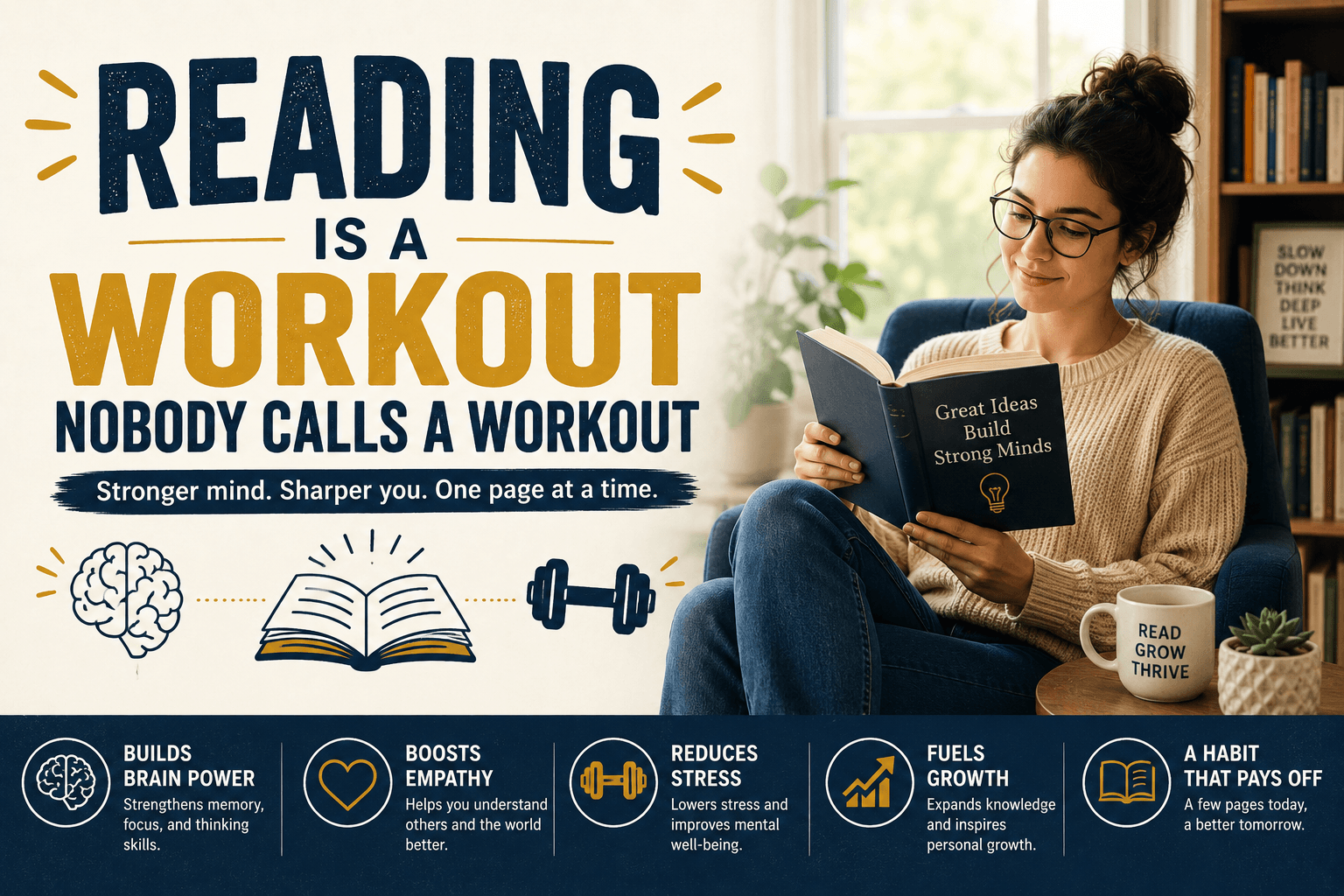
Reading Is a Workout Nobody Calls a Workout: How Reading Improves Brain Health, Memory, and Mental Wellness
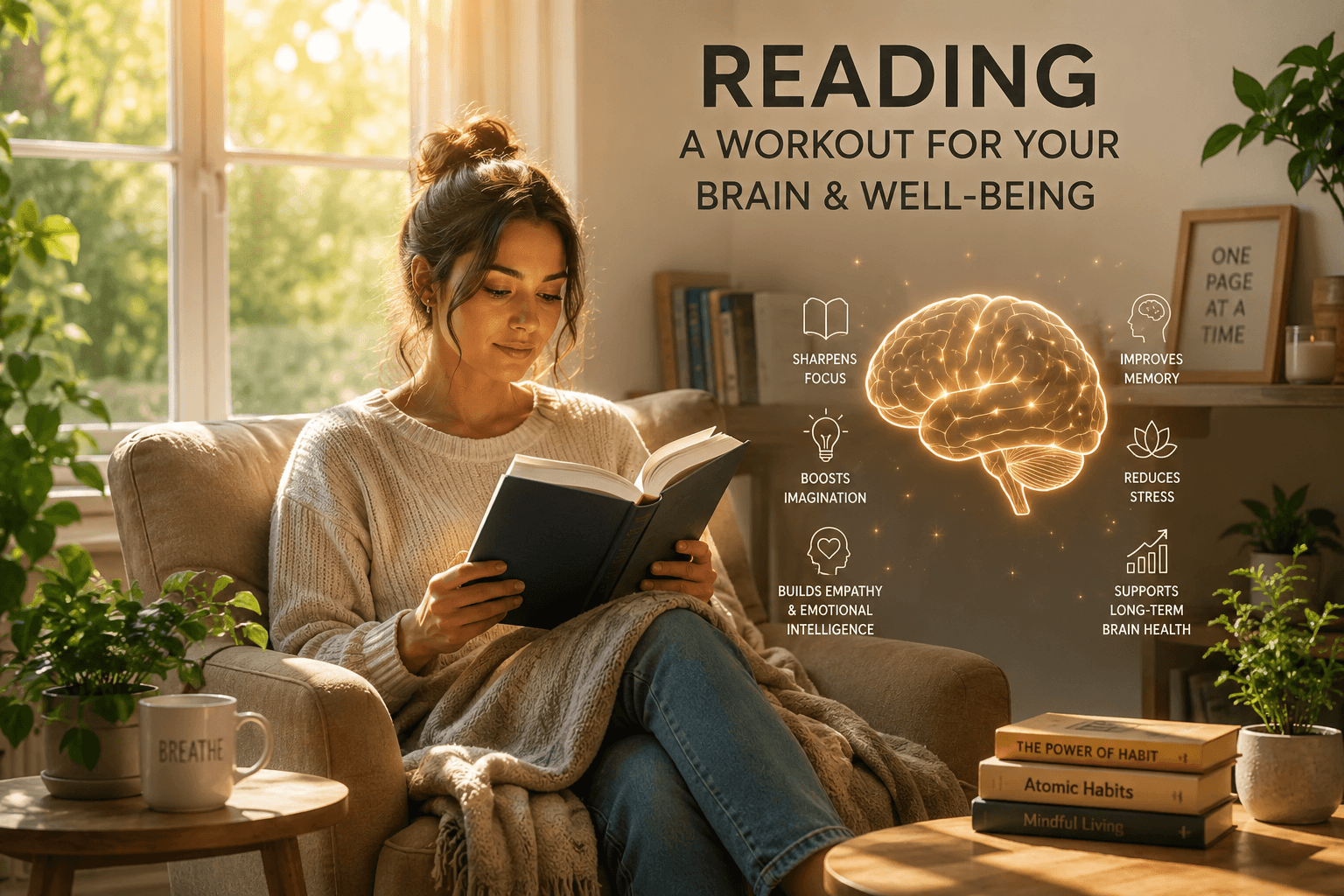
Introduction
When people think about exercise, they usually imagine lifting weights, jogging through a park, or practicing yoga. Rarely do they think about sitting comfortably with a good book. Yet science increasingly shows that reading improves brain health in much the same way physical exercise strengthens the body. Every chapter you finish challenges your memory, sharpens your attention, expands your imagination, and exercises the complex neural networks that keep your brain healthy throughout life.
Unlike watching television or scrolling through social media, reading demands active participation. A movie gives you the scenery, expressions, voices, and emotions. A book gives you words and invites your brain to construct everything else. You become the director, architect, and storyteller simultaneously. Every sentence asks your mind to create vivid landscapes, recognize emotions, predict outcomes, and connect ideas.
This is why reading deserves to be viewed not merely as entertainment or education but as one of the most effective forms of mental exercise available to anyone.
Whether you enjoy novels, biographies, self-improvement books, history, or poetry, every reading session contributes to lifelong cognitive fitness. Combined with other healthy habits like practising regular movement through transformative yoga routines or exploring natural mindfulness techniques for stress relief, reading becomes an essential pillar of a balanced and healthy lifestyle.
How Reading Acts as a “Whole-Brain” Activity
Imagine entering a modern gym. Different machines strengthen different muscles—your legs, shoulders, core, and cardiovascular system. Reading functions in much the same way, except the workout takes place inside your brain.
As you read, several regions of your brain work together at the same time:
Language centers decode words and grammar.
Memory systems connect new information with past experiences.
Visual processing areas transform text into mental images.
Emotional centres help you understand characters’ feelings.
Executive functions maintain attention and predict what comes next.
Instead of exercising a single mental skill, reading engages multiple cognitive systems simultaneously. Neuroscientists often describe this as a “whole-brain activity.” This explains why people who read regularly often demonstrate stronger concentration, a richer vocabulary, greater creativity, and better problem-solving abilities than those who rarely read.
Unlike passive entertainment, reading continuously asks your brain questions: “Who is this character?” “Why did they make that decision?” “What might happen next?” “How does this idea connect to what I already know?” Each question activates different neural pathways, strengthening connections through repeated use. Just as muscles become stronger through regular training, neural pathways become more efficient through consistent reading.
What Happens Inside Your Brain While You Read?
Reading appears effortless once you’ve learned the skill, but beneath that effortless experience lies an astonishing amount of brain activity. When your eyes move across a sentence, they are not reading one letter at a time. Instead, your brain rapidly recognizes entire patterns, predicts upcoming words, retrieves meanings from memory, and constructs a coherent picture—all within fractions of a second.
Researchers using functional magnetic resonance imaging (fMRI) have shown that reading activates much more than the brain’s language centers. When a novel describes someone climbing a mountain, parts of your motor cortex—the region associated with movement—become active. When a character tastes fresh bread, sensory regions linked to taste and smell may also respond. Your brain partially simulates the experience as though you were living it yourself. This remarkable phenomenon helps explain why books can transport readers into entirely different worlds.
Researchers at Emory University found that brain changes from reading a gripping novel can last for days. Their findings suggest immersive reading leaves a temporary “shadow activity” in the brain. This may strengthen neural connections even after the reading session ends. For readers, this means that the benefits of reading extend beyond the moments spent holding a book.
The Neuroscience Behind Reading and Brain Health
Modern neuroscience paints a fascinating picture of what happens when we read. Unlike many everyday activities, reading recruits several major brain networks simultaneously:
1. The Language Network
Located primarily in the left hemisphere, this network processes vocabulary, grammar, sentence structure, and meaning. Every unfamiliar word slightly expands your linguistic abilities. Over months and years, this accumulated vocabulary improves communication, learning, and critical thinking.
2. The Memory Network
Reading constantly requires the hippocampus—your brain’s memory center—to work. You must remember previous chapters, character relationships, plot developments, and facts you’ve already learned. This continual retrieval strengthens memory formation and recall. People who read consistently often find it easier to absorb new knowledge in other areas of life because they regularly practice these memory processes.
3. The Attention Network
In today’s world, attention has become one of our most valuable cognitive resources. Notifications, endless scrolling, and short-form videos train the brain to expect constant novelty. Books demand the opposite; they reward sustained attention. Even reading for just twenty minutes without interruption helps retrain your brain to maintain focus over longer periods. This makes reading an excellent complement to daily mindfulness exercises where sustained awareness is equally important.
4. The Imagination Network
One of reading’s greatest strengths is that it asks your brain to create rather than consume. A film shows you every detail, whereas a novel invites you to invent those details yourself—landscapes, voices, facial expressions, and architectural elements. Every reader creates a slightly different version of the same story. That creative construction strengthens imagination, visualization, and abstract thinking.
Reading Is Active, Not Passive
One reason reading improves brain health so effectively is that it demands active participation. Watching a documentary may teach you information, but reading requires you to slow down, interpret ideas, question assumptions, and imagine possibilities. This active engagement stimulates neuroplasticity—the brain’s remarkable ability to form new neural connections throughout life.
According to the Harvard Medical School, mentally stimulating activities such as reading, lifelong learning, and solving challenging problems may help build cognitive reserve, making the brain more resilient as people age. For those interested in creating a complete wellness routine, reading pairs naturally with foundational habits like staying properly hydrated because hydration, regular movement, mindfulness, and intellectual stimulation all contribute to long-term brain health.
Reading and Whole-Person Wellness
Brain health does not exist in isolation. Your cognitive performance is influenced by sleep, nutrition, physical activity, emotional well-being, and lifelong learning. Reading complements these habits by offering something increasingly rare in modern life: uninterrupted attention.
Spending even 20 minutes each day immersed in a meaningful book provides a mental reset from digital distractions while nurturing curiosity and personal growth. Over time, this simple habit can enhance not only your intellectual abilities but also your emotional resilience and overall sense of well-being.
4 Ways Reading Strengthens Empathy and Mental Wellness
While memory, attention, and imagination are important cognitive skills, empathy is what allows us to connect with others in meaningful ways.
Every time you read a novel, biography, or memoir, you are invited to step into someone else’s world. You experience life through their eyes, understand their motivations, and witness their struggles and triumphs. Unlike movies, which often present emotions through visual cues, books require you to imagine those emotions yourself. This active participation makes reading a powerful exercise in emotional understanding.
Psychologists call this ability “theory of mind”—the capacity to recognize that other people have different beliefs, emotions, intentions, and perspectives. Developing this skill improves communication, strengthens relationships, and helps us respond to others with greater compassion.
A landmark study published in the journal Science found that participants who read literary fiction performed better on tests measuring empathy and social perception than those who read nonfiction, popular fiction, or no reading material at all. Literary fiction often presents complex characters with nuanced emotions, encouraging readers to interpret subtle feelings and motivations.
In today’s increasingly connected yet often divided world, empathy is one of the most valuable life skills we can develop. Reading provides a safe space to experience lives vastly different from our own, broadening our understanding of cultures, beliefs, and experiences.
Reading Improves Memory and Cognitive Function
Have you ever noticed how a good novel asks you to remember dozens of characters, locations, relationships, and events over hundreds of pages? That mental effort is a highly effective workout for your memory.
Every chapter requires your brain to retrieve previously stored information and integrate it with new details. This constant retrieval strengthens neural pathways associated with learning and long-term memory. Scientists refer to this process as active recall, one of the most effective methods for strengthening memory.
Over months and years, this repeated practice may contribute to:
Better short-term memory
Improved long-term information retention
Faster learning
Enhanced critical thinking
Better problem-solving skills
Reading nonfiction offers additional cognitive benefits by exposing readers to new ideas, historical events, scientific discoveries, and practical knowledge that can be applied in everyday life. Whether you’re reading about nutrition, psychology, business, or personal development, your brain is constantly building new connections between ideas.
For example, reading wellness books alongside articles highlighting the massive [health benefits of regular walking] allows readers to reinforce healthy habits through both intellectual understanding and practical action.
Reading and Stress Reduction: A Natural Way to Calm the Mind
Modern life often feels overwhelming. Emails, social media notifications, breaking news, and endless digital distractions keep our minds in a constant state of alertness. Over time, this mental overload contributes to stress, anxiety, and difficulty concentrating. Reading offers a simple yet powerful antidote.
Immersing yourself in a good book creates a temporary escape from daily pressures. As your attention shifts toward the story, your heart rate slows, muscle tension decreases, and anxious thoughts begin to fade.
Does reading reduce stress?
According to a frequently cited study conducted at the University of Sussex, reading for as little as six minutes can significantly reduce stress levels—outperforming activities such as listening to music or drinking tea. Immersing your mind in a narrative shifts your attention away from daily stressors, allowing your nervous system to physically relax.
Unlike scrolling through social media—which often increases information overload—reading encourages deep focus and sustained attention. This shift helps quiet the constant mental chatter that contributes to chronic stress.
Why Deep Reading Is Becoming More Difficult
If you’ve ever picked up a book only to realize you’ve reread the same paragraph three times, you’re not alone. Many people find it increasingly difficult to concentrate for extended periods, even on books they genuinely want to read. The reason is not a lack of intelligence or motivation; it is largely a consequence of how modern technology shapes our attention.
Our brains are constantly adapting to the environments we create. Short videos, rapid notifications, and endless scrolling train us to expect continuous novelty. Each interruption encourages the brain to switch tasks quickly rather than remain focused on one activity.
Cognitive neuroscientist Maryanne Wolf has spent decades studying how reading shapes the brain. She warns that heavy exposure to fragmented digital content may weaken our ability to engage in “deep reading”—the slow, reflective process that supports critical thinking, empathy, and deep comprehension.
Deep reading involves:
Reflecting on ideas
Making connections between concepts
Asking questions and evaluating arguments
Imagining possibilities
Building lasting understanding
These higher-order thinking skills require uninterrupted attention—something increasingly rare in our always-connected world. The encouraging news is that attention is highly trainable. Just as physical fitness improves through consistent exercise, concentration strengthens through regular reading practice.
Even setting aside 15 to 20 minutes each day for uninterrupted reading can gradually rebuild your ability to focus deeply, making books feel enjoyable again rather than mentally exhausting.
How to Build a Daily Reading Habit (Step-by-Step)
Building a reading habit doesn’t require finishing a book every week or setting unrealistic goals. Like physical fitness, the benefits come from showing up regularly, even in small amounts. If you’ve struggled to maintain a reading routine, these science-backed strategies can help you rediscover the joy of books.
1. Start with Books You Genuinely Enjoy
One of the biggest mistakes people make is choosing books they think they should read instead of books they actually want to read. A gripping mystery novel, an inspiring biography, or a practical wellness guide is far more likely to keep you turning pages than a dense classic you’re forcing yourself through. Reading should feel rewarding, not like homework.
2. Begin with Just 10–20 Minutes Each Day
Consistency matters far more than duration. Reading for 15 minutes every day is generally more beneficial than reading for two hours once a month. Link your reading time to an existing daily routine—like your morning coffee or right before bed—to make it an automatic habit. This approach mirrors effective stress management habits, where small, daily practices produce meaningful long-term benefits.
3. Create a Comfortable Reading Environment
Your surroundings influence your ability to concentrate. Consider creating a simple reading corner that includes a supportive chair, warm lighting, and a small table for tea or water. Crucially, remove digital distractions: silence notifications and keep your phone in another room to help your brain transition into focused reading mode.
4. Carry a Book Wherever You Go
Unexpected waiting time appears throughout the day. Instead of automatically reaching for social media, use those spare moments to read a few pages. Whether you prefer printed books or an e-reader, keeping reading material within easy reach makes it easier to build consistency.
5. Give Yourself Permission to Stop Reading a Book
Many people abandon reading altogether because they feel guilty about not finishing a book they dislike. Life is too short to force yourself through books that fail to hold your interest. Choosing another book isn’t failure—it’s protecting your motivation.
6. Keep a Reading Journal
Writing a few sentences after each reading session reinforces learning and improves long-term memory. You might simply record a favourite quote, a new idea you learned, or a personal reflection. Journaling also strengthens self-awareness and beautifully complements the mental health benefits of expressive writing, creating another powerful loop for personal growth.
Which Types of Books Are Best for Mental Wellness?
Rather than asking which type of book is “best,” consider what you hope to gain from your reading:
Literary Fiction: Encourages empathy, emotional intelligence, and deeper reflection by challenging readers to understand complex, nuanced characters.
Nonfiction: Books about psychology, history, science, and philosophy expand your knowledge baseline while stimulating analytical, critical thinking.
Biographies and Memoirs: Learning about real people’s successes, failures, and resilience provides practical wisdom while inspiring personal perseverance.
Poetry: Encourages slow reading, careful observation, and appreciation of language, which naturally supports mindfulness.
Health and Wellness Books: Reading evidence-based wellness information empowers readers to make informed lifestyle choices, reinforcing routines like optimal daily water intake and active living.
Reading Throughout Life: Benefits at Every Age
Unlike many activities, reading naturally adapts to our changing developmental needs across our lifespan:
Children: Helps develop foundational vocabulary, language skills, creativity, and early emotional intelligence.
Teenagers: Supports critical thinking, academic success, and identity formation while providing a healthy escape during emotionally challenging years.
Adults: Offers a direct line to stress reduction, improved workplace decision-making, and expanded professional knowledge.
Older Adults: Research suggests that lifelong engagement in mentally stimulating activities—including reading—helps maintain cognitive function as people age. Intellectually engaging activities contribute to healthy brain aging when combined with regular physical activity, balanced nutrition, and quality sleep.
Digital Screen Time vs. Reading Books: Which Supports Brain Health?
Both books and digital devices deliver information, but the way our brains interact with them is vastly different. Scrolling through social media often encourages rapid attention shifts, short bursts of information, and constant novelty. This can leave us feeling mentally fatigued without providing lasting understanding.
Reading a book, by contrast, promotes sustained concentration, deeper comprehension, and thoughtful reflection. It invites us to slow down, connect ideas, and immerse ourselves in a single narrative or topic.
This doesn’t mean technology is harmful or that digital reading has no value. E-books, online articles, and educational resources can all support learning. The key is to balance fast-paced digital consumption with periods of uninterrupted, reflective reading to give our brains the opportunity to recover from information overload.
Frequently Asked Questions About Reading & Cognition
Does reading really improve brain health?
Yes. Research suggests that reading improves brain health by engaging multiple brain regions responsible for language, memory, attention, imagination, and emotional understanding. Regular reading strengthens neural connections, supports cognitive function, and contributes to lifelong mental fitness. While reading is not a guarantee against age-related cognitive decline, it is considered an important part of a brain-healthy lifestyle alongside regular exercise, nutritious eating, quality sleep, and social engagement.
How many minutes should I read each day?
There is no single “perfect” amount of time. However, many experts recommend reading for 20–30 minutes a day. Even 10–15 minutes of focused reading can provide meaningful benefits when practiced consistently. The key is consistency rather than duration.
Is reading better than watching television?
Both activities have their place, but reading generally requires more active mental engagement. When you read, your brain must interpret language, create mental images, remember details, and connect ideas. Television provides much of this information visually, requiring less imaginative and cognitive effort.
Can reading reduce stress?
Yes. Reading can be an effective way to unwind after a busy day. Becoming absorbed in a good book shifts your attention away from daily worries, helping your body and mind relax. Combining reading with other wellness practices such as [mindfulness techniques], gentle yoga, and deep breathing can create a comprehensive routine for managing stress naturally.
What types of books are best for brain health?
The best book is the one you’ll actually finish. A varied reading diet—balancing fiction for empathy, nonfiction for knowledge, and poetry for reflection—keeps the brain challenged while maintaining personal enjoyment.
Key Takeaways
Reading activates multiple brain regions simultaneously, strengthening language, memory, imagination, and attention networks.
Regular reading improves emotional intelligence and empathy by training us to understand different perspectives.
Deep reading encourages sustained concentration, helping retrain attention spans damaged by digital distractions.
Reading for as little as six minutes can significantly reduce physical muscle tension and lower heart rates caused by stress.
Lifelong reading contributes to cognitive reserve, supporting healthy brain aging.
Small, daily 15-minute sessions are far more effective for building neuroplasticity than rare, hours-long marathon sessions.
Final Thoughts: Invest in Your Brain One Page at a Time
Every day, we make choices about how we spend our time. Some activities entertain us for a few moments, while others leave a lasting impression. Reading belongs firmly in the second category. Every page you read strengthens your ability to think, imagine, remember, and empathize. Unlike many forms of entertainment, reading actively engages your mind, making it one of the simplest yet most powerful investments in your long-term well-being.
In today’s fast-paced digital world, choosing to read—even for just a few minutes each day—is an act of self-care. It is a quiet commitment to lifelong learning, emotional resilience, and intellectual growth.
At BenVitalFive, we believe that true wellness is built through balanced daily habits. Reading stands alongside movement, mindfulness, nourishing food, and meaningful relationships as one of the pillars of a healthy and fulfilling life.
If you’re looking to create a complete wellness routine, explore our related guides to build a healthier body, a calmer mind, and a sharper brain—one small step, and one page, at a time:
The Transformative Power of Yoga for Physical and Mental Wellness
How Much Water Should You Drink Daily?
Walking Is the Most Underrated Exercise for Long-Term Health
The Benefits of Journaling for Mental Health

