
Table of Contents
ToggleHow to Start Journaling When You Have Nothing to Say
Have you ever opened a new notebook, picked up your favorite pen, and stared at the blank page? If so, you’re far from alone.
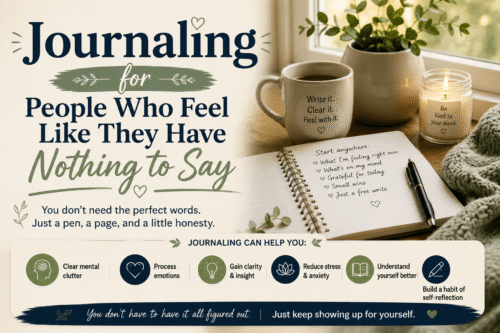
Journaling for people who feel like they have nothing to say is one of the most common yet least discussed challenges in personal growth and mental wellness. Many traditional guides assume that you already know what you’re feeling. They encourage you to “write whatever comes to mind” or “pour your heart onto the page.” While this advice works for some, it can leave beginners feeling frustrated. What if nothing comes to mind? What if your thoughts feel ordinary, scattered, or simply empty?
The truth is that there is nothing wrong with you. A blank page is intimidating because it asks your brain to do several demanding tasks at once: choose a topic, organize your thoughts, find the right words, and decide where to begin—all without any guidance. After a busy day filled with work, family responsibilities, or constant digital distractions, that mental effort can feel overwhelming.
Instead of seeing silence as a failure, think of it as the starting point of self-discovery. Journaling is not about producing beautiful writing; it is simply a conversation with yourself.
Quick Summary: Why is Journaling So Hard?
Journaling often feels difficult because of choice overload (too many blank pages with no structure) and mental fatigue (decision fatigue from a long day). To make journaling easy, transition from open-ended writing to structured prompts and combine the practice with mindful habits like deep breathing.
Why a Blank Page Feels Harder Than It Looks
From a psychological perspective, an empty page offers unlimited possibilities. While freedom sounds appealing, too many choices can actually make decision-making more difficult. Researchers call this choice overload, where having countless options makes it harder to take the first step.
Our brains naturally prefer structure. We solve problems more easily when we receive a clear, directed question rather than an open-ended request. That is why many people can answer a question like, “What made you smile today?” much more easily than “Write about your life.”
Mental fatigue also plays an important role. Throughout the day, your brain makes hundreds of decisions. By evening, your ability to generate new ideas is significantly reduced. In that state, an empty journal can feel less like an opportunity and more like another demanding task. Fortunately, the solution isn’t to force inspiration—it’s to reduce the pressure by making the first step incredibly small.
What Clinical Research Says About Expressive Writing
Scientific research has consistently shown that expressive writing can support emotional well-being. Pioneered by social psychologist James Pennebaker in 1986, expressive writing is a proven therapeutic technique where individuals write continuously about deep experiences for 15–20 minutes over consecutive days, completely ignoring grammar and spelling.
Importantly, participants in these studies were not simply handed a blank notebook—they were given clear, structured instructions about what to write.
According to the American Psychological Association (APA), expressive writing helps process emotions and improve self-awareness when practiced thoughtfully. Similarly, organizations like the World Health Organization (WHO) continue to emphasize the importance of promoting mental well-being through daily self-care practices.
Journaling Is a Skill, Not a Talent
One of the biggest myths about journaling is that you have to be a “good writer” to keep a journal. In reality, journaling is not a literary exercise. Your journal is not being graded, published, or judged.
Think of journaling the same way you think about yoga or meditation. You don’t expect to master a new yoga pose on your first day, and you don’t expect your mind to become perfectly calm during your first meditation session. In the same way, journaling becomes easier through regular, low-pressure practice.
You Don’t Need a Crisis to Start Journaling
Many people believe journaling is only useful during stressful times. While writing can certainly help you process difficult emotions, it is equally valuable when life feels calm or routine.
Think of your journal as a mirror rather than an emergency exit. A mirror doesn’t change who you are—it simply helps you see yourself more clearly. In the same way, journaling helps you notice your thoughts, habits, and emotions before they become overwhelming.
Over time, your journal becomes a personal record of growth. Looking back through old entries often reveals positive changes that are easy to overlook in daily life. You may notice that situations that once caused stress now feel manageable or that small habits—such as taking a daily walk or practicing mindful breathing—have had a lasting, positive impact on your energy.
10 Simple Journaling Prompts When You Don’t Know What to Write
Instead of asking yourself, “What should I write today?” try answering just one of these small questions to instantly beat blank-page anxiety:
What took most of my energy today? (Not necessarily the biggest event—just the one that stayed with you the longest).
What made me smile today? (Even a brief moment of kindness or beauty is worth noticing).
What am I grateful for right now? (Describe one specific, meaningful experience in detail rather than listing several generic things).
What didn’t I say out loud today? (Give your unspoken thoughts a safe place on paper).
What surprised me today? (Unexpected moments often reveal what captures our attention and why).
If today had a weather forecast, what would it be? (Sunny, cloudy, windy? Metaphors can unlock complex emotions.
What challenged me today? (Reflect on how you responded rather than whether you succeeded).
What am I looking forward to? Anticipating positive experiences builds hope and motivation.
What lesson did today teach me? (Every day offers opportunities to learn, even from ordinary events).
What do I need more of tomorrow? (This simple question transforms reflection into meaningful action).
5 Different Types of Journaling Styles to Try
If traditional diary-writing feels unnatural, experiment with these five distinct styles to find what fits your personality:
1. Free Writing (Stream of Consciousness)
Set a timer for five or ten minutes and write continuously without stopping, editing, or worrying about grammar. This style works exceptionally well when your thoughts feel cluttered or you can’t identify exactly what is bothering you.
2. Specific Gratitude Journaling
Instead of writing, “I’m grateful for my family,” try describing one precise moment. For example: “This morning my daughter smiled while we shared breakfast. For a few quiet minutes, nobody looked at a phone.” Specific memories create stronger emotional connections.
3. Reflection Journaling
Focus your writing on self-evaluation by asking simple, daily tracking questions:
What went well today?
What challenged me?
What would I do differently next time?
4. Goal-Oriented Journaling
Use your journal as a tangible roadmap. Record your weekly wellness goals, reading milestones, yoga practice achievements, or walking habit targets. Writing down goals increases commitment by transforming vague intentions into visible plans.
5. Mindfulness Journaling
Focus entirely on sensory awareness in the present moment:
What physical sensations do I notice in my body?
What sounds or smells are around me?
What emotions are passing through me right now?
How to Combine Journaling with Other Healthy Habits
Journaling becomes far more effortless when it is integrated into a broader mindfulness routine.
Begin with Gentle Yoga: Spending 10 to 15 minutes practicing gentle stretches releases physical tension and quietens the mind, making it easier to express thoughts on paper. If you’re ready to combine these practices, explore our guide on The Transformative Power of Yoga for Physical and Mental Wellness.
Practice Mindful Breathing: Taking five slow, deep breaths before picking up your pen settles the nervous system and improves concentration. Learn simple, everyday techniques in our guide to Pranayama for Anxiety Relief: 6 Powerful Breathing Techniques
Read for Inspiration: Sometimes, the hardest part of journaling is finding a spark. Reading a few pages of a thoughtful book can raise meaningful questions worth exploring in your notebook. Discover the cognitive benefits of this habit in Book Reading for Intellectual Growth and Mental Wellness.
Build a Holistic Daily Routine: To see how reflective writing fits into a broader, balanced lifestyle, check out our guide on Healthy Daily Habits for a Balanced Life.
The Ultimate Beginner’s Journaling Kit
Having the right tools won’t write the words for you, but they can make the ritual something you actively look forward to each day. Here are a few thoughtfully curated essentials to elevate your practice:
Guided Gratitude Journals: Excellent for beginners who struggle with empty pages. Daily prompts provide a comforting structure.
Premium Hardcover Notebooks: Choose journals with thick, archival-quality paper (120+ GSM) to prevent ink ghosting or bleeding.
Fine-Tip Gel & Fountain Pens: A smooth-writing pen reduces hand fatigue and makes the physical act of writing deeply satisfying.
Dimmable Desk Lamps or Book Lights: Warm, adjustable lighting is perfect for setting a calming atmosphere during early morning or late-evening sessions.
Meditation Cushions: Creating a dedicated, physically comfortable space encourages longer periods of quiet reflection.
Frequently Asked Questions
Is it normal to have absolutely nothing to write about?
Yes, completely normal. Clarity usually emerges during the process of writing, not before. Writing about even the most mundane detail of your morning can open the door to deeper self-reflection.
How long should I journal each day?
There is no perfect length. For most beginners, writing for five to fifteen minutes is the sweet spot. Consistency is far more valuable than writing pages of text once a month.
Should I write by hand or use a digital app?
Both have merits. Writing by hand slows down your thinking and removes digital screen distractions. However, digital apps offer convenience, searchability, and password security. Choose the method you enjoy enough to return to daily.
What if I am worried about someone reading my journal?
Privacy is essential for honest reflection. If you share a living space, consider using a notebook with a physical lock, a password-protected digital journaling app, or storing your physical notebook in a highly secure personal spot.
When Journaling Isn’t Enough
While writing is a powerful tool for emotional regulation and stress management, it is not a substitute for professional mental health care.
If you are experiencing persistent sadness, overwhelming anxiety, severe burnout, or traumatic memories, reaching out to a qualified professional is a courageous and necessary step. A journal works best as a companion to therapy, not a replacement for it.
For evidence-based, professional guidance on mental health and stress management, you can explore resources from:
Harvard Health Publishing’s guides on evidence-based stress management techniques.
The American Psychological Association (APA) mental health educational resources.
The National Institute of Mental Health (NIMH) emotional health guidance.

