
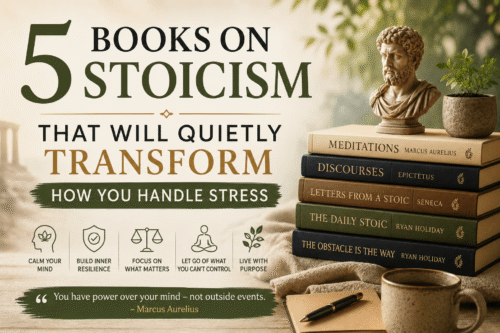
5 Best Books on Stoicism for Stress, Resilience, and a Calmer Mind
Ancient Wisdom for Handling Modern Challenges
The best Stoic books are not quick motivational reads. They work slowly — like a conversation you return to throughout different seasons of life.
Philosophy doesn’t remove every difficulty from life. It changes the way we stand in front of them.
Stress, uncertainty, criticism, failure, and unexpected change are not new human experiences.
Long before smartphones, notifications, and modern stress, ancient philosophers faced similar life questions. They also searched for ways to stay calm, make better choices, and handle challenges wisely.
How do I stay calm when life feels uncertain?
How do I respond wisely instead of reacting emotionally?
How do I find peace when circumstances are outside my control?
This is where Stoicism continues to remain relevant.
In recent years, Stoicism has become popular again. You may have seen simple phrases online, such as:
“Control what you can control.”
While this captures part of Stoic thinking, real Stoicism goes much deeper.
It is not about suppressing emotions, ignoring problems, or pretending difficulties do not exist.
It is about developing:
- clearer thinking
- emotional awareness
- patience
- resilience
- better responses to challenges
A passage that seems ordinary today may feel deeply meaningful months later when you are facing a new challenge.
What Is Stoicism?
Stoicism is an ancient philosophy that began in Greece around the 3rd century BCE. Later developed in Rome through thinkers such as Marcus Aurelius, Seneca, and Epictetus.
At its heart, Stoicism teaches a simple but powerful idea:
Some things are within our control, and many things are not.
We cannot always control the following:
- other people’s opinions
- unexpected events
- the past
- external circumstances
But we can work on:
- our choices
- our actions
- our values
- our responses
Stoicism encourages us to pause between what happens and how we react.
This makes it closely connected with modern ideas such as mindfulness, self-reflection, and emotional regulation.
A calm mind grows with daily practice. Explore mindfulness meditation practices that help improve attention, awareness, and inner balance naturally.
Can Stoicism Help With Stress?
Stoicism should not be viewed as a replacement for professional mental health support when needed.
However, many Stoic ideas share similarities with modern psychological approaches, especially the practice of noticing how thoughts influence emotions.
For example:
Two people can experience the same situation but respond differently based on how they interpret it.
Stoicism teaches us to examine the following:
- Is this situation truly within my control?
- Am I reacting to reality or my thoughts about reality?
- What action can I take right now?
Over time, this type of reflection may help many people build a healthier relationship with everyday challenges.
The best Stoicism books guide toward patience, wisdom, and inner strength.
1. Meditations — Marcus Aurelius
Best for: Self-reflection and daily wisdom
The most remarkable thing about Meditations is that it was never written for an audience.
Marcus Aurelius was a Roman emperor. He is one of the most powerful people of his time—yet his private writings reveal a person constantly working on himself.
He wrote about:
- frustration with people
- responsibility
- tiredness
- discipline
- controlling his reactions
That honesty is what makes the book timeless.
It does not feel like a lecture from history.
It feels like reading the journal of someone trying every day to become calmer, wiser, and more patient.
Key Stoic Lesson:
You may not control everything that happens around you, but you can choose the character you bring into each moment.
Who Should Read It?
This book is helpful if you:
- overthink situations
- enjoy journaling
- want morning reflection habits
- are interested in personal growth
How to read it:
Keep it near your bed. Read one short passage in the morning—not just for inspiration, but as a daily mental reset.
2. Letters from a Stoic — Seneca
Best for: Anxiety, uncertainty, and life perspective
Seneca was one of Stoicism’s most fascinating figures.
He wrote about simplicity and self-control while living a complicated life filled with politics, influence, and wealth.
Rather than weakening his message, these contradictions make his writing feel human.
Letters from a Stoic is a collection of writings addressed to his friend Lucilius.
Seneca explores:
- fear
- friendship
- time
- happiness
- handling uncertainty
One of his strongest ideas is that humans often suffer twice:
First in imagination.
Then, in reality.
We worry about events that may never happen.
Key Stoic Lesson:
Do not spend today’s peace on tomorrow’s imagined problems.
Who Should Read It?
Choose this book if:
- You worry about the future
- You feel overwhelmed by uncertainty
- You enjoy thoughtful essays
3. A Guide to the Good Life — William B. Irvine
Best for: Complete beginners
If ancient Stoic writings feel difficult, this is one of the easiest places to begin.
William Irvine explains Stoicism using modern examples.
The book explores practices such as the following:
- negative visualization
- appreciating ordinary moments
- handling criticism
- reducing unnecessary desires
A common misunderstanding is that Stoicism means becoming emotionless.
Irvine explains that the purpose is not to remove emotions—it is to create a wiser relationship with them.
Key Stoic Lesson:
Peace often comes not from having more, but from appreciating what is already present.
Who Should Read It?
Ideal for:
- beginners
- younger readers
- Anyone wanting practical exercises
4. The Obstacle Is the Way — Ryan Holiday
Best for: Turning challenges into growth
This modern Stoic book introduced millions of readers to ancient wisdom.
The central message comes from Marcus Aurelius:
Challenges themselves can become opportunities to practice strength and creativity.
Ryan Holiday uses stories from the following:
- leaders
- athletes
- entrepreneurs
- historical figures
to show how people transform difficulty into progress.
This book is less about philosophical theory and more about practical application.
Key Stoic Lesson:
Obstacles are not only things blocking your path. Sometimes they become the path that develops you.
Who Should Read It?
Recommended if:
- You face career challenges
- You struggle with setbacks
- You need motivation during difficult periods
5. Enchiridion — Epictetus
Best for: Pure Stoic philosophy
Epictetus had a completely different life from Marcus Aurelius.
Marcus was an emperor.
Epictetus was born into slavery.
Yet both arrived at similar wisdom:
Your circumstances do not completely define your inner life.
The Enchiridion, meaning “handbook,” is short enough to read quickly but powerful enough to study for years.
Its main message:
Separate what belongs to you from what does not.
Your actions belong to you.
Other people’s judgments do not.
Key Stoic Lesson:
Freedom begins by understanding where your true control exists.
Who Should Read It?
Best for readers who want:
- direct wisdom
- short passages
- deeper philosophical study
Best Order to Read Stoicism Books for Beginners
If you are new to Stoicism, try this order:
1. A Guide to the Good Life
Easy modern introduction.
2. Meditations
Daily reflections from Marcus Aurelius.
3. Letters from a Stoic
Deeper exploration of life and emotions.
4. The Obstacle Is the Way
Practical application during challenges.
5. Enchiridion
The core philosophy in its simplest form.
How to Practice Stoicism Daily
Reading Stoic books is only the beginning.
Stoicism becomes useful when practiced.
Try:
Morning Reflection
Ask:
“What kind of person do I want to be today?”
Evening Journaling
Reflect:
“What did I handle well?”
“What can I improve?”
Mindful Pausing
Before reacting, create a small space.
A pause often creates better choices.
You can combine this habit with simple evening relaxation routines that support better sleep quality and mental calm.
Recommended Stoicism Books and Reading Tools
If you want to build a Stoic reading habit, consider:
Best Beginner Book
A Guide to the Good Life — William Irvine
Great first step into Stoicism.
Best Daily Reflection Book
Ideal for morning reading.
Best Deep Wisdom Book
Perfect for slow reading and journaling.
Helpful accessories:
- reading journal
- notebook for reflections
- comfortable reading light
- bookmarks
- audiobook versions
A small daily reading habit can become a lifelong practice.
Frequently Asked Questions About Stoicism Books
1. What is the best Stoicism book for beginners?
A Guide to the Good Life is the easiest starting point. Because it explains Stoic principles using modern examples.
Many readers then move to Meditations by Marcus Aurelius.
2. Can Stoicism help reduce stress?
Stoicism may help people handle everyday stress. It encourages reflection and acceptance. It teaches us to focus on actions we can control.
It is not about avoiding emotions but learning to respond thoughtfully.
3. Is Stoicism similar to mindfulness?
They are different traditions, but both encourage awareness, observation, and creating space before reacting automatically.
4. Should I read Marcus Aurelius or Seneca first?
Marcus Aurelius is better for short daily reflections.
Seneca is better if you enjoy longer discussions about human behavior and life.
5. Does Stoicism mean having no emotions?
No.
Stoicism does not teach people to eliminate feelings.
It teaches understanding emotions and responding with wisdom rather than impulse.
Final Thoughts: Ancient Books for Modern Minds
The best Stoicism books do not promise a perfect life.
They offer something quieter:
A different way to meet life.
Marcus Aurelius, Seneca, and Epictetus shared one important lesson. Events alone do not shape our lives. Our thoughts, judgments, and the meanings we give to those events also influence how we experience them.
Practiced consistently, Stoicism can encourage patience, gratitude, perspective, and inner strength.
Not suddenly.
Not dramatically.
But slowly—one thought, one choice, and one day at a time.

