
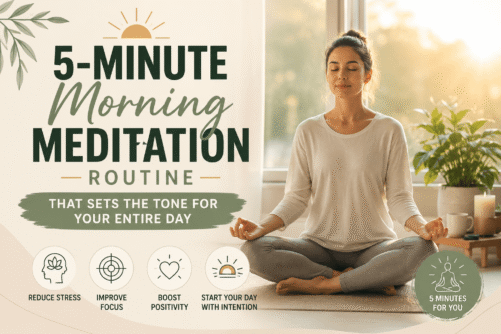
Before the World Gets Loud: A 5-Minute Morning Meditation Routine for a Calmer Day
Five minutes before the messages arrive.
Five minutes before decisions, responsibilities, and expectations start asking for your attention.
That small window before the world gets loud might be one of the most overlooked parts of your entire day.
Many people picture morning meditation as complex. They imagine sitting still on a cushion for 30 minutes. They try to clear their mind completely while life waits.
Then reality happens.
The alarm goes off. There are things to do. Someone needs something. Your thoughts are already moving before your feet touch the floor.
But meditation does not have to begin with thirty perfect minutes.
It can begin with five.
Not because five minutes is better than thirty — it isn’t. Five minutes of practice every morning is more powerful than a longer session. You only do it occasionally when motivation appears.
This simple 5-minute morning meditation routine is not about escaping your day. It is about entering it differently.
Here is why those first quiet moments matter — and exactly how to use them.
Why the First Few Minutes of Your Morning Matter
The way you start your morning often influences the way you carry yourself through the rest of the day.
Think about the difference between these two beginnings.
One morning starts with reaching for your phone immediately—messages, notifications, news, unfinished tasks, and other people’s priorities.
Another morning starts with a few moments of stillness, breathing, and choosing how you want to approach the hours ahead.
The circumstances of your day may not change.
But the state you bring into those circumstances can.
In the minutes after waking, your mind and body are still transitioning from sleep into full alertness. This period is sometimes connected with the hypnopompic state—the natural transition between sleep and wakefulness.
Many people find this window useful because their attention has not yet been fully pulled into outside demands.
A short mindfulness practice now can help you start calmer. It trains attention, builds awareness, and reduces the habit of reacting right away.
The research examines how morning meditation and daily micro-breaks affect healthcare workers’ vitality and mental health. The study highlights that sleep quality influences. how morning meditation affects positive feelings at work, which in turn predicts better health by the end of the day. Data collected from 44 employees over five days indicates that morning meditation enhances positive affect and overall health. The findings emphasize the importance of sleep quality as a boundary for maximizing the benefits of meditation.
A single morning meditation will not magically remove stress. But small moments repeated daily can gradually change your relationship with stress.
If you are new to meditation, you may also enjoy this guide on daily wellness habits for beginners.
(Internal link suggestion.)
Before You Start: The Only Rule
Before beginning this practice, remember one thing:
Your meditation does not need to feel peaceful to be working.
Some mornings your mind will feel quiet.
Other mornings your thoughts will jump between yesterday’s problems, today’s responsibilities, and completely random memories from years ago.
Both count.
The goal is not to empty your mind.
The goal is to notice when your attention has wandered and gently return.
That returning is the practice.
A busy mind is not a sign that you are bad at meditation. It is the reason meditation is useful.
The 5-Minute Morning Meditation Routine
This beginner-friendly morning meditation routine does not require an app, special equipment, complete silence, or a perfect environment.
You only need one thing:
A few minutes before you give your attention away.
Sit somewhere comfortable before checking your phone. Place your feet on the floor, let your body settle, and begin.
Minute 1 — Just Arrive
Sit.
Do not worry about creating the perfect meditation posture. Do not spend the first minute correcting everything about yourself.
Just arrive.
Close your eyes if that feels comfortable.
Take three slow breaths without forcing or controlling them.
Notice your body.
Notice that you are here.
You are not trying to achieve anything yet. You are simply creating a small separation between waking up and rushing forward.
This first minute sends a simple message:
This moment is different.
Before the doing begins, you are allowing yourself a moment of being.
Minutes 2–3 — Follow the Breath
Now bring your attention gently toward your breathing.
Do not change it.
Just notice it.
Feel the air entering and leaving your body.
Notice the slight coolness of each inhale. Notice your chest or belly rising and falling.
Sooner or later, a thought will appear.
Maybe:
“I need to reply to that email.”
“What time is my meeting?”
“I don’t think I’m doing this correctly.”
That is normal.
When you notice your mind has wandered, simply return to your breathing.
No frustration.
No criticism.
No starting over.
Just return.
That act of returning — not perfect concentration — is the real training.
Every return is a rep.
Over time, this simple practice strengthens your ability to come back when life pulls your attention away.
Minute 4 — Set One Intention
In the fourth minute, gently ask yourself:
How do I want to show up today?
Not:
“What do I need to finish?”
Not:
“How much can I accomplish?”
Instead:
How do you want to move through the day?
Maybe the answer is
- patient
- focused
- calm
- present
- kind
- open
Let one word or phrase naturally appear.
Do not force it.
Some mornings you may not have an answer — and that is okay.
The purpose is not to create another task.
The purpose is to interrupt autopilot.
Your intention becomes a small reminder of who you want to be while handling everything you need to do.
For more ideas, see this guide on creating meaningful daily intentions instead of overwhelming goals.
Minute 5 — Create a Gratitude Anchor
For the final minute, bring your attention to one thing you are genuinely glad exists.
Keep it simple.
It might be:
Your morning coffee.
Someone you love.
The sunlight entering the room.
A comfortable place to sit.
The fact that you have another day to begin.
Gratitude works best when it is specific and honestly felt — not when it becomes another thing you think you “should” do.
You are simply giving your mind a moment to notice what is steady and supportive, instead of immediately searching for problems to solve.
Research on gratitude and emotional well-being states that gratitude is clinically defined as the appreciation of valuable and meaningful aspects of life associated with overall well-being. While most studies link gratitude to better well-being, some research shows this link is complex. It can also have negative effects in some cases. Various tools exist for assessing gratitude, and straightforward therapeutic techniques to foster gratitude can be integrated into psychotherapy. However, the effectiveness of these approaches is still unclear. More research is needed to study assessment methods, possible benefits, and ways to boost gratitude.
After one minute, slowly open your eyes.
That’s it.
Five minutes.
Your day has started differently.
Why This Simple Sequence Works
Each part of this five-minute meditation practice has a purpose.
The first minute helps you slow the automatic rush into the day.
The breathing practice trains attention and awareness.
The intention-setting creates a moment of conscious choice before your schedule takes over.
The gratitude practice helps you notice what is already present instead of only focusing on what is missing.
It will not transform your life overnight.
But small practices repeated consistently can create meaningful changes in how you respond to everyday moments.
Meditation is not about becoming someone who never feels stress.
It is about changing your relationship with stress when it appears.
Common Morning Meditation Problems (And What They Mean)
“My mind is too busy in the morning.”
That’s exactly why practicing can help.
You are not waiting for your mind to become quiet before meditating.
You are practicing being present with the mind you already have.
A busy mind is not an obstacle.
It is your training ground.
“I keep falling asleep.”
Try sitting upright instead of meditating in bed.
Place your feet on the floor.
Allow your posture to remind your body:
This is a moment of awareness, not a return to sleep.
“Five minutes feels too short to matter.”
Small actions are easy to underestimate because their effects are not always immediate.
Try practicing for two weeks.
Instead of asking, “Did this change my life?”
Ask:
“Do I meet my mornings differently?”
That is where the change begins.
How to Make Your Morning Meditation Habit Stick
The easiest habits are connected to things you already do.
Attach your meditation to an existing morning routine:
After turning off your alarm.
Before your first cup of coffee.
After brushing your teeth.
Before opening your phone.
A reliable cue removes the need to decide every morning.
You simply begin.
If you want to create more consistent routines, read this guide on building healthy habits that actually last.
Final Thoughts
The goal is not five perfect minutes of silence.
Some mornings will feel calm.
Some mornings will feel messy.
Both are part of the practice.
Because meditation is not really about escaping ordinary life.
It is about returning to it with more awareness.
Five minutes of breathing.
Five minutes of noticing.
Five minutes of remembering that before the world asks for your attention, you are allowed to return to yourself.
Start there.

