
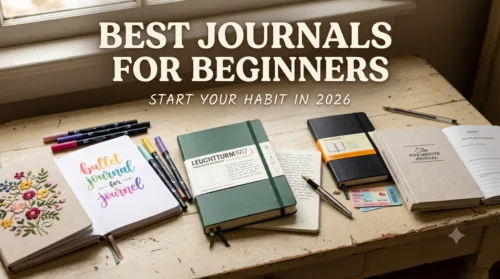
Introduction:
Starting a journaling habit is one of the simplest yet most rewarding ways to improve your mental well-being, organize your thoughts, and develop greater self-awareness. Whether you want to reduce stress, practice gratitude, set meaningful goals, or simply capture life’s memorable moments, choosing one of the best journals for beginners in 2026 can make the journey enjoyable and sustainable.
Many people begin journaling with great enthusiasm but stop after only a few days or weeks. Surprisingly, one common reason isn’t a lack of motivation—it’s using a journal that doesn’t suit their writing style or daily routine. A notebook designed for artistic bullet journaling may feel overwhelming to someone who simply wants to write a few thoughts before bed. Likewise, a heavily structured journal may frustrate a creative writer who prefers complete freedom.
The good news is that there is no “perfect” journal for everyone. The best journal is the one that matches your personality, goals, and lifestyle.
Why Your First Journal Matters More Than You Think
Many beginners believe that journaling success depends entirely on discipline. While consistency certainly matters, your choice of journal plays a surprisingly important role in determining whether the habit sticks.
Imagine purchasing a notebook with extremely thin paper that allows ink to bleed through every page. Every writing session becomes frustrating. Or perhaps the notebook is so large and heavy that you rarely carry it with you. Over time, these small inconveniences gradually reduce your motivation.
On the other hand, a journal that feels comfortable to hold, opens flat on your desk, and invites you to write can transform journaling into an enjoyable daily ritual rather than another task on your to-do list.
The right journal can help you:
Build a consistent writing habit by removing daily friction.
Stay motivated for months instead of just a few days.
Organise your ideas more effectively through intuitive layouts.
Reduce perfectionism and embrace the raw process of writing.
Support emotional well-being and increase daily self-reflection.
The Science Behind Journaling
Journaling isn’t simply about recording daily events. Numerous studies suggest that expressive writing can positively influence emotional health, stress management, and even physical well-being.
Researchers have found that writing about thoughts and emotions may help people reduce psychological stress, improve emotional regulation, and clarify personal goals. Expressive writing has also been associated with improvements in resilience and emotional processing, making it a highly valuable self-care practice when used alongside healthy lifestyle habits.
Likewise, gratitude journaling has gained widespread attention because regularly focusing on positive experiences can encourage optimism and improve overall life satisfaction. These findings explain why therapists, life coaches, and wellness experts frequently recommend learning how to start journaling for beginners as part of a broader personal development routine.
Journaling Complements Your Wellness Journey
One of the greatest advantages of journaling is that it works beautifully alongside other healthy habits. Instead of viewing it as a standalone activity, think of it as the glue that connects different aspects of your wellness routine.
Yoga & Meditation: Journaling immediately after a Vinyasa or Yin yoga session allows you to capture physical sensations, emotional shifts, and mental breakthroughs while they are still fresh.
Mindfulness: Practicing a brief heart-centered meditation before picking up your pen helps quiet mental chatter, making your journal entries significantly more thoughtful and authentic.
Evening Rituals: Pairing your writing with a warm cup of herbal tea creates a peaceful, screen-free environment that signals to your brain it is time to unwind and reflect.
Common Mistakes Beginners Make
Understanding what to avoid can be just as helpful as knowing what to buy:
Buying the Wrong Journal: Purchasing a notebook purely based on its cover without considering if the layout matches your daily goals.
Expecting Perfection: Hesitating to write out of fear of messy handwriting or grammar mistakes. Your journal is for your eyes only.
Writing Too Much Too Soon: Trying to write for an hour on day one. Writing for just five minutes every day is far more effective for building a habit than writing for an hour once a month.
Choosing Complicated Layouts: Attempting elaborate artistic layouts seen on social media can quickly overwhelm a true beginner.
Ignoring Paper Quality: Using a notebook where your favourite pen constantly bleeds through, turning a relaxing ritual into an annoying mess.
How We Evaluated These Journals
Transparency is essential when reviewing stationery. Rather than relying solely on manufacturer descriptions, we based our recommendations on a strict set of practical criteria:
Paper Quality: Thickness, resistance to ink bleed-through, ghosting, and overall fountain pen friendliness.
Build Quality: Hardcover durability, binding strength, and lay-flat capability.
Writing Comfort: Smoothness of page texture and hand comfort during long writing sessions.
Portability & Value: Weight, size, and features balanced against the total price.
In-Depth Reviews of the Best Journals for Beginners
Finding the sweet spot between structural quality and personal writing style is the secret to making your new habit stick. Now that you know how to avoid the common pitfalls that cause most beginners to give up, it’s time to look at the physical tools that will support your journey. Rather than relying on empty marketing claims, the following in-depth reviews look at real-world usability, pen performance, and exactly how these notebooks stack up when put to daily use.
1. Leuchtturm1917 Hardcover Notebook
Best For: Daily reflective writing, long-form journaling, and structured goal tracking.
Overall Rating: ⭐⭐⭐⭐⭐ (4.9/5)
Price Bracket: Premium
 Design & Features
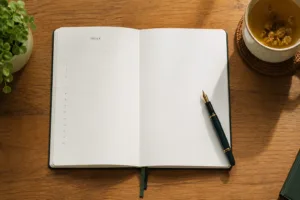 Design & Features
The Leuchtturm1917 has earned a legendary following among stationery enthusiasts. It appears simple and understated, but once you begin writing, its thoughtful engineering becomes apparent. It features pre-numbered pages, a blank index (table of contents), dual ribbon bookmarks, and spine labels. If you want to look back months later and easily find specific entries, this organisational structure is unmatched.
Paper Quality & Pen Performance
The notebook features 80 gsm acid-free paper. While it is widely seen as one of the best papers for fountain pens, it resists ink feathering very well. However, the paper is thin, so you may see slight “ghosting” (shadowing) with very wet inks.
| Pen Type | Performance Rating | Notes & Observations |
| Ballpoint | Excellent | Superb glide, absolutely zero indentation. |
| Gel Pen | Very Good | Clean, crisp lines with rapid drying time. |
| Fine Liner | Excellent | Perfect precision; ideal for detailed text. |
| Rollerball | Very Good | Rich ink laydown with minimal spreading. |
| Fountain Pen | Good | Excellent ink control; minor ghosting with wet nibs. |
Writing Comfort
One of the notebook’s greatest features is its true lay-flat binding. You never have to fight the spine or awkwardly press down near the center fold, ensuring your hand remains completely comfortable during long, uninterrupted reflective writing sessions.
The Pros: Exceptional stitched binding; numbers and index make tracking easy; opens completely flat; durable hardcover.
The Cons: Premium price point; minor ghosting visible with heavy ink profiles.
Our Verdict: If you are committed to making journaling a long-term habit and want an organized, durable book that will sit beautifully on a shelf for years, this is the gold standard.
2. Moleskine Classic Notebook
Best For: Everyday carry, travel writing, and maximum portability.
Overall Rating: ⭐⭐⭐⭐☆ (4.5/5) |
Price Bracket: Mid-range
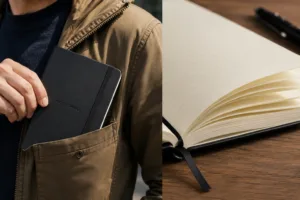
Design & Features
Few notebooks are as instantly recognizable as the Moleskine Classic. Featuring its signature rounded corners, elastic closure band, and expandable rear pocket, its ultimate competitive edge is pure convenience. It is highly flexible and lightweight, making it effortless to slip into a bag or coat pocket.
Paper Quality & Pen Performance
The Moleskine uses 70 gsm ivory-colored paper. The warm cream tone is incredibly gentle on the eyes, but the paper is noticeably thinner than its competitors, making it sensitive to wet inks.
| Pen Type | Performance Rating | Notes & Observations |
| Ballpoint | Excellent | Flawless, quick performance; no issues. |
| Gel Pen | Good | Reliable, though slight shadow shows on the back. |
| Rollerball | Fair | Minor ink spreading depending on the ink flow. |
| Fountain Pen | Moderate | Prone to ghosting; best restricted to fine, dry nibs. |
| Markers | Poor | Significant bleed-through; avoid wet art mediums. |
Writing Comfort
The paper texture is incredibly smooth, providing an inviting canvas for quick thoughts. While the binding does not lie completely flat right out of the box, it gradually breaks in with regular use. Because it is so lightweight, it is perfect for spontaneous writing in coffee shops, parks, or during daily commutes.
The Pros: Unmatched portability; elegant minimalist look; globally available and easy to replace.
The Cons: Thin paper limits your pen choices; does not lay perfectly flat initially.
Our Verdict: If your primary goal to build consistency is ensuring your journal is always by your side, the Moleskine Classic’s ultra-lightweight design makes it an excellent starter tool.
Head-to-Head Comparison
| Feature | Leuchtturm1917 | Moleskine Classic |
| Paper Thickness | 80 gsm (Thicker) | 70 gsm (Thinner) |
| Fountain Pen Friendly | Yes (Minor ghosting) | Limited / Best for fine nibs |
| Lay-Flat Design | Excellent (Immediate) | Good (Requires break-in) |
| Built-In Index | Yes | No |
| Portability | Very Good | Excellent (Ultra-lightweight) |
| Best Used For | Deep reflective home/desk writing | Travel, commuting, and daily carry |
3. Intelligent Change – The Five Minute Journal
Best For: Gratitude practices, structured mindfulness, and complete beginners.
Overall Rating: ⭐⭐⭐⭐⭐ (4.8/5)
Price Bracket: Premium
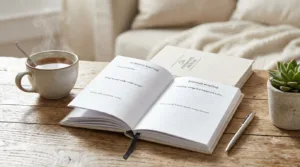
Design & Features
Staring at a blank page is intimidating, especially if you worry about saying the “right” thing. The Five Minute Journal solves this problem by removing decision fatigue entirely. Bound in a beautiful linen hardcover, this undated, pre-formatted layout exchanges blank space for science-backed prompts rooted in positive psychology.
Paper Quality & Pen Performance
The natural cream pages provide a highly responsive surface optimized for everyday writing instruments. Because the intent is structured text rather than art, it favors standard fine-tipped pens:
| Pen Type | Performance Rating | Notes & Observations |
| Ballpoint | Excellent | Smooth, reliable, zero impression on the back. |
| Gel Pen | Very Good | Crisp lines; quick drying time prevents smudging. |
| Fine Liner | Very Good | Clear layout tracking without feathering. |
| Fountain Pen | Good | Handles daily ink well; avoid overly wet ink flows. |
| Markers | Not Recommended | Prone to bleeding; avoid heavy felt-tip art pens. |
The Guided Routine
Instead of demanding long reflections, the daily grid is split into two brief, intentional check-ins that take less than five minutes total:
Morning Prompts: Focus on defining gratitude, setting daily intentions, and outlining positive affirmations before the rush of the day begins.
Evening Prompts: Provide a space for screen-free reflection on the day’s successes, lessons learned, and moments of joy.
The Pros: Absolute lowest barrier to entry for beginners; completely eliminates writer’s block; encourages rapid habit loop formation.
The Cons: Highly rigid layout; zero flexibility for long-form venting or free-form sketching.
Our Verdict: If your biggest obstacle is simply getting started, this is one of the best investments you can make to lower daily friction. It provides the training wheels needed to build momentum and consistency.
Check the Latest Price on Amazon
4. Archer & Olive Notebook
Best For: Bullet journaling, creative scrapbooking, and heavy mixed-media art.
Overall Rating: ⭐⭐⭐⭐⭐ (4.9/5)
Price Bracket: Premium
 Design & Features
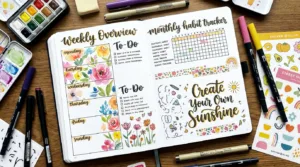
If classic notebooks are designed for text, the Archer & Olive is built as a premium canvas for your imagination. Featuring gorgeous, illustrated cloth covers, a built-in pen loop, and dual ribbon markers, this notebook immediately feels like an heirloom-quality keepsake.
Paper Quality & Pen Performance
The true standout feature is the ultra-thick 160 gsm crisp white paper. It is specifically engineered to handle wet mediums that would instantly destroy standard notebooks:
| Pen Type | Performance Rating | Notes & Observations |
| Ballpoint / Gel Pen | Excellent | Perfectly crisp lines; zero page indentation. |
| Fountain Pen | Excellent | Zero feathering or ghosting, even with broad nibs. |
| Brush Pens | Outstanding | Smooth blending without damaging the paper fibers. |
| Markers | Outstanding | Heavy alcohol and water-based markers will not bleed. |
| Watercolor | Very Good | Easily tolerates light washes and mixed-media pasting. |
Creative Expression & Usability
Because the pages are completely opaque, ghosting is virtually nonexistent. You can craft intricate habit trackers, paint landscapes, or use heavy stamps without worrying about ruining the reverse side of the page. Due to the heavy paper weight, it is noticeably bulkier and less suited for travel, making it perfect as a dedicated desk piece for your home routine.
The Pros:
Unmatched paper thickness; stunning artistic cover designs; maximum durability for creative projects.
The Cons:
Heavy and less portable; represents a significant financial investment; features may overwhelm minimalists.
Our Verdict: A flawless creative canvas. If your journaling style is deeply visual, artistic, or relies on multi-colored layouts, the structural mastery of an Archer & Olive easily justifies its premium price tag.
Which Journal Is Right for You?
Choosing the best notebook depends entirely on your personal style and goals. Use this targeted reference to find your match:
Complete Beginner: Choose The Five-Minute Journal. The guided prompts remove the pressure of the blank page and make consistency effortless.
Daily Reflective Writer / Goal Setter: Choose the Leuchtturm1917. The pre-printed index and numbered layout make tracking personal growth over months seamless.
Frequent Traveler / Commuter: Choose the Moleskine Classic. The ultra-lightweight, flexible design fits effortlessly into daily transit.
Creative Artist / Bullet Journal Enthusiast: Choose the Archer & Olive. The 160 gsm paper provides the necessary weight to support heavy inks, watercolours, and scrapbooking.
Key Factors to Consider Before Buying
Before purchasing, weigh these technical elements against your routine to ensure long-term satisfaction:
The Page Layout: Lined pages are best for traditional stream-of-consciousness writing. Dotted grids offer structure for custom bullet journaling, while blank pages invite free sketching. Guided pages are ideal for structured mindfulness.
Paper Weight (gsm): Standard writing requires 70–80 gsm. If you prefer heavy ink tools or artistic markers, look for specialized cardstock limits between 120–160 gsm to prevent ghosting.
Portability vs. Real Estate: An A5 size offers the ideal baseline balance between writing space and bag friendliness. Pocket sizes excel for travel, while B5 or square formats are best kept on a desk.
How to Build a Daily Journaling Habit That Lasts
Many people begin with great enthusiasm but lose momentum within a few weeks. Usually, the issue isn’t motivation—it’s trying to do too much too soon. Use these proven strategies to make the habit stick:
Anchor to an Existing Routine: Reduce cognitive friction by linking your writing to an established daily habit. Place your journal next to your morning coffee cup, or open it immediately after a calming yoga or evening walk session.
Embrace the Five-Minute Rule: Sustainable habits grow slowly. Commit to writing just a single sentence, three bullet points of daily gratitude, or a quick summary of a lesson learned. Consistency always matters more than entry length.
Ditch the Perfectionism: Your journal is a functional tool for your eyes only, not a curated social media post. Messy handwriting, spelling errors, and fragmented thoughts are often the most honest reflections.
Conduct Regular Reviews: Every few weeks, look back at earlier pages. Tracking your shifts in mood, emotional patterns, and progress toward goals provides positive reinforcement that makes you want to return to the page day after day.
Frequently Asked Questions
Is an expensive journal truly worth the investment?
Only if the features directly support your writing style. A premium notebook makes the physical act of writing more tactile and enjoyable, but the habit comes from commitment. Choose a notebook you feel excited to open, not one you are afraid to ruin.
How does journaling support a broader wellness routine?
Journaling functions as the emotional connective tissue for your health habits. Writing after a mindfulness or meditation session helps capture insights while your mind is quiet. Similarly, keeping a log while reading allows you to absorb and apply new knowledge to your personal growth journey.
Can journaling help with stress management?
Yes. Numerous studies in positive psychology indicate that expressive writing and structured gratitude tracking help reduce mental clutter, improve emotional regulation, and process daily anxieties by moving them out of your head and onto the page.
The Final Verdict
                     FINAL PRODUCT COMPARISON
┌───────────────────┬─────────────────┬──────────────────┬──────────────┐
│ Journal           │ Focus           │ Paper Thickness  │ Portability  │
├───────────────────┼─────────────────┼──────────────────┼──────────────┤
│ Leuchtturm1917    │ Reflection      │ 80 gsm           │ Very Good    │
│ Moleskine Classic │ Travel          │ 70 gsm           │ Excellent    │
│ Five Minute       │ Gratitude       │ Guided Layout    │ Very Good    │
│ Archer & Olive    │ Creativity      │ 160 gsm          │ Desk-centric │
└───────────────────┴─────────────────┴──────────────────┴──────────────┘
Best Overall for Beginners: Leuchtturm1917 Hardcover Notebook. Its unmatched organization, durable stitched binding, and lay-flat comfort provide everything a new writer needs.
Best Portability: Moleskine Classic Notebook. An ultra-lightweight, iconic design that is ideal for commuters, students, and spontaneous thinkers.
Best Guided Framework: The Five-Minute Journal. The absolute gold standard for individuals looking to build a structured gratitude practice without writer’s block.
Best Creative Canvas: Archer & Olive Notebook. A durable, heavy-duty artistic masterpiece that handles mixed media with flawless grace.
Starting a journaling habit doesn’t require complex creative skills or hours of free time. The pages are meant to be a raw, honest space to reflect, learn, and grow. Pick the tool that matches your current lifestyle, keep it within arm’s reach, and take your first step today.

