
Table of Contents
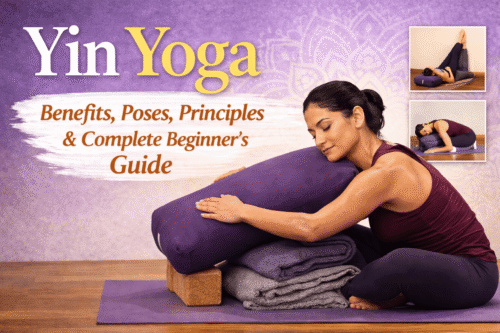
ToggleYin Yoga: Benefits, Poses, Principles & Complete Guide.
Introduction
Today, most people focus on intense exercise. The goal is often to burn calories, build strength, and push limits.This mindset reflects what yoga philosophy calls Yang energy—movement, activity, and outward focus.But the body also needs the opposite.This is where Yin Yoga comes in.This slow and gentle practice invites stillness instead of effort. It focuses on softness rather than intensity. By holding poses for longer periods, it helps release deep tension and restore balance in both the body and mind.Unlike Vinyasa or Power Yoga, this approach allows deeper tissues to relax and improve mobility over time. It is especially helpful for people who feel tight, stressed, or constantly busy.This article is based on personal experience. This is combined with established yoga principles and research on flexibility and nervous system regulation.Explore more in our complete guide: The Ultimate Guide to Yoga for Health, Flexibility, and Mental WellnessLearn more about calming the mind: Yoga for Stress and Anxiety: A Natural Way to Calm the Nervous SystemWhat is Yin Yoga? (Benefits and How It Works)
Yin Yoga is a slow and gentle style of yoga focused on deep relaxation. It involves holding a small number of poses for several minutes, allowing the body to stretch and release tension.Although it may seem too slow at first, many people find it deeply calming. It can improve flexibility and bring a sense of emotional balance. It is especially helpful for reducing stress and inner restlessness.Instead of focusing mainly on muscles, this practice targets deeper structures in the body, including:Fascia – connective tissue surrounding musclesLigaments – tissues connecting bonesJoints – supporting mobility and stabilityThe practice was developed by teachers like Paul Grilley and Sarah Powers. It also draws influence from Traditional Chinese Medicine.At its core, this method is about balance. It provides stillness in a world full of constant movement.The 4 Key Principles for Beginners
To fully benefit from Yin Yoga, it’s important to understand its foundational principles. These are the things that distinguish Yin from other yoga styles.1. Find Your Edge
You are encouraged to move slowly in yin yoga until you feel a gentle but noticeable sensation. This is often called your “edge.”This is not pain.It’s a place where you feel resistance but can still breathe comfortably and remain relaxed. Finding this balance is key to practicing safely and effectively.2. Resolve to Remain Still
Once you’ve settled into a pose, the goal is to stay as still as possible.Stillness allows the body to shift from muscular effort into deeper tissue engagement. It also creates space for mental awareness, helping you observe sensations without reacting to them.3. Hold for Time
Unlike dynamic yoga, where poses are held for seconds, Yin Yoga holds are measured in minutes.This is because connective tissues respond differently from muscles. They require slow, sustained pressure to adapt and lengthen.Over time, such techniques can lead to improved flexibility and joint mobility.4. Release with Care
Coming out of a pose is just as important as entering it.After holding a posture, the body experiences a “rebound effect”—a rush of blood flow and sensation. Moving slowly helps the body integrate the stretch safely and comfortablyScience-Backed Benefits:
Yin Yoga is not just a relaxing practice—it also has measurable physical and psychological benefits.1. Improved Fascial Health and Flexibility
Fascia plays a crucial role in how our body moves. When it becomes stiff or dehydrated, it can restrict mobility and cause discomfort.Slow, sustained stretching—like in Yin Yoga—may help improve the elasticity of fascia and overall flexibility.Many practitioners notice:- Increased range of motion
- Reduced stiffness
- Greater ease in movement
2. Reduced Stress and Nervous System Regulation
Yin yoga emphasizes slow breathing and stillness, which activates the body’s parasympathetic nervous system. This is “rest and digest” mode.This can:- Lower stress levels
- Reduce mental fatigue
- Improve emotional regulation
3. Better Joint Health and Mobility
Gentle, sustained loading of the joints encourages circulation and may support joint lubrication.This is especially important for:- People with sedentary lifestyles
- Those experiencing stiffness or reduced mobility
4. Enhanced Mindfulness and Mental Clarity
Holding poses for extended periods creates an opportunity to observe thoughts, sensations, and emotions without distraction.Such practice builds the following:- Awareness
- Patience
- Emotional resilience
My Journey: From High Intensity to Stillness
For years, I believed that a workout only counted if it felt intense. My routine revolved around running, strength training, and fast-paced yoga flows.If I wasn’t sweating or pushing myself, it felt unproductive.But over time, I noticed something strange. Despite staying active, my body felt tight. My hips were stiff, my back often ached, and my mind rarely felt fully at ease.The Shift
My first Yin Yoga class felt uncomfortable—not physically, but mentally.Holding a pose for several minutes felt endless. My mind wandered, I fidgeted, and I kept wanting to move.But something intriguing happened when I stayed.What Changed
Flexibility Improved My body began to open in ways it never had before. Areas that felt constantly tight—especially my hips and hamstrings—started to release.Relief from Sitting After long hours at a desk, yin yoga helped undo the effects of poor posture and inactivity.Mental Stillness Perhaps the most significant shift was internal. I learned how to sit with discomfort, breathe through it, and remain present.That skill carried into my daily life—helping me manage stress more calmly and respond rather than react.Real-Life Experience: Healing After Childbirth
A powerful example of the “less is more” philosophy comes from Samantha Kristoferson, a yoga practitioner who shared her recovery journey on Quora.
After experiencing a painful tailbone injury during childbirth, Samantha spent months struggling with chronic discomfort. While professional pelvic floor therapy introduced essential stretches, she found it difficult to stay consistent with the exercises in a clinical setting.
Everything changed when a teacher suggested shifting to a slower, more restorative approach. Through Yin Yoga, she discovered the same therapeutic movements she had been taught, but within a supportive and calming environment.
The Shift in Perspective
Coming from a highly active lifestyle, Samantha previously believed that for exercise to be “effective,” it had to be intense. Yin Yoga challenged this belief. By prioritizing stillness and mindful breathing, she experienced:
Physical Relief: The long, supported holds allowed her injured tissues to finally relax and heal.
Emotional Release: The practice helped her process the stress of her injury and reconnect with her body’s true needs.
A New Mindset: She realized that pushing harder isn’t always the answer.
The Takeaway: Samantha’s journey highlights a vital truth: healing often requires us to stop “doing” and start “being.” Sometimes, the greatest progress happens when we finally slow down.
Common Yin Yoga Poses: Step-by-Step Guide
1. Butterfly Pose (Baddha Konasana)
Target Area: Hips and lower back.- Setup: Sit on the floor and bring the soles of your feet together.
- Placement: Slide your feet away from your body so your legs form a large diamond shape (rather than pulling them tight to the groin).
- The Fold: Slowly fold forward, allowing your spine to round naturally
- Support: Let your head hang toward your heels or rest it on a block or firm cushion.
- Stillness: Rest your hands on your feet or the floor in front of you.
- Sit on the floor and bring the soles of your feet together.
- Slide your feet away from your body so your legs form a large diamond shape (rather than pulling them tight to the groin).
- Fold forward gently, allowing your spine to round.
- Let your head hang toward your heels or rest it on a block/cushion.
- Rest your hands on your feet or the floor in front of you.
2. Caterpillar Pose (Paschimottanasana)
Target Area: The entire back body, specifically the hamstrings and spine.- Setup: Sit with your legs extended straight out in front of you.
- Alignment: If your hamstrings feel very tight, sit on the edge of a folded
- blanket to tilt your pelvis forward.
- The Fold: Lean forward from the hips. Allow your back to round.
- Relaxation: Keep your legs totally relaxed; do not flex your feet.
- Hands: Rest your hands beside your legs, palms facing up to avoid the urge to pull yourself deeper.
- Sit with your legs extended straight out in front of you.
- If your hamstrings are tight, sit on the edge of a folded blanket to tilt your pelvis forward.
- Slowly fold forward over your legs. Allow your back to round naturally.
- Keep your legs relaxed; do not flex your feet. Rest your hands beside your legs, palms facing up to discourage pulling.
3. Dragon Pose (Anjaneyasana Variation)
Target Area: Hip flexors and groin.- Setup: Start on your hands and knees (Tabletop).
- Step Forward: Step your right foot forward between your hands, keeping the knee directly above the ankle.
- The Stretch: Slide your left knee back until you feel a gentle stretch in the front of the left hip.Hand Position: You can keep your hands on the floor, on blocks, or rest them on your front thigh.
- Switch: After 2–3 minutes, move back to the Tabletop and repeat on the other side.
- Start on your hands and knees (Tabletop).
- Step your right foot forward between your hands, ensuring the knee is directly above the ankle.
- Slide your left knee back as far as comfortable until you feel a stretch in the front of the left hip.
- You can keep your hands on the floor, on blocks, or rest them on your front thigh.
- After the allotted time, move back to the Tabletop and switch sides.
4. Sphinx Pose (Salamba Bhujangasana)
Target Area: Compression of the lower spine (lumbar) and opening the chest.- .Setup: Lie flat on your stomach.
- Lift: Prop yourself up on your elbows. Place your elbows slightly ahead of your shoulders.
- Relax: Let your weight rest on your forearms. Relax your legs, glutes, and lower back completely.
- Head Position: You can look slightly forward or let your chin drop toward your chest to release the neck.
- Lie flat on your stomach.
- Prop yourself up on your elbows. Place your elbows slightly ahead of your shoulders.
- Let your weight rest on your forearms.
- Relax your legs, glutes, and lower back.
- You can keep your head neutral, look slightly forward, or let your chin drop to your chest.
5. Child’s Pose (Balasana)
Target Area: Hips, ankles, and a gentle stretch for the spine.Setup: Kneel on the floor. Touch your big toes together and sit on your heels.Opening: Separate your knees about hip-width apart (or wider for more comfort).The Fold: Lay your torso down between your thighs.Rest: Place your forehead on the mat, a block, or a stack of blankets.Arms: Stretch your arms forward for a shoulder stretch, or tuck them back by your sides for total relaxation.How to do it:- Kneel on the floor. Touch your big toes together and sit on your heels.
- Separate your knees about hip-width apart (or wider for more comfort).
- Fold forward and lay your torso between your thighs.
- Rest your forehead on the mat or a block.
- Stretch your arms forward for a slight shoulder opening, or tuck them back by your sides for total relaxation.
How to “End” Your Practice
In Yin Yoga, the transition out of a pose is as important as the pose itself.Move like a snail: Come out of these poses very slowly. Your tissues will feel “fragile” or “creaky” for a few seconds.The Rebound: After each pose, lie flat on your back or belly for 1 minute. This allows the blood and “Qi” (energy) to flush back into the joints you just compressed.Yin ga vs Other Styles
| Style | Focus | Intensity |
|---|---|---|
| Yin Yoga | Stillness, deep tissue | Low |
| Vinyasa Yoga | Flow and movement | Moderate–High |
| Ashtanga Yoga | Structured sequence | High |
Safety and Contraindications
Yin Yoga is generally safe, but caution is important.Avoid or modify the practice if you have- Joint injuries
- Severe back pain
- Hypermobility conditions
- Avoid sharp or intense pain
- Use props when needed
- Consult a professional if unsure

