
Vitamin B12 Supplements: Benefits, Dosage, Forms, Foods, and How to Choose the Right One
Introduction
Your body does not need dozens of random supplements—it needs the right nutrients, in the right amounts, for the right reasons.
Vitamin B12 is easy to overlook until a deficiency impacts how you feel. It plays an essential role in red blood cell formation, DNA synthesis, and nervous system function. Yet getting enough B12 can be challenging—particularly for those eating little to no animal foods or individuals taking medications that interfere with absorption.
This is where B12 supplements help. However, choosing one isn’t as simple as picking the highest number on the label.
A 1,500 mcg methylcobalamin tablet, a 2.2 mcg B12 oral strip with botanical extracts, and a 1.1 mcg vegetarian capsule serve completely different purposes. They are not interchangeable.
This guide breaks down what vitamin B12 does, who needs it, what the science says about different forms and dosages, and how three popular commercial products compare.
What Is Vitamin B12?
Vitamin B12 (cobalamin) is an essential, water-soluble vitamin required for core physiological processes:
Red blood cell formation.
DNA synthesis.
Neurological and nerve cell health.
Cellular energy metabolism.
Because the human body cannot produce B12, it must come from diet or supplementation. Naturally occurring B12 is found almost exclusively in animal-derived foods. Fortified foods and dietary supplements offer critical alternatives, especially for vegetarian and vegan diets.
Key Benefits: Why Does Vitamin B12 Matter?
1. Supports Healthy Blood Cells
B12 is required for healthy red blood cell maturation. Severe deficiency causes **megaloblastic anemia**—a state where red blood cells become abnormally large and inefficient at carrying oxygen, leading to:
- Chronic fatigue and weakness
- Pale or yellowish skin
- Shortness of breath
- Low exercise tolerance
Clinical Reality Check: Fatigue alone does not equal a B12 deficiency. Tiredness stems from many root causes, including iron deficiency, thyroid dysfunction, poor sleep, or chronic stress. Supplements should never replace investigating persistent symptoms with a doctor.
2. Protects the Nervous System
B12 helps maintain the myelin sheath that insulates nerves. A prolonged deficiency can trigger neurological symptoms:
- Numbness or a “pins and needles” sensation in hands and feet
- Balance problems and gait changes
- Cognitive difficulties (“brain fog” or memory issues)
The National Institute for Health and Care Excellence (NICE) explicitly notes that B12 deficiency should not be ruled out simply because a patient shows no signs of anemia. Neurological symptoms can occur independently.
3. Essential for DNA Synthesis
Every cell relies on DNA replication. B12 serves as a cofactor in biochemical reactions required for fundamental cellular metabolism and DNA integrity, which explains why a long-term deficiency impacts multiple body systems.
Recommended Dosage vs. Label Strengths: Understanding Absorption
For healthy adults, the Recommended Dietary Allowance (RDA) is 2.4 micrograms (mcg) per day (increasing to 2.6 mcg during pregnancy and 2.8 mcg during breastfeeding).
Why do supplements contain 500-1,500 mcg when we only need 2.4 mcg?
The answer lies in how the digestive tract absorbs B12.
Under normal conditions, B12 binds to a protein called intrinsic factor (IF) in the stomach, allowing efficient absorption in the small intestine. However, the IF transport system saturates at roughly 1.5 to 2 mcg per meal.
When you take high-dose oral supplements, your body relies on passive diffusion, which is far less efficient:
- Doses below 2 mcg: ~50% absorption rate
- 500 mcg dose: ~2% absorbed (~10 mcg)
- 1,000 mcg dose: ~1.3% absorbed (~13 mcg)
Therefore, a 1,000 mcg tablet does not flood your body with 1,000 mcg of usable B12—it simply overcomes the body’s passive absorption barrier to deliver a therapeutic dose.
Who Is at Risk of B12 Deficiency?
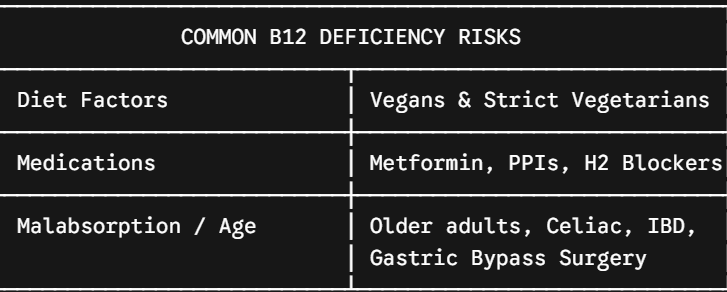
1. Vegans and Vegetarians: Plant foods do not naturally contain active B12 unless fortified. Vegetarians who eat eggs and dairy get some B12, but intake varies.
2. Older Adults: Aging reduces stomach acid production (atrophic gastritis), which is necessary to separate B12 from food proteins.
3. People Taking Metformin: Long-term use of metformin (for type 2 diabetes or PCOS) can impair B12 absorption in the ileum.
4. People Taking Acid-Suppressing Medications: Proton Pump Inhibitors (PPIs) and H2 blockers reduce stomach acid, impairing the release of bound B12 from diet.
5. Gastrointestinal Conditions: Surgical resection, bariatric procedures, Crohn’s disease, or celiac disease can disrupt intrinsic factor production or absorption sites.
When and How Should You Test Your B12 Levels?
If you exhibit symptoms alongside risk factors, consult a healthcare professional. NICE guidelines recommend initial testing if a patient displays at least one symptom and one risk factor.
Common Tests Include:
Total Serum B12
Active B12 (Holotranscobalamin)
Methylmalonic Acid (MMA) — a accurate marker of cellular B12 status
Important Diagnostic Tip: Always draw blood samples for B12 testing **before** starting high-dose supplements. Supplementation rapidly inflates blood B12 levels, which can mask an underlying tissue deficiency on lab results.
Methylcobalamin vs. Cyanocobalamin: Which Form Is Best?
Supplement labels typically list one of four B12 forms:
1. Methylcobalamin: A coenzyme form used directly in cellular processes.
2. Cyanocobalamin: A stable, synthetic form converted by the body into active cobalamins.
3. Adenosylcobalamin: A cellular coenzyme form active in mitochondrial reactions.
4. Hydroxocobalamin: An injectable or high-dose oral form often used in clinical settings.
Does “active” mean better?
Not necessarily. Marketing often labels methylcobalamin as superior, but scientific data shows nuanced results:
The NIH Office of Dietary Supplements notes no clinically significant difference in overall bioavailability or absorption rates between oral cyanocobalamin and methylcobalamin in healthy individuals.
Both cyanocobalamin and methylcobalamin are recognized by NICE as suitable oral replacement forms.
Are Oral Strips or Sublingual B12 Better Than Tablets?
Sublingual (under-the-tongue) tablets and oral thin strips are popular for convenience and pill-swallowing difficulties. However:
Myth: Sublingual B12 bypasses digestion directly into the bloodstream in massive amounts.
Fact: Research summarized by the NIH demonstrates no statistically significant difference in efficacy or bioavailability between swallowing a standard oral tablet vs. using a sublingual strip.
Choose the delivery mechanism that best fits your daily routine and compliance.
Vitamin B12 Supplements: Compare & Shop
If you have decided that a B12 supplement is appropriate for your needs, compare the form, dose, ingredients and delivery format before purchasing.
1. Carbamide Forte Vitamin B12 (1,500 mcg)
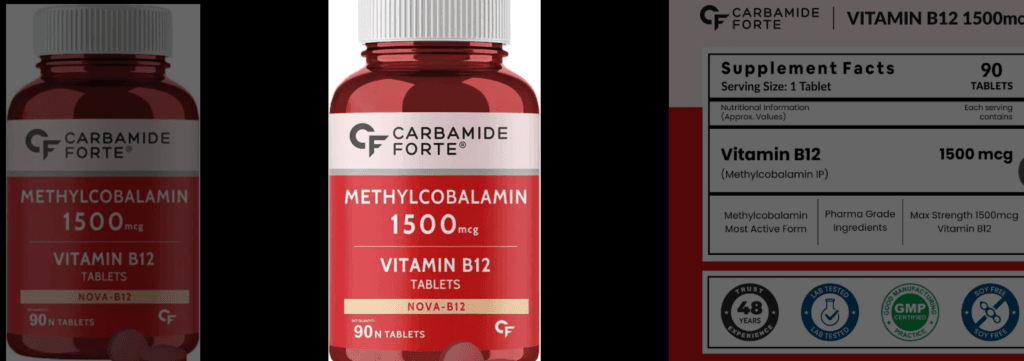
Format: Conventional Tablet
Serving: 1,500 mcg Methylcobalamin
Best For: High-dose replacement under clinical guidance or confirmed malabsorption needs.
Analysis: A single-ingredient, high-potency formula designed to deliver therapeutic B12 levels through passive diffusion. It may appeal to readers specifically looking for a methylcobalamin B12 supplement in a conventional tablet format.
Purchase: Buy Carbamide Forte Vitamin B12
An alternative current listing is also available through Amazon:
Check Carbamide Forte on Amazon
BenVitalFive note: 1,500 mcg is a high-dose formulation compared with the adult nutritional requirement of 2.4 mcg/day. Readers should consider why they need supplementation rather than assuming that a higher dose is automatically better.
2. Wellbeing Nutrition Melts Vegan Vitamin B12

Key features: Oral strips | Vegan | B12 + folate + Brahmi + curcumin | 30 strips
The manufacturer’s current product information lists 2.2 mcg of B12 as cyanocobalamin per strip, together with folate, BacoMind® Brahmi extract and CurcuWIN® curcumin.
The oral-strip format may be convenient for people who prefer not to swallow tablets or capsules.
Direct purchase: Buy Wellbeing Nutrition Melts Vitamin B12
Best For: Daily dietary maintenance for vegans, travelers, or those who dislike swallowing pills.
Analysis: A low-dose maintenance product that mimics standard daily dietary intake while adding botanical compounds.
BenVitalFive note: This product should not be compared directly with a 1,500-mcg B12 tablet simply on the basis of “strength.” Its formulation, B12 quantity and additional ingredients are different.
Note: Clinical studies on individual botanical extracts do not automatically guarantee synergy in a combination product.
Check Wellbeing Nutrition Melts Vegan Vitamin B12 on Amazon
### 3. HealthyHey Natural Vitamin B12
* **Format:** Vegetarian Capsule
* **Serving:** 1.1 mcg B12 (derived from Quinoa Sprouts)
* **Best For:** Plant-based eaters looking for gentle, whole-food-aligned daily nutritional support.
* **Analysis:** A minimal, whole-food derived option providing modest daily support rather than high-potency therapeutic correction.
—
## Product Comparison Matrix
| Feature | Carbamide Forte | Wellbeing Nutrition Melts | HealthyHey Natural |
| — | — | — | — |
| **Format** | Tablet | Oral Thin Strip | Vegetarian Capsule |
| **Serving Size** | 90 Count | 30 Strips | 30 Capsules |
| **Listed B12 Form** | Methylcobalamin | Cyanocobalamin | Cyanocobalamin (Quinoa) |
| **B12 Amount** | 1,500 mcg | 2.2 mcg | 1.1 mcg |
| **Co-Nutrients** | None (B12 focused) | Folate, Brahmi, Curcumin | Quinoa Sprouts (100 mg) |
| **Primary Focus** | High-Dose Therapeutic | Convenience + Multi-Ingredient | Daily Plant-Sourced Maintenance |
—
## 5 Questions to Ask Before Buying a B12 Supplement
1. **Why am I taking it?** (Managing a diagnosed deficiency vs. daily vegan maintenance).
2. **How much B12 does it actually supply?** (Check elemental dosage in mcg, not brand size).
3. **Do I need added ingredients?** (Extra botanicals add cost; decide if you want pure B12 or a multi-ingredient blend).
4. **Is the delivery form sustainable for me?** (Strips vs. capsules vs. standard tablets).
5. **Has the brand verified its quality?** (Look for third-party lab testing or ISO/GMP certifications).
—
## Myths & Realities: Energy, Brain Health, and Aging
### Myth 1: “B12 gives you an instant energy boost.”
**Reality:** B12 helps convert food into cellular energy, but it is not a stimulant. If you are not deficient, taking additional B12 will **not** increase baseline energy levels.
### Myth 2: “B12 works as a cognitive enhancer.”
**Reality:** Preventing B12-deficiency-related neurological decline is medically proven. However, taking excess B12 when levels are normal does not grant super-memory or heightened intellect.
### Myth 3: “B12 prevents heart disease by lowering homocysteine.”
**Reality:** B12 participates in breaking down homocysteine (an amino acid linked to cardiovascular risk). While B12 supplements lower serum homocysteine levels, clinical trials show this reduction does not automatically correlate to lower rates of heart attacks or strokes.
—
## Safety and Side Effects
Vitamin B12 exhibits low toxicity risk. Because it is water-soluble, excess amounts are routinely excreted in urine. The **NIH** has established **no Tolerable Upper Intake Level (UL)** for B12.
However, taking excessive therapeutic doses without reason adds unnecessary financial cost and can mask other underlying nutritional imbalances.
—
## Practical B12 Selection Checklist
* [ ] Have I evaluated my dietary intake (vegan, vegetarian, omnivore)?
* [ ] Am I currently taking Metformin or acid reducers (PPIs)?
* [ ] Have I checked for neurological signs like unexplained tingling or numbness?
* [ ] Have I scheduled a B12 diagnostic blood test prior to starting high doses?
* [ ] Does the product label clearly state the exact microgram (mcg) yield per serving?
—
## Frequently Asked Questions (FAQ)
### Is methylcobalamin better than cyanocobalamin?
No single form is universally superior. Clinical data from the NIH indicates that total absorption efficiency between methylcobalamin and cyanocobalamin oral supplements shows no significant difference in standard use.
### Can B12 deficiency cause tiredness?
Yes, deficiency can lead to megaloblastic anemia and severe fatigue. However, because fatigue has dozens of clinical causes, persistent tiredness should be evaluated by a healthcare professional rather than self-treated with supplements.
### Do vegans need B12 supplements?
Yes. Unfortified plant foods do not provide reliable active B12. Vegans should utilize fortified foods or daily B12 supplements to maintain healthy levels.
### Is 1,500 mcg of B12 safe to take daily?
Yes, high oral doses are generally safe due to low toxicity and low passive absorption rates (~1.3%). However, high therapeutic doses should ideally be used to treat diagnosed low levels or malabsorption conditions rather than routine maintenance for healthy omnivores.
—
## Final Thoughts
Vitamin B12 is essential for blood, brain, and cellular health, but **more is not always better**. Match your supplement choice to your personal situation:
* Choose **high-dose formulations (1,000+ mcg)** if managing malabsorption or guided by a physician.
* Choose **moderate/daily-value formulations (2.4–100 mcg)** for general vegan or vegetarian dietary maintenance.
—
### Medical Disclaimer
*This article is for educational purposes only and does not replace medical advice, diagnosis, or treatment. Always consult a qualified healthcare provider before starting a new supplement routine or investigating persistent symptoms.*
—
### Authoritative Scientific References & Resources
* **NIH Office of Dietary Supplements:** [Vitamin B12 Fact Sheet for Health Professionals](https://ods.od.nih.gov/factsheets/VitaminB12-HealthProfessional/)
* **NICE Guidelines:** [Vitamin B12 deficiency in over 16s: diagnosis and management](https://www.nice.org.uk/guidance/ng239)

