
Table of Contents
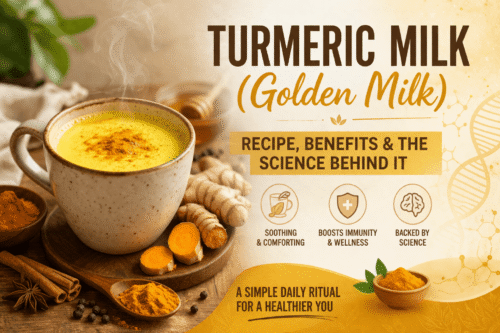
ToggleGolden Milk (Turmeric Milk): Science-Backed Benefits, Recipe, and How to Use It Daily
Introduction
In the Tamil Nadu villages where I spent years observing traditional health practices, there was one remedy that appeared in almost every household—golden milk (turmeric milk).
If someone had a sore throat, they were given a warm cup before bed. If joints ached after long days in the fields, the same remedy appeared. Even sleep problems or digestive discomfort were often met with this simple drink.
At the time, I saw it as cultural habit. But after years of studying clinical research and nutritional science, I’ve come to a different conclusion:
Golden milk is one of the most efficient, low-cost, and scientifically supported functional drinks available today.
In this guide, you’ll learn:
- What golden milk really is
- The science behind each ingredient
- Proven and emerging benefits
- A proper, bioavailable recipe
- When and how to use it for the best results
What Is Golden Milk?
Golden milk (also called turmeric milk, haldi doodh, or manjal paal) is a traditional Indian drink made by combining:
- Milk (or plant-based milk)
- Turmeric
- Black pepper
- Optional spices like ginger and cinnamon
Rooted in Ayurveda, it has been used for centuries as a natural remedy for:
- Inflammation
- Poor digestion
- Sleep disturbances
- Immune support
Today, modern research—especially around turmeric’s active compound—has begun to validate many of these uses.
The Science Behind Golden Milk Ingredients
Turmeric (Curcuma longa): The Core Compound
The primary active ingredient in turmeric is curcumin, a polyphenol with powerful biological effects.
Research published in journals like Nutrients shows that curcumin may:
- Help reduce inflammatory markers such as CRP (C-reactive protein)
- Act as a strong antioxidant
- Support cellular repair mechanisms
This is why golden milk is often categorized as an anti-inflammatory drink.
However, there’s a catch…
Black Pepper: The Absorption Multiplier
Curcumin alone is poorly absorbed by the body.
This is where black pepper becomes essential.
Its active compound, piperine, has been shown (in Planta Medica) to increase curcumin absorption by up to 2000%.
Without black pepper, most turmeric passes through your body unused.
Practical insight:
In traditional Tamil recipes, even a tiny pinch of pepper is never skipped—this is not accidental; it’s biochemical wisdom.
Milk (or Plant-Based Milk): The Fat Factor
Curcumin is fat-soluble, meaning it needs fat to be properly absorbed.
That’s why traditional recipes use:
- Whole milk
- Coconut milk
- Almond milk
From a bioavailability standpoint, full-fat coconut milk is one of the most effective options.
Ginger: Digestive and Anti-Inflammatory Support
Ginger contains compounds like:
- Gingerols
- Shogaols
Research in the Journal of Medicinal Food suggests ginger may:
- Reduce muscle soreness
- Support digestion
- Help with nausea
In practice, ginger makes golden milk more effective for gut health.
Cinnamon: Blood Sugar and Metabolic Support
Cinnamon has been studied for its ability to:
- Improve insulin sensitivity
- Reduce fasting blood glucose (modestly, per meta-analyses)
This makes golden milk useful not just for immunity, but also for metabolic health.
Honey or Jaggery: Functional Sweeteners
Traditional sweeteners offer more than taste:
- Raw honey → antimicrobial properties
- Jaggery → contains trace minerals like iron and magnesium
Compared to refined sugar, these are nutritionally superior options.
Evidence-Based Benefits of Golden Milk
Let’s separate what science strongly supports vs what is still emerging.
Strong Evidence
1. Reduces Inflammation
Curcumin has consistently shown anti-inflammatory effects in multiple studies.
Useful for:
- Joint pain
- Muscle soreness
- Chronic inflammation
2. Supports Immune Function
Turmeric, ginger, and honey provide:
- Antioxidants
- Antimicrobial compounds
Especially helpful during:
- Seasonal illness
- Recovery periods
Moderate Evidence
3. Improves Sleep Quality
Golden milk may support sleep through:
- Warm milk → tryptophan
- Relaxation response
- Possible serotonin pathway support
Best consumed before bed.
4. Supports Digestion
Ginger and turmeric:
- Reduce bloating
- Improve gut motility
Emerging Evidence
5. Brain and Cognitive Health
Curcumin is being studied for:
- Neuroinflammation reduction
- Potential cognitive support
Promising, but still under active research.
How to Make Golden Milk (Proper Method)
Ingredients (1 serving)
- 1 cup full-fat milk or coconut milk
- ½ tsp turmeric powder (or fresh turmeric)
- ¼ tsp black pepper
- ¼ tsp ginger
- ¼ tsp cinnamon
- 1 tsp honey or jaggery
- Optional: cardamom
Method
- Heat milk gently (do not boil)
- Add turmeric, pepper, ginger, cinnamon
- Simmer for 3–5 minutes
- Remove from heat
- Add sweetener after cooling slightly
Drink warm.
When to Drink Golden Milk
Best Time: Night
Drinking golden milk 30 minutes before bed:
- Promotes relaxation
- Supports recovery
- Helps sleep cycles
Alternative: Morning Use
For those avoiding caffeine:
- Use it as a coffee alternative
- Add a pinch of saffron or nutmeg for variation
Practical Tips (From Real Use)
Based on both research and field observation:
Tip 1: Always Add Fat + Pepper
Without both, you lose most benefits.
Tip 2: Use Fresh Turmeric When Possible
Fresh root:
- Contains more active compounds
- Has better bioactivity
Tip 3: Don’t Overdose
More turmeric ≠ better results.
Stick to ½–1 teaspoon per serving
Tip 4: Cycle Usage
Use for:
- 2–4 weeks regularly
- Then take a short break
This prevents over-reliance and improves effectiveness.
Who Should Be Careful?
Golden milk is generally safe, but:
- People on blood thinners → turmeric may enhance effects
- Gallbladder issues → turmeric stimulates bile
- Iron deficiency → avoid taking with iron supplements
Always consult a healthcare provider if unsure.
FAQ: Golden Milk
1. Can I drink golden milk every day?
Yes, in moderate amounts (1 cup daily). Cycling every few weeks is ideal.
2. Does golden milk help with weight loss?
Indirectly. It may support metabolism and reduce inflammation, but it is not a fat-loss drink.
3. Can I make golden milk without dairy?
Yes. Coconut milk is one of the best alternatives for absorption.
4. Is golden milk safe during pregnancy?
In small amounts, it is generally safe—but always consult a doctor.
5. Why is black pepper necessary?
It increases curcumin absorption significantly—without it, benefits are minimal.
Conclusion
Golden milk is not a miracle cure—but it is something arguably more valuable:
A simple, scientifically supported, culturally proven daily health practice.
What makes it powerful is not just turmeric, but the synergy of ingredients:
- Curcumin + piperine
- Fat + heat
- Tradition + science
From Tamil village kitchens to modern research labs, the conclusion is increasingly clear:
Golden milk works—not because it is trendy, but because it is intelligently designed.
If used consistently and correctly, it can become one of the most effective additions to your daily routine—supporting inflammation control, recovery, and overall well-being.
References
- Nutrients Journal – Curcumin and inflammation
- Planta Medica – Piperine and bioavailability
- Journal of Medicinal Food – Ginger and cinnamon effects
- Healthline – Golden milk overview
- Medanta – Clinical insights on turmeric milk
- Citizens Hospitals – Traditional and modern benefits
About the Author
Jesuraj is a wellness researcher and health optimization specialist focused on the intersection of modern neuroscience and traditional herbalism.
He spends hundreds of hours analyzing clinical trials, ingredient bioavailability, and third-party lab data to deliver evidence-based, practical health insights. By bridging ancient botanical knowledge with modern science, Jesuraj helps readers improve mental clarity, recovery, and long-term vitality through strategic wellness practices.

