Ashwagandha vs Brahmi: Benefits, Differences & Which Adaptogen Is Right for Your Stress Type?

Stress does not look the same for everyone.For one person, stress feels like physical exhaustion, poor sleep, and feeling drained after months of pressure. For another, stress appears as endless thinking, difficulty focusing, and a mind that refuses to slow down.This is why two ancient Ayurvedic herbs—Ashwagandha
and Brahmi—are often compared.Both have been used for centuries in traditional Indian wellness practices. Both are studied by modern researchers. But they do not work exactly the same way.Ashwagandha has become one of the most recognized Ayurvedic adaptogens worldwide. Brahmi has a smaller global profile, but it has a long reputation in Ayurveda as a herb. Traditionally associated with learning, memory, and mental clarity.This comparison is not about choosing the “stronger” herb. It is about understanding which one better matches your body, mind, and type of stress.
Ashwagandha vs Brahmi
| Feature | Ashwagandha | Brahmi |
|---|
| Botanical name | Withania somnifera | Bacopa monnieri |
| Main traditional use | Strength, stress resilience, rejuvenation | Memory, learning, mental clarity |
| Best suited for | Physical stress and exhaustion | Mental stress and overthinking |
| Primary focus | Body stress response | Brain and cognitive support |
| Commonly chosen for | Relaxation, sleep support, recovery | Focus, concentration, memory |
| Ayurvedic category | Rasayana (rejuvenating herb) | Medhya Rasayana (cognitive rejuvenator) |
| Traditional quality | Grounding and warming | Cooling and calming |
What Are Adaptogens?
Adaptogens are natural substances traditionally believed to help the body maintain balance during periods of stress.In modern research, adaptogens are studied for their possible influence on:
- Stress response pathways
- Energy balance
- Fatigue
- Mental performance
- Sleep quality
However, every adaptogen works differently. Ashwagandha and Brahmi influence different aspects of stress. Ashwagandha and Brahmi belong to a larger family of traditional herbs known as adaptogens. You can learn more about different
adaptogens for stress and burnout recovery and how they are traditionally used to support balance during challenging periods.
Understanding Ashwagandha
Ashwagandha (Withania somnifera) is a root herb used in Ayurveda for thousands of years.The name translates roughly as “smell of the horse,” traditionally symbolizing strength and vitality.Ayurveda classifies Ashwagandha as a
rasayana, meaning a rejuvenating herb traditionally used to support overall wellness.
Science-Backed Benefits of Ashwagandha
1. Supports a Healthy Stress Response
Ashwagandha is best known for its role in stress management.Several studies have explored Ashwagandha’s effects on stress-related outcomes. One commonly referenced human trial examined
clinical research on ashwagandha and stress response, including perceived stress scores and cortisol-related measurements. Some human studies suggest that certain standardized ashwagandha extracts may help support healthier cortisol responses during periods of stress.Cortisol is often called the “stress hormone” because levels can rise during challenging situations.Ashwagandha appears to influence the body’s stress-response system, including pathways connected with the hypothalamic–pituitary–adrenal (HPA) axis.
2. Supports Relaxation and Sleep Quality
Ashwagandha is not considered a sleeping pill. Ashwagandha supports relaxation, but healthy sleep depends on more than one herb. Building steady habits can help you sleep better. Ease stress in the evening. Do gentle breathing. Use the
Ayurveda Tips for Everyday Health to improve sleep quality through evening routines and relaxation practices.This guide explains 15 simple and powerful practices to use Ayurveda for everyday health. Improve digestion, boost energy, reduce stress, and stay naturally balanced.Research studies suggest that some Ashwagandha extracts may improve sleep quality. Clinical trials listed by the
National Institutes of Health (NIH) support this. This may help some people, especially those with sleep problems.One study of 150 adults found that participants taking Ashwagandha root and leaf extract reported better sleep quality compared with the placebo group.Another eight-week study using Ashwagandha root extract showed improvements in sleep quality, time taken to fall asleep, and morning alertness among people with insomnia.A 2021 review of five clinical studies involving 372 adults suggested that ashwagandha has a positive effect on sleep, with regular use over several weeks.Researchers believe these benefits may come from Ashwagandha’s ability to support relaxation and reduce stress-related mental and physical tension that can interfere with sleep.Healthy sleep also depends on daily habits. Creating calming nighttime rituals, reducing screen exposure, and practicing relaxation techniques can support natural ways to improve sleep quality through evening routines and relaxation practices.
3. Supports Physical Performance and Recovery
Some studies suggest Ashwagandha supplementation may support:
- Exercise performance
- Strength improvement
- Recovery after physical activity
These benefits appear strongest when combined with regular exercise and a healthy lifestyle.
Who May Prefer Ashwagandha?
Ashwagandha may be a better match if:
- Your stress feels physical
- You feel exhausted after prolonged pressure
- Stress affects your sleep quality
- You feel drained but unable to relax
- Your body struggles to recover after demanding periods
Instead of describing this as “adrenal overload,” a more accurate explanation is prolonged stress combined with poor recovery, which can leave people feeling both tired and mentally alert.
Understanding Brahmi
Brahmi (Bacopa monnieri) is a small creeping herb traditionally valued in Ayurveda for supporting the mind.It belongs to a group called
“Medhya Rasayana — herbs traditionally associated with intelligence, memory, and cognitive wellness.While Ashwagandha is often connected with body stress, Brahmi is more associated with mental balance.
Science-Backed Benefits of Brahmi
1. Supports Memory and Learning
Brahmi contains active compounds called
bacosides.Modern researchers have studied Bacopa monnieri for its possible influence on memory and cognition. Reviews of
scientific studies on Brahmi and cognitive performance suggest that regular use may help some memory functions. Regular use may need to continue for several weeks.
- Communication between nerve cells
- Antioxidant protection
- Processes involved in learning and memory
Several studies have examined Brahmi’s potential role in memory formation and recall.
2. Supports Focus and Mental Performance
Brahmi is commonly chosen by:
- Students
- Professionals with mentally demanding work
- People wanting cognitive support
Brahmi is only one part of supporting cognitive wellness. Daily nutrition also matters. Including
foods that support meditation and mental clarity can provide important nutrients that support overall brain health.Research suggests regular use may support certain aspects of attention and information processing.
3. Helps Calm Mental Restlessness
Some people experience stress mostly in the following:
- Overthinking
- Constant worry
- Difficulty switching off thoughts
- Mental fatigue
Brahmi has traditionally been used to promote a calm, clear state of mind.
Meditation techniques for stress management with herbal wellness practices help to build a calmer relationship with daily thoughts and emotions.Mind-based practices may also support emotional balance. You can combine traditional herbs with beginner meditation techniques for stress management for a more complete wellness approach.
Who May Prefer Brahmi?
Brahmi may be a better match if:
- Your stress is mainly mental
- You experience racing thoughts
- You struggle with concentration
- You feel mentally overloaded
- You want memory and learning support
Ashwagandha vs Brahmi: Which Should You Choose?
Choose
Ashwagandha if your main concern is:
- Physical exhaustion
- Stress-related sleep problems
- Recovery
- Feeling constantly drained
Choose
Brahmi if your main concern is:
- Mental fatigue
- Focus problems
- Forgetfulness
- Overthinking
Many people describe it simply:Ashwagandha supports the stressed body.Brahmi supports the busy mind.
Can You Take Ashwagandha and Brahmi Together?
Traditionally, Ashwagandha and Brahmi have sometimes been used together because they support different aspects of wellness.Ashwagandha mainly addresses stress resilience and recovery.Brahmi mainly supports cognitive function and mental calmness.However, if you are new to these herbs, trying one at a time for several weeks makes it easier to understand how your body responds.
Different Forms of Ashwagandha and Brahmi
Ashwagandha Forms
Common options include:
- Ashwagandha root powder
- Capsules
- Standardized extracts
- Herbal blends
- Traditional preparations with warm milk
Brahmi Forms
Common options include:
- Brahmi powder (churna)
- Capsules
- Standardized Bacopa extracts
- Brahmi tea
Choose products from reputable brands that provide quality testing and clear ingredient information.
General Dosage Information
Common research ranges:
Ashwagandha:Approximately 300–600 mg daily of standardized root extract has been used in many studies.
Brahmi:Around 300–450 mg daily of standardized extract has commonly been studied.Individual needs vary, and dosage depends on extract strength and personal health factors.
Possible Side Effects and Precautions
Although natural, Ayurvedic herbs can still have effects on the body.
Possible Ashwagandha Side Effects
Some people may experience:
- Digestive discomfort
- Drowsiness
- Headache
- Changes in energy levels
Ashwagandha may not be suitable for:
- Pregnancy
- Certain thyroid conditions
- People taking specific medications unless medically advised
Possible Brahmi Side Effects
Some people may experience:
- Mild stomach discomfort
- Nausea
- Digestive changes
- Temporary tiredness
Taking Brahmi with food may reduce digestive discomfort for some individuals.
Supplement Safety Disclaimer
This article is for educational purposes only and does not replace professional medical advice.Herbal supplements can interact with medications and may not be suitable for everyone.Consult a qualified healthcare professional before using ashwagandha, brahmi, or any supplement, especially if you are pregnant, breastfeeding, taking medication, or managing a medical condition. Although herbs come from natural sources, they can still affect the body. Learning about the
safe use of herbal supplements can help people understand possible interactions, precautions, and responsible supplement choices.
Scientific References
- Chandrasekhar K, Kapoor J, Anishetty S.
“A prospective, randomized double-blind, placebo-controlled study of safety and efficacy of a high-concentration full-spectrum extract of Ashwagandha root in reducing stress and anxiety in adults.”
Indian Journal of Psychological Medicine, 2012.
- Kongkeaw C, et al.
“Meta-analysis of randomized controlled trials on cognitive effects of Bacopa monnieri extract.”
Journal of Ethnopharmacology, 2014.
- National Center for Complementary and Integrative Health (NCCIH), National Institutes of Health (NIH) — Herbal supplement safety information.
Frequently Asked Questions (FAQ)
Is Brahmi better than Ashwagandha?Neither herb is universally better. Ashwagandha is traditionally used more for stress resilience and recovery, while Brahmi is mainly associated with memory, focus, and mental clarity.Is Brahmi better than Ashwagandha?
Which is better for anxiety?It depends on the type of stress. Ashwagandha may suit stress that affects the body, while Brahmi may suit stress linked with excessive thinking and mental restlessness.
Can I take Ashwagandha and Brahmi together?Traditional practices sometimes combine them, but beginners may benefit from trying one first to understand personal response.
Which is better for sleep?Ashwagandha has more research related to stress-associated sleep quality.
Which is better for studying?Brahmi has stronger research related to memory, attention, and cognitive performance.
How long do Ashwagandha and Brahmi take to work?Effects vary. Research studies often examine consistent use over several weeks, commonly around 4–12 weeks depending on the herb and outcome measured.
Final Thoughts
Ashwagandha and Brahmi are not competitors. They represent two different approaches to balance.Modern life creates both physical exhaustion and mental overload.Ashwagandha may support the person who feels tired, tense, and physically affected by stress.Brahmi may support the person whose challenge is mental noise, distraction, and difficulty focusing.The best herb is not the most popular one — it is the one that matches what your body and mind truly need.

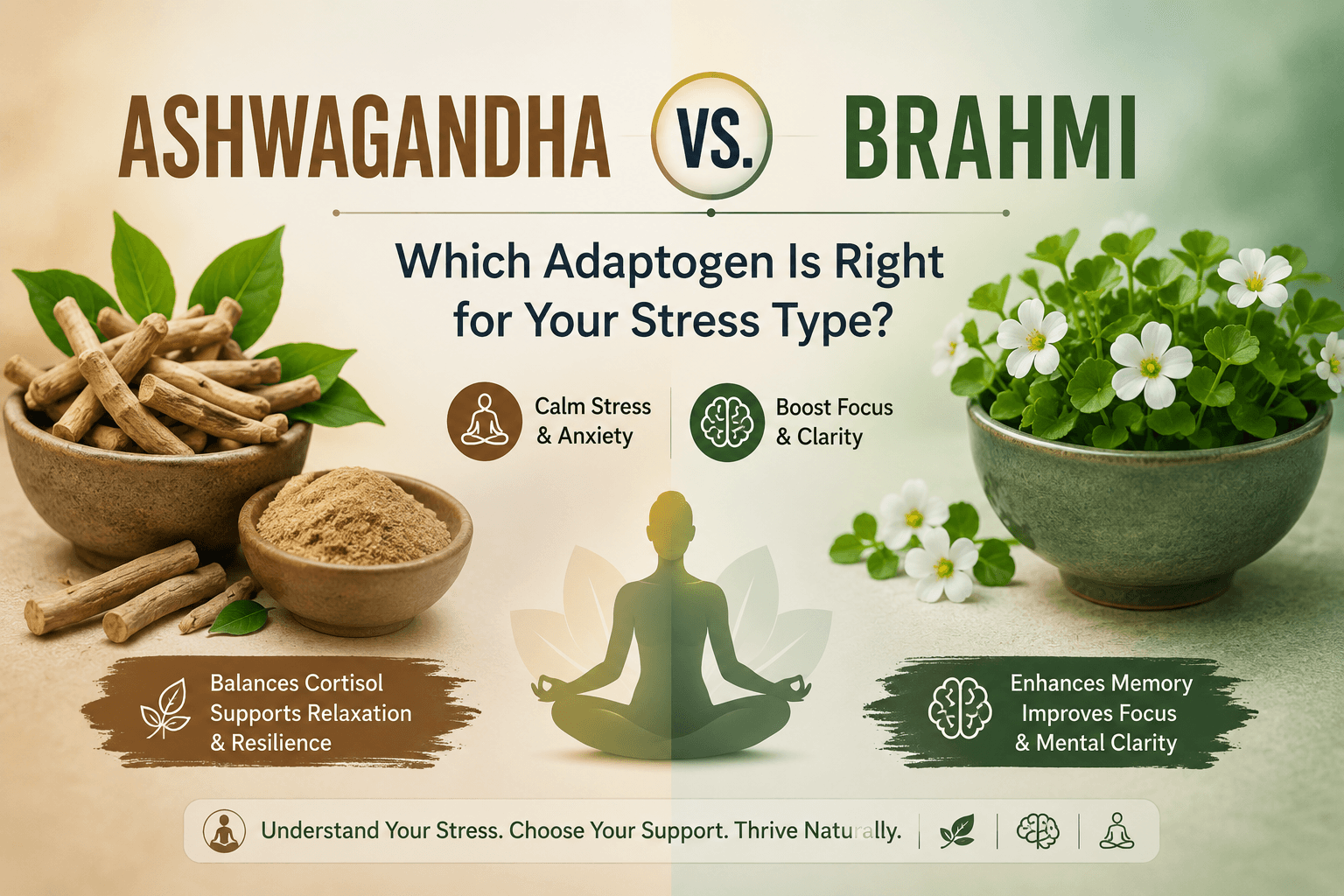
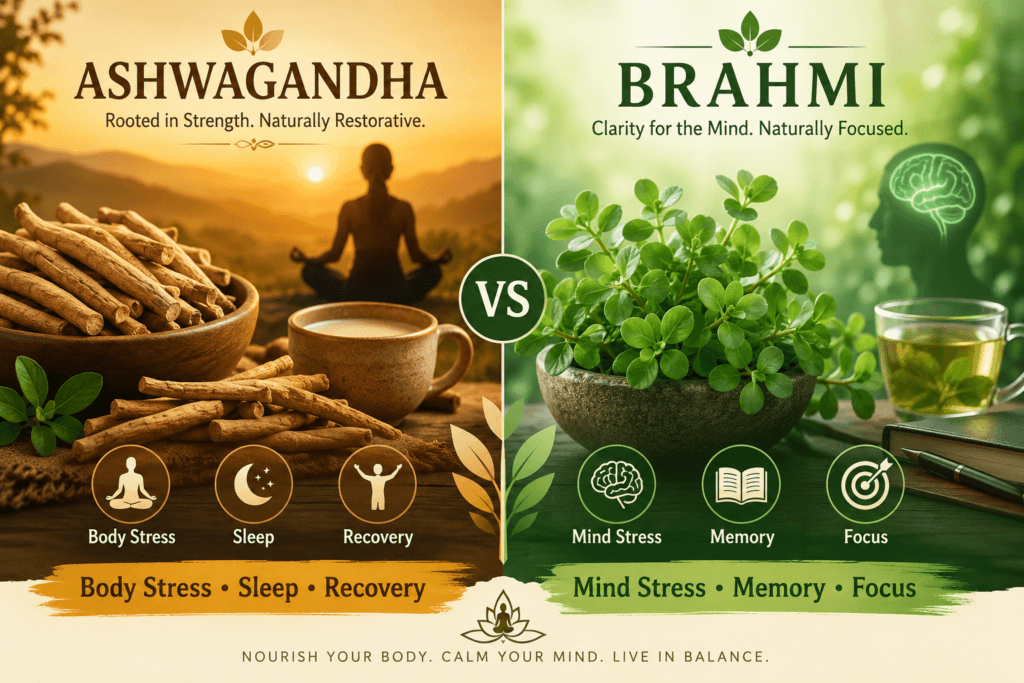 Stress does not look the same for everyone.For one person, stress feels like physical exhaustion, poor sleep, and feeling drained after months of pressure. For another, stress appears as endless thinking, difficulty focusing, and a mind that refuses to slow down.This is why two ancient Ayurvedic herbs—Ashwagandha and Brahmi—are often compared.Both have been used for centuries in traditional Indian wellness practices. Both are studied by modern researchers. But they do not work exactly the same way.Ashwagandha has become one of the most recognized Ayurvedic adaptogens worldwide. Brahmi has a smaller global profile, but it has a long reputation in Ayurveda as a herb. Traditionally associated with learning, memory, and mental clarity.This comparison is not about choosing the “stronger” herb. It is about understanding which one better matches your body, mind, and type of stress.
