
Table of Contents
ToggleRescue First, Teach Later: The Wellness Principle That Can Transform Lives
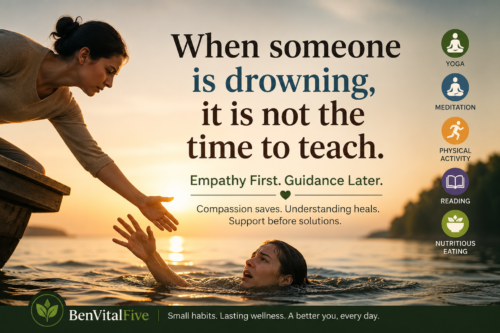
“When someone is drowning, it is not the time to teach.” — A saying commonly attributed to Japanese wisdom
Table of Contents
Introduction
Imagine walking beside a river and spotting someone struggling in deep, rapid water. Would you stand on the riverbank explaining the proper freestyle swimming stroke? Would you lecture them about lung capacity or criticize them for not taking lessons earlier?
Of course not. Your immediate instinct would be to extend a hand, throw a life ring, or jump in to save them. Only after they reached the safety of the dry shore would it be time to offer instruction.
This simple image captures one of the most vital yet overlooked lessons in health and wellness.
Many people today are drowning—not in water, but in stress, anxiety, loneliness, burnout, and chronic illness. They are utterly overwhelmed by information, surrounded by endless advice from social media, wellness influencers, and self-help books. Yet, despite having access to more information than any generation in human history, millions still struggle to live healthier, happier lives.
The reason is simple: people rarely need more data. First, they need compassion.
At BenVitalFive, we believe lasting health begins with understanding people exactly where they are before trying to change them. This philosophy anchors our Five Pillars of Wellness, which encourage balanced living through yoga, meditation, physical activity, reading, and wholesome nutrition.
If you are just beginning your path, our guide on the Wellness Journey for Beginners provides a practical, gentle foundation. True, sustainable change is built on daily habits rather than overnight transformations; our breakdown of Daily Wellness Habits for a Balanced Life explains how small, consistent actions create remarkable long-term results.
The principle of “Rescue First, Teach Later” reminds us that all true healing starts with basic humanity.
The Hidden Meaning Behind the Saying
At first glance, the saying appears obvious—naturally, you pull someone from a river before offering swimming lessons. Yet, beneath its simplicity lies a profound truth about human psychology: people cannot absorb wisdom while they are actively trying to survive.
A mind overwhelmed by fear cannot process instructions. A body exhausted by chronic stress cannot immediately adopt rigid, demanding routines. An anxious person cannot simply sit down and clear their mind just because an app tells them to, and someone battling deep depression may struggle to complete even the simplest daily task. Their immediate need is not education; it is basic, unconditional support.
This principle applies across every meaningful human interaction:
A compassionate doctor listens deeply to a patient’s life context before writing a prescription.
An effective teacher understands a student’s unique struggles before delivering a lecture.
A wise parent comforts an upset child before correcting their behavior.
A caring friend offers a silent, listening ear long before suggesting solutions.
When people feel safe, understood, and valued, their nervous systems settle. Only then do they develop the emotional bandwidth to embrace healthier behaviors.
Modern Wellness Has a Missing Ingredient
The wellness industry has exploded into a global phenomenon. Every single day, we are bombarded with advice regarding the perfect diet, the ideal morning routine, the ultimate exercise program, and the latest superfoods or supplements.
Information is everywhere. Transformation is not. The missing ingredient is empathy.
Imagine someone returning home after a grueling twelve-hour shift. They are mentally drained, physically exhausted, and have been sleeping poorly for weeks. If we step in and say, “You should wake up at 5 a.m., meditate for thirty minutes, complete a high-intensity workout, and meal-prep organic food,” our advice might be technically correct, but it is entirely useless to them in that moment.
Real wellness doesn’t start with a checklist; it begins by asking: “What is making your life heavy right now?”
Sometimes the answer is systemic burnout, grief, loneliness, or financial pressure. Only after we recognize these root causes can we offer meaningful support. For those navigating intense, ongoing pressure, our guide to Natural Ways to Reduce Stress offers gentle strategies that fit into a chaotic life. Similarly, our look at Mindfulness Exercises for Busy Professionals proves that even a few intentional minutes a day can rebuild emotional resilience.
When We Teach Before We Understand
One of the greatest missteps in modern wellness is assuming that everyone starts from the same baseline. In reality, every person carries an invisible story. One person may be quietly recovering from a chronic illness; another may be caring for an aging parent or grieving a sudden loss. Yet, from the outside, they are expected to perform normally.
This is why rigid judgment fails. Consider the classic advice given to someone trying to manage their weight: “Just eat healthier.” But what if they work erratic night shifts? What if fresh produce is financially or geographically inaccessible? What if emotional eating has been their only coping mechanism against trauma? The advice isn’t wrong—it is just incomplete.
True wellness requires us to look at the whole picture. At BenVitalFive, we emphasize a holistic approach where nutrition, movement, rest, mindfulness, and relationships work in harmony. For instance, sustainable eating must fit your actual life, a concept we explore deeply in Nutrition for Health and Wellness: A Complete Guide.
Even a basic need like hydration is frequently overlooked in favor of complex wellness trends. Our guide, The Role of Hydration in Diet and Body Health, explores how simply drinking enough water anchors energy and digestion long before you need to worry about complicated supplements.
Sometimes, the truest first step toward wellness isn’t a yoga pose or a strict meal plan. It is a raw conversation, a hand reached out in the dark, and the foundational belief that change is actually possible.
The Difference Between Advice and Support
Advice and support are both valuable tools, but they serve entirely different functions.
Advice tells people where they need to go. Support helps them believe they actually have the strength to get there.
Many wellness journeys falter because individuals receive an abundance of information but a shortage of encouragement. They already know they should exercise, sleep better, and eat whole foods. The obstacle isn’t a lack of knowledge; it is a lack of energy, time, or emotional safety.
Consider how different these two interactions feel:
| Type | Approach | Impact |
| Advice | “You really need to start exercising more.” | Points to the destination, often triggering guilt. |
| Support | “Would you like to take a quick 15-minute walk together after dinner?” | Walks alongside the traveler, removing the barrier to entry. |
People navigating difficult seasons of life do not need a lecture on perfection; they need companionship and practical patience. As wellness seekers and supportive friends, we must constantly ask ourselves: Are we listening before we speak? Are we encouraging instead of judging? Are we helping someone take just one achievable step today?
The Five Pillars of Compassionate Wellness
At BenVitalFive, wellness isn’t built on overnight miracles or extreme lifestyle overhauls. It is sustained by five interconnected pillars, each approached with self-compassion rather than self-inflicted pressure.
Pillar 1: Healthy Living Begins with Small Choices
Healthy living doesn’t mean upending your entire life for a strict regime. It is built on micro-decisions: drinking an extra glass of water, walking for ten minutes, or going to bed thirty minutes earlier. In our guides on a Healthy Daily Routine for Long-Term Wellness and Simple Self-Care Habits, we share realistic strategies designed to blend into your existing routine seamlessly.
Pillar 2: Yoga Meets You Where You Are
Yoga doesn’t care about your flexibility; it only requires your willingness to show up on the mat. It can be as simple as rolling your shoulders back after a long day at a desk or spending five minutes noticing your breath. Beginners can find a gentle entry point through Simple Yoga Practices for Daily Energy or our comprehensive Hatha Yoga for Beginners: Complete Guide. Progress is always measured by consistency, never complexity.
Pillar 3: Meditation Starts with One Quiet Moment
A common misconception is that meditation requires a perfectly blank, thoughtless mind. This impossible standard causes many beginners to quit. Meditation is simply the practice of gently bringing your attention back whenever your mind wanders.
Even a single minute of mindfulness can clear mental clutter. Explore our 5-Minute Morning Meditation Routine or the Pranayama for Anxiety guide to discover how intentional breathing can rapidly soothe an overstimulated nervous system.
Pillar 4: Reading Nourishes the Mind
In a world dominated by rapid digital algorithms, reading is an act of quiet resistance. Unlike mindless scrolling, picking up a book slows the heart rate, deepens empathy, and sharpens focus. Reading just a single page of meaningful text a day provides a grounding effect that screens simply cannot replicate, a philosophy we explore in our piece on Reading for Stress Relief vs. Scrolling.
Pillar 5: Nutrition Is an Act of Kindness Toward Yourself
Food should never be a source of guilt or anxiety. True nutrition is about nourishing your longevity, not punishing yourself with restriction. Instead of chasing erratic diet trends, focus on adding whole foods—vegetables, legumes, healthy fats, and fruits—into your day. Our 7-Day Anti-Inflammatory Meal Plan provides practical, delicious ideas that celebrate food as a source of vibrant life.
A Personal Reflection: What Rural Communities Taught Me
The most profound lesson I ever learned about wellness didn’t come from a university lecture hall or a medical text. It came from the years I spent working closely with rural communities across Tamil Nadu.
Many of the families I met lived with very limited material wealth, yet they possessed a deep, resilient well-being that modern cities are rapidly losing. Their wellness was communal. When a neighbor fell ill, the village showed up. When a family experienced a poor harvest, others shared their meals. Support was given automatically, long before anyone had to ask.
Furthermore, their daily health was naturally woven into the fabric of life. They moved their bodies constantly through manual work, ate fresh, seasonal food grown nearby, and gathered for long evening conversations instead of staring at screens. Children played under the open sky.
These beautiful, grounded experiences directly shaped the philosophy behind BenVitalFive. Our Five Pillars are simply a modern reflection of those rural truths: moving naturally, eating simply, resting deeply, keeping the mind sharp, and fiercely looking out for one another. In those villages, if someone was struggling, nobody handed them a book of advice. They handed them a hand. Wisdom always followed the help.
Small Acts That Rescue Before They Teach
Practicing compassion doesn’t require massive, dramatic gestures. The most powerful rescues happen through quiet, ordinary actions. You can actively choose to rescue before you teach by
Listening entirely without interrupting or formulating a counter-argument.
Validating someone’s effort when they make a clumsy or hesitant attempt at a healthier habit.
Offering to sit in silence or take a walk with a friend who is lonely.
Dropping off a home-cooked, nutritious meal for someone recovering from an illness or a loss.
Helping an elderly neighbor manage their groceries or yard work.
Sending a simple, expectation-free text to a colleague under immense stress.
These choices build a foundation of emotional safety. Knowledge can change a mind, but pure kindness has the power to change a life. When we combine both, true wellness occurs.
Practical Ways to Live This Principle Every Day
At Home
Family dynamics are often where we are quickest to dish out unsolicited advice. We tell our partners to eat better, our kids to put down their phones, and our parents to move more. Try shifting from directive to collaborative actions.
Instead of saying, “You spend way too much time staring at that screen,” gently propose an evening walk at a local park or a device-free family dinner. If you want to create a healthier home environment, our guide on [Digital Detox Benefits: Reduce Screen Time] offers actionable ways to disconnect from devices and reconnect with each other.
At Work
Many of our colleagues are quietly wrestling with heavy workloads, impending deadlines, and burnout. Before handing them a book on time management or a productivity tip, offer a small token of support. Take a stressful task off their plate if you have capacity, listen to them vent without offering a fix, or voice genuine appreciation for their presence.
If your own workplace stress has mounted, resources like [Mindfulness Exercises for Busy Professionals] can help you find calm in the middle of a chaotic day.
Common Mistakes on the Wellness Journey
When people decide to improve their lives, they often start with massive enthusiasm but inadvertently create roadblocks by attempting too much, too fast.
Mistake 1: Trying to Change Everything Overnight: Attempting a total lifestyle transformation in 24 hours is a recipe for quick burnout. Pick exactly one micro-habit—like drinking more water or stretching for five minutes—and lock it in first. Our guide on a [Healthy Morning Routine for Mind and Body] shows you how to build momentum step-by-step.
Mistake 2: Comparing Your Behind-the-Scenes to Someone Else’s Highlight Reel: Social media displays curated results, never the messy, inconsistent daily effort it took to get there. Your only benchmark should be who you were yesterday.
Mistake 3: Treating the Body While Ignoring the Mind: Wellness isn’t just about clean eating and gym metrics. Unresolved stress, isolation, and anxiety will impact your physical health just as deeply as a poor diet. Nurture your emotional landscape using our science-backed tools in [Overcoming Stress: Science-Backed Strategies].
Mistake 4: Chasing the Shortcut: The wellness market is flooded with quick fixes, detox teas, and miracle routines. True health is a slow, beautiful accumulation of ordinary daily choices.
Mistake 5: Viewing Rest as a Failure of Productivity: Recovery is an active, essential part of growth. Deep sleep, quiet reflection, and time spent in nature are not luxuries—they are fuel. You can design an optimal environment for recovery using our tips in [Healthy Evening Routine for Better Sleep and Wellness].
A Simple Seven-Day Action Plan
Transformation doesn’t require a massive leap; it requires a single, intentional direction. Try this low-pressure, seven-day challenge to integrate this philosophy into your life.
Engage in at least one conversation today where your sole goal is to listen deeply. Restrain yourself from offering solutions, fixes, or advice.
Go for a simple twenty-minute walk, ideally outside in nature. Focus entirely on the sensation of your feet hitting the ground, an approach we discuss in Daily Walking Benefits for Holistic Health.
Dedicate five quiet minutes to observing your natural inhalation and exhalation. If you’re unsure how to start, follow our gentle guide on Pranayama for Beginners: Techniques and Benefits.
Prepare one meal today focused entirely on whole ingredients—vibrant vegetables, grains, and clean proteins. Keep a water bottle nearby and prioritize basic hydration using insights from Superfoods That Improve Overall Health Naturally.
Set a timer, put your phone in another room, and spend twenty uninterrupted minutes reading a physical book or a deeply thoughtful article to calm your nervous system.
Reach out to someone in your life who might be struggling. Send a text, make a phone call, or visit them just to say, “I’m thinking of you, and I’m here if things are heavy
Take a few minutes to look back on your week. Ask yourself: When did I feel most aligned? Which small habit felt easiest to maintain? How can I bring this calm into next week?
Key Takeaways
- Empathy Over Education: Compassion must always precede correction.
- Safety Generates Change: True trust and healing occur only when an individual feels safe and understood.
- Small Steps Matter: Sustainable, microscopic habits consistently outperform massive, sudden lifestyle overhauls.
- People Over Perfection: Wellness is entirely about honoring human beings, not meeting flawless, unrealistic standards.
- Holistic Health: Mental, emotional, and social health demand the exact same dedication as physical fitness.
Frequently Asked Questions
What should I do if someone I care about is making unhealthy choices but refuses my advice?
Step back from giving advice entirely and pivot to offering pure support. Instead of highlighting what they are doing wrong, ask how you can help make their daily life easier. Often, when people stop feeling judged or pressured to change, their defensiveness drops, and they become far more open to making healthier choices on their own terms.
How can I apply the “Rescue First” principle to myself when I am burned out?
Treat yourself like a friend who is drowning. When you are deeply burned out, it is not the time to force yourself into a punishing new 5 a.m. workout routine or an extreme diet. “Rescuing” yourself means stripping away non-essential demands, focusing purely on basic needs like deep rest, simple hydration, and gentle movement, and letting go of perfectionist guilt.
Does “Rescue First, Teach Later” mean I should never offer health or wellness advice?
Not at all. It simply means timing is everything. Advice is incredibly valuable, but only when the recipient has the stability, energy, and mental clarity to receive it. Ensure someone is on safe ground and feels completely supported by you before you begin offering strategies for change.
Conclusion
At its core, “Rescue First, Teach Later” is an invitation to bring humanity back to the center of wellness. We live in a world that is incredibly wealthy in information but desperately bankrupt in basic empathy. True health cannot be forced through strict rules, critical judgment, or overwhelming checklists of things we should be doing.
People do not change because they are criticized into submission; they change because they feel seen, valued, and fiercely supported. The next time you see someone in your life—or even yourself—struggling to keep their head above water, leave the instruction manual on the shore. Extend a hand first. The wisdom can wait until everyone is safely back on land.

