
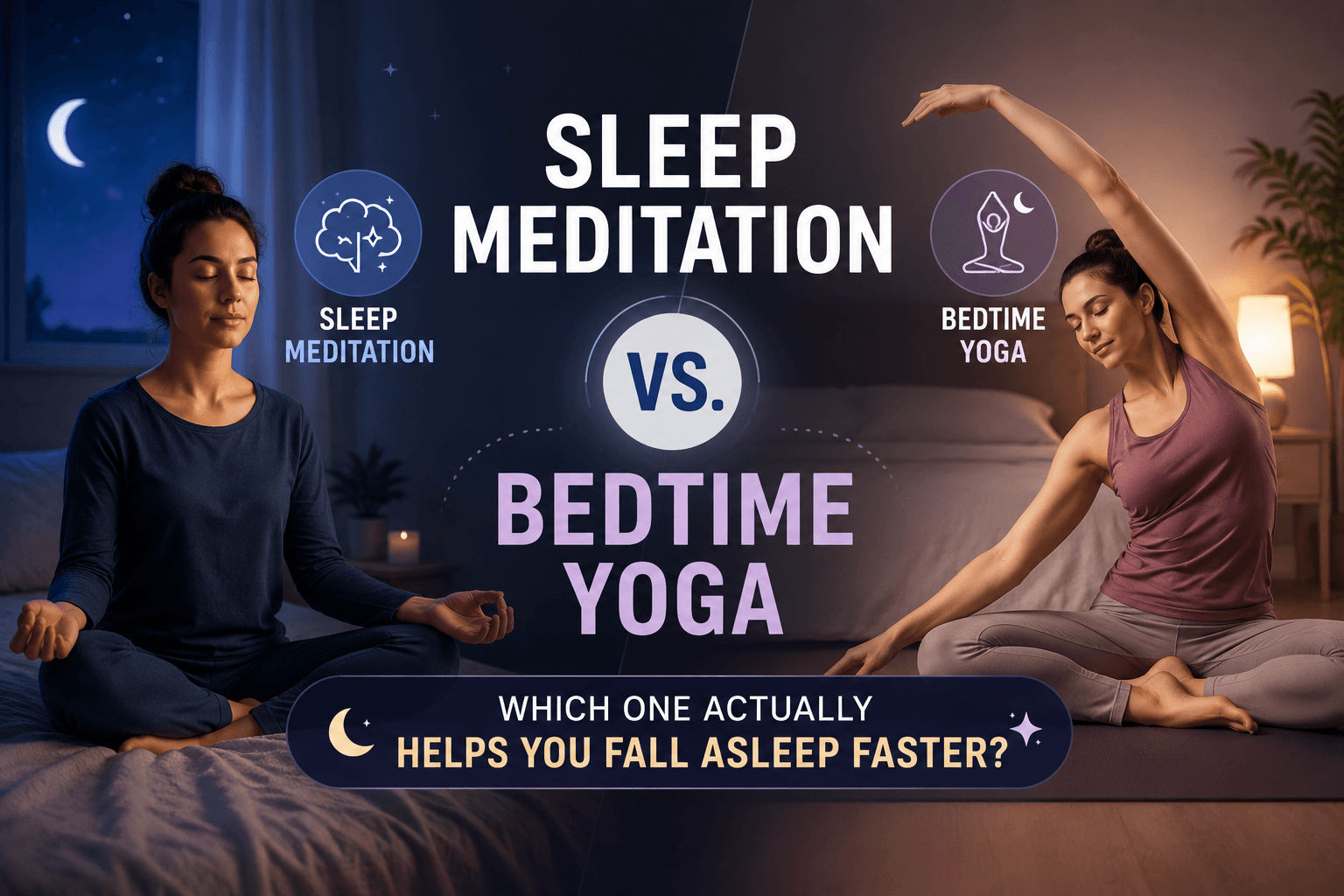
You’ve been lying there for forty minutes. Eyes closed, mind wide open. Does your body need movement, or silence?
This question comes up more than you’d think, especially among people who’ve already cut the caffeine, dimmed the screens, and still find themselves staring at the inside of their eyelids at midnight.
Sleep meditation and bedtime yoga both promise rest. But they work through completely different doors. And depending on what’s keeping you awake — a racing mind, a tight body, or both — one will almost always work better for you than the other.
Here’s what each actually does, and how to figure out which one your nights are asking for.
Why Sleep Is a Nervous System Problem, Not a Willpower Problem
Before we compare the two practices, it helps to understand why sleep feels impossible in the first place. The body shifts into sleep through the parasympathetic nervous system — the “rest and digest” mode. Most modern evenings keep us stuck in sympathetic overdrive, the alert, reactive state your body uses for navigating deadlines and difficult conversations.
Both meditation and bedtime yoga are parasympathetic activators. But they reach that state from opposite directions.
What Sleep Meditation Actually Does
Sleep meditation doesn’t ask your body to do anything. It asks your mind to stop doing. That’s a harder task than it sounds.
When you sit or lie quietly and follow a guided voice, a body scan, or simply your own breath, you’re training the prefrontal cortex to let go of narrative. The stories, the replays, the tomorrow-planning — meditation gradually drains the charge from all of that.
Research from the Harvard Medical School has shown that mindfulness meditation can reduce pre-sleep cognitive arousal — the mental chatter that keeps people awake. It doesn’t knock you unconscious; it creates the conditions under which your body can do what it already knows how to do.
Sleep Meditation Works Best When:
- Your problem is mental, not physical — you feel tired but your mind won’t quiet
- You’ve had an emotionally charged day and need to process before sleeping
- You wake in the middle of the night and can’t return to sleep
- You dislike physical movement close to bedtime
What Bedtime Yoga Actually Does
Bedtime yoga takes a physical route to the same destination. Slow, held poses — think child’s pose, legs-up-the-wall, supported fish — work directly on the fascia and the nervous system simultaneously.
The fascia (the connective tissue wrapping your muscles) holds tension from the day. When you sit at a desk, drive, or carry stress in your shoulders and hips, that tension doesn’t automatically release when you lie down at night. Bedtime yoga gives it somewhere to go.
The slow breathing that accompanies yin-style or restorative yoga also activates the vagus nerve — the primary conductor of your parasympathetic nervous system.
Bedtime Yoga Works Best When:
- Your problem is physical — tight hips, a sore back, restless legs
- You feel physically wired even when you’re tired
- You’ve been sedentary all day and your body hasn’t moved enough
- You’re a kinesthetic person who finds stillness more frustrating than helpful
The Head-to-Head: What the Evidence Says
A 2019 study published in JAMA Internal Medicine found that mindfulness meditation programs significantly improved sleep quality compared to sleep hygiene education alone. Participants fell asleep faster and reported less daytime fatigue.
On the yoga side, a review in the Journal of Clinical Sleep Medicine found that yoga interventions improved sleep efficiency, reduced nighttime waking, and lowered insomnia severity — particularly in older adults and those with chronic stress.
Neither practice “wins.” They work through different mechanisms. Which is better depends entirely on which mechanism your body needs.
The Combination That Most People Miss
Here’s something both research and experienced practitioners agree on: the order matters.
If you’re going to use both, do a short yoga sequence first — 10 to 15 minutes of slow, floor-based movement — and then move into meditation. The physical release gives the mind something to settle into. Trying to meditate when your body is still vibrating from the day is like trying to write in a room that’s still being renovated.
Movement first. Stillness after. Sleep comes more naturally when the body has already arrived somewhere calm.
A Simple Decision Guide
Racing thoughts, anxiety, overthinking: → Start with sleep meditation
Physical tension, restlessness, body discomfort: → Start with bedtime yoga
Combination of both: → 10 min yoga → 10 min meditation
Middle-of-the-night waking: → Meditation (no movement required)
Practical Starting Points
For Sleep Meditation:
- Body scan meditation: systematically release tension from feet to head
- 4-7-8 breathing: inhale 4 counts, hold 7, exhale 8
- NSDR (Non-Sleep Deep Rest): a science-backed guided relaxation protocol
For Bedtime Yoga (15-Minute Sequence):
- Child’s pose — 3 minutes
- Supine spinal twist — 2 minutes each side
- Legs-up-the-wall — 5 minutes
- Savasana with conscious breathing — 3 minutes
One Last Thought
Sleep trouble is rarely just one thing. It’s worth paying attention to whether your nights are more about a mind that won’t stop or a body that won’t release. That distinction, more than any comparison study, will point you toward your answer.
Both practices are worth having. Knowing which door to walk through tonight is the real skill.

