
There’s a difference between rest and recovery. Restorative yoga is the latter.
Most of us are familiar with the kind of rest that doesn’t actually restore us. You sit on the couch, you scroll, you watch something. The hours pass. You go to bed and wake up still feeling behind.
This is because passive rest doesn’t address what chronic stress actually does to the body. It doesn’t discharge the accumulated tension held in the fascia, it doesn’t reset the nervous system’s threat-detection baseline, and it doesn’t shift the body out of the low-level sympathetic activation that most modern people walk around in constantly.
Restorative yoga does those things. Not through effort — quite the opposite. Through deliberate stillness in positions that allow the body to genuinely release.
How Restorative Yoga Works
In active yoga, the muscles work. In restorative yoga, they’re fully supported — by bolsters, blankets, blocks, or the floor — and asked to do nothing. The poses are held for extended periods, typically 5 to 15 minutes each.
This extended passive holding activates the parasympathetic nervous system through the vagus nerve, reduces cortisol, and initiates what’s sometimes called a “relaxation response” — a measurable physiological state that’s the neurological opposite of the stress response.
You don’t need special props. Folded blankets replace bolsters. Books replace blocks. A wall replaces anything it can.
The 7 Poses
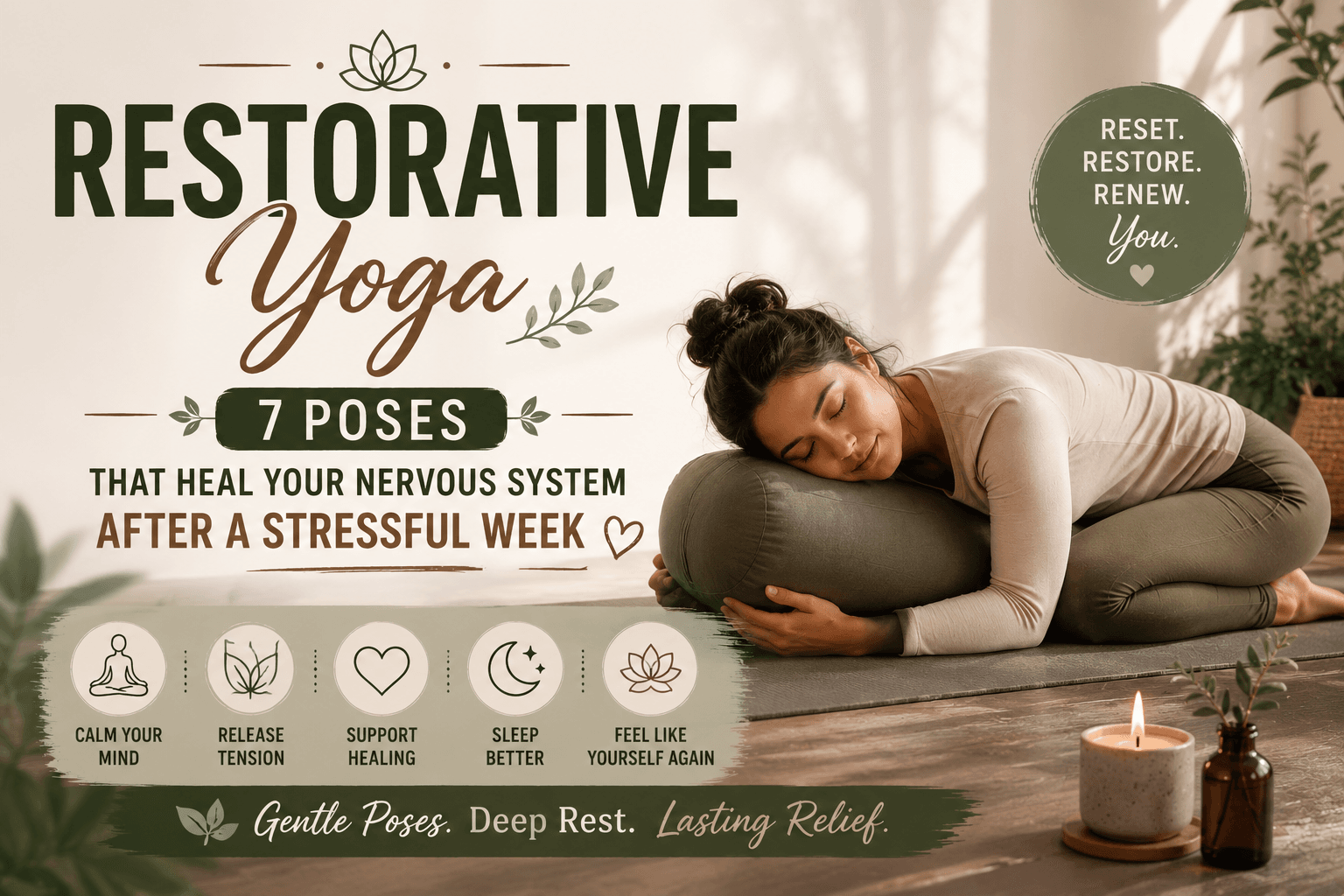
1. Supported Child’s Pose (Balasana)
Place a folded blanket or pillow on your thighs and fold forward, letting your torso rest completely. Arms can extend forward or rest alongside your body. Hold for 5–10 minutes.
This pose releases the lower back, hips, and shoulders simultaneously. The pressure on the abdomen provides gentle stimulation to the vagus nerve through the gut.
2. Legs-Up-the-Wall (Viparita Karani)
Sit sideways against a wall, then swing your legs up and lie back. Your sitting bones should be close to the wall, your legs resting vertically. Hold for 10–15 minutes.
This is one of the most studied restorative poses. The reversal of blood flow from the legs toward the heart calms the cardiovascular system. People who practice this regularly report reduced anxiety and improved sleep.
3. Supported Bridge Pose
Lie on your back, place a block or firm pillow under your sacrum (the flat bone at the base of the spine), and let your hips rest on the support. Hold for 5–10 minutes.
This gentle inversion opens the chest and counteracts the forward-folded posture most people hold during desk work. It releases the psoas muscle, which is one of the primary muscles that tenses in the stress response.
4. Reclined Bound Angle (Supta Baddha Konasana)
Lie on your back, bring the soles of your feet together, and let your knees fall to the sides. Place support under each knee if the inner thighs are very tight. One hand on the belly, one on the chest. Hold for 10 minutes.
This is the restorative pose for anxiety. The open hip position releases the adductor muscles, which carry a surprising amount of tension. The hand placement encourages diaphragmatic breathing.
5. Side-Lying Savasana
Lie on your right side with a pillow between your knees and another under your head. Keep your spine in a natural curve. This is the preferred savasana for anyone who experiences discomfort lying flat.
The right-side position particularly supports digestion and puts the heart in a slightly less pressured position. Hold for 10–15 minutes.
6. Supported Seated Forward Fold
Sit with legs extended. Place a bolster or folded blankets on your thighs, then fold forward and rest your torso and head on the support. Hold for 5–8 minutes.
Forward folds activate the parasympathetic nervous system more reliably than backbends. This supported version removes the hamstring tension that makes most forward folds more effort than rest.
7. Full Savasana with Eye Pillow
Lie flat, a folded blanket under the knees, an eye pillow or cloth covering the eyes. Do nothing. Stay for 15 minutes.
Blocking light through the eyes, particularly with slight pressure from an eye pillow, stimulates the oculocardiac reflex, which slows the heart rate. Savasana isn’t sleeping. It’s conscious rest, and it’s neurologically distinct from both sleep and ordinary waking.
Putting a Session Together
You don’t need to do all seven in one session. A 45-minute restorative practice might be:
- Supported Child’s Pose — 7 minutes
- Reclined Bound Angle — 10 minutes
- Legs-Up-the-Wall — 12 minutes
- Full Savasana — 15 minutes
That’s it. No transition, no flow, no effort. Just a sequence of held positions that progressively deepen the body’s move into rest.
The week carries weight. Restorative yoga is how you set it down. Not gradually, not with effort — just by giving your body the conditions it needs to release what it’s been holding.

