
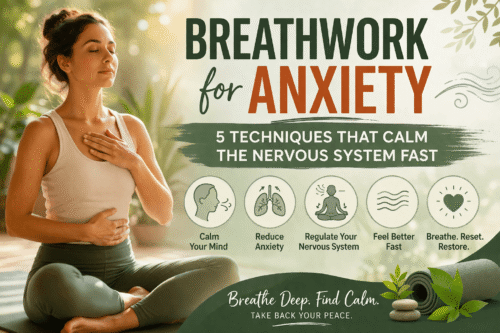
Breathing Exercises for Anxiety: 5 Science-Backed Techniques That Work Fast
Introduction
Anxiety can feel overwhelming. But breathing exercises for anxiety are one of the fastest, proven ways to calm your mind and body. Unlike medicine or complex therapy, your breath is always with you.Used the right way, it can lower anxiety in minutes.
According to the World Health Organization, anxiety disorders affect over 300 million people worldwide. Yet most people overlook a powerful fact:
Your breath directly controls your nervous system.
In this guide, you’ll learn how breathing exercises work, plus 5 powerful techniques you can use immediately for fast anxiety relief.
The Science: Why Breathing Controls Anxiety
When anxiety strikes, the sympathetic nervous system activates what is commonly called the fight-or-flight response. Heart rate rises, breathing becomes shallow and rapid, muscles tense, and stress hormones like cortisol and adrenaline flood the body.
Here is the key insight: this process works in reverse. By deliberately slowing and deepening the breath, you activate the vagus nerve — the longest nerve in the body — which signals the parasympathetic nervous system to switch the body into calm mode.
Research from Stanford University published in Science (2023) identified specific neurons in the brainstem that link breath rhythm directly to emotional state. The study confirmed that slow, controlled breathing activates calming neurons and reduces the intensity of anxiety responses.
You are not just relaxing. You are using your breath to biologically override the anxiety response.
What Are the Best Breathing Exercises for Anxiety? (Quick Answer)
The most effective breathing exercises for anxiety are:
- 4-7-8 breathing → best for sleep and rapid calming
- Box breathing → best for stress and focus
- Physiological sigh → fastest relief for panic
- Resonance breathing → best for long-term anxiety
- Alternate nostril breathing → best for mental balance
These techniques work by activating the parasympathetic nervous system, helping your body shift from stress to calm.
Why Breathing Exercises Work for Anxiety (Science Explained)
When anxiety hits, your body activates the fight-or-flight response:
- Heart rate increases
- Breathing becomes shallow
- Cortisol and adrenaline spike
But here’s the key:
This system works both ways.
By slowing your breathing, you stimulate the vagus nerve, which activates your body’s relaxation response.
Research from Stanford University (published in Science, 2023) shows that specific breathing patterns directly influence brain activity and emotional regulation.
In simple terms:
You can biologically override anxiety using your breath.
5 Powerful Breathing Exercises for Anxiety (Step-by-Step)
1. 4-7-8 Breathing (The Relaxation Breath)
Developed by Dr. Andrew Weil and based on pranayama traditions, the 4-7-8 technique is one of the most widely studied breathing exercises for acute anxiety. It works by extending the exhalation, which activates the parasympathetic nervous system.
How to practice:
How to do it:
- Inhale through your nose for 4 seconds
- Hold for 7 seconds
- Exhale slowly for 8 seconds
- Repeat for 4 cycles
Best for:
- Sleep anxiety
- Nighttime overthinking
- Pre-event nerves
Effect: Calm within ~60 seconds
2. Box Breathing (The Military Method)
Box breathing, also called square breathing or Sama Vritti in yoga, creates a perfectly balanced breathing cycle. It is used by Navy SEALs, surgeons, and professional athletes to perform under pressure. Its power lies in its simplicity and the mental focus it requires.
Box breathing creates a balanced rhythm that stabilizes your nervous system.
How to do it:
- Inhale for 4 seconds
- Hold for 4 seconds
- Exhale for 4 seconds
- Hold for 4 seconds
Repeat for 5–10 minutes.
Best for:
- Work stress
- Performance anxiety
- Daily anxiety management
3. Physiological Sigh (The Fastest Anxiety Reset)
Discovered by researchers at Stanford and the University of California, the physiological sigh is described as the fastest known way to reduce acute stress. It involves a double inhalation followed by a long, slow exhalation.
This technique works because the double inhalation re-opens collapsed air sacs (alveoli) in the lungs, maximizing oxygen exchange. The extended exhalation then activates the vagus nerve powerfully.
This technique is backed by research from Stanford University and is considered the fastest way to reduce stress.
How to do it:
- Take a deep inhale through your nose
- Take a second, quick inhale
- Exhale slowly through your mouth
Repeat 1–3 times.
Best for:
- Panic attacks
- Sudden stress
- Immediate relief
Effect: Often works in a single breath
4. Resonance Breathing (Coherent Breathing)
Resonance breathing involves breathing at a rate of exactly 5 to 6 breaths per minute, which creates heart rate variability (HRV) coherence — a state in which the heart, lungs, and brain are operating in optimal synchrony. Studies published in Frontiers in Psychology show that this technique significantly reduces anxiety and improves emotional regulation.
Also called coherent breathing, this method improves heart rate variability (HRV), a key marker of stress resilience.
How to do it:
- Inhale for 5 seconds
- Exhale for 5 seconds
- Continue for 10–20 minutes
Best for:
- Chronic anxiety
- Emotional regulation
- Nervous system balance
5. Nadi Shodhana (Alternate Nostril Breathing)
From the yogic tradition, Nadi Shodhana balances the two hemispheres of the brain and calms the nervous system. Research published in the International Journal of Yoga found that Nadi Shodhana significantly reduces anxiety scores and normalizes heart rate variability in anxious individuals.
Rooted in yogic tradition, this technique balances brain hemispheres and reduces stress.
How to do it:
- Close right nostril → inhale left
- Close both → pause
- Open right → exhale
- Repeat on opposite side
Best for:
- Mental clarity
- Meditation preparation
- Racing thoughts
Breathing Techniques Comparison Table
| Technique | Best For | Time to Work |
|---|---|---|
| Physiological sigh | Panic attacks | Seconds |
| 4-7-8 breathing | Sleep anxiety | 1–2 minutes |
| Box breathing | Stress & focus | 5 minutes |
| Resonance breathing | Chronic anxiety | 10–20 minutes |
| Alternate nostril | Mental clarity | 5–10 minutes |
Building a Daily Breathwork Practice for Anxiety
The most effective approach is to use breathwork both preventively (daily practice to reduce baseline anxiety) and responsively (in the moment when anxiety spikes).
A simple daily routine:
- Morning — 5 minutes of Box Breathing to set a calm tone for the day
- Midday — 3 Physiological Sighs if stress builds during work
- Evening — 10 minutes of Resonance Breathing to decompress
- Before sleep — 4 cycles of 4-7-8 Breathing to transition into rest
What Breathwork Cannot Replace
Breathwork is a powerful tool, but it is one component of a comprehensive approach to anxiety management. Chronic or severe anxiety benefits most from a combination of breathwork, regular physical activity, adequate sleep, meaningful social connection, and — when necessary — professional psychological support.
At BenVitalFive, we see breathwork as the bridge between the body and mind — accessible to everyone, immediately effective, and deeply aligned with our philosophy of living long and living quietly.
Key Takeaways
- Breathwork directly activates the parasympathetic nervous system, providing a biological override of the anxiety response
- The Physiological Sigh is the fastest technique for acute anxiety relief — often effective in a single breath
- Box Breathing and Resonance Breathing are best for daily anxiety management
- Consistency matters more than duration — even 5 minutes daily creates measurable results

