Table of Contents
- Introduction
- Why Physical Exercise Matters (Especially for Beginners)
- A Beginner’s Mindset: The Missing Piece
- How to Start Exercising Safely as a Beginner
- Simple Exercises That Actually Work
- How to Stick to Your Exercise Routine Long-Term
- A Realistic Beginner Weekly Exercise Plan
- Common Beginner Mistakes (and How to Avoid Them)
- Final Thoughts
- FAQs
- References
- About the Author
Introduction
Starting physical exercise can feel intimidating — especially if you haven’t worked out in years or ever. Many beginners believe they need intense workouts, perfect motivation, or a “fitness personality” to succeed. That belief alone stops more people than laziness ever does.From years of reviewing health research and observing real beginners, one truth stands out:
successful fitness routines are built on simplicity, not intensity.This guide focuses on how beginners can start exercising safely, enjoy the process, and turn movement into a habit — not a short-lived challenge.
Why Physical Exercise Matters (Especially for Beginners)
Physical exercise is often marketed as a way to change how you look. But for beginners, the
real benefits show up much sooner and matter far more.
Key Benefits You’ll Notice First
- Improved energy levels— movement improves blood flow and oxygen delivery
- Better mood and mental clarity— exercise triggers endorphins and dopamine
- Reduced stress and anxiety— even light movement calms the nervous system
- Stronger joints and muscles— protecting you from future injuries
- Improved sleep quality— one of the fastest benefits beginners notice
According to the
World Health Organization, even moderate physical activity significantly reduces the risk of heart disease, depression, and metabolic disorders — benefits that begin within weeks, not years.
Internal link suggestion: “Benefits of Light Exercise for Mental Health”
A Beginner’s Mindset: The Missing Piece
One of the biggest mistakes beginners make is thinking exercise needs to be hard to be effective.In reality:
- Consistency beats intensity
- Gentle progress beats motivation
- Habit beats willpower
A beginner who walks 15 minutes daily will outperform someone who does extreme workouts once a month. Progress comes from showing up, not suffering.
How to Start Exercising Safely as a Beginner
1. Start Smaller Than You Think You Should
If you believe you can handle 30 minutes, start with 15.This builds:
- Confidence
- Injury resistanceHabit momentum
Example:One beginner I observed committed to “just 10 minutes after dinner.” Six months later, exercise felt automatic — not forced.
2. Choose Movements That Fit Your Life
You don’t need a gym. Beginners often succeed faster with familiar movements:
- Walking around the neighborhood
- Stretching while watching TV
- Bodyweight exercises at home
- Short online beginner workouts
Internal link suggestion: “At-Home Workouts for Absolute Beginners”
3. Protect Your Body Early
Mild soreness is normal. Sharp pain is not.Always:
- Warm up for 3–5 minutes
- Stretch lightly after workouts
- Rest when your body feels overwhelmed
If you have medical conditions or long-term inactivity, consult a healthcare professional before starting.
Simple Exercises That Actually Work for Beginners
These movements build strength and confidence without complexity:
- Walking– improves heart health and joint mobility
- Chair squats– strengthens legs and balance
- Wall push-ups– builds upper body strength safely
- Gentle yoga or mobility work– reduces stiffness and stress
You don’t need more than this in the beginning.
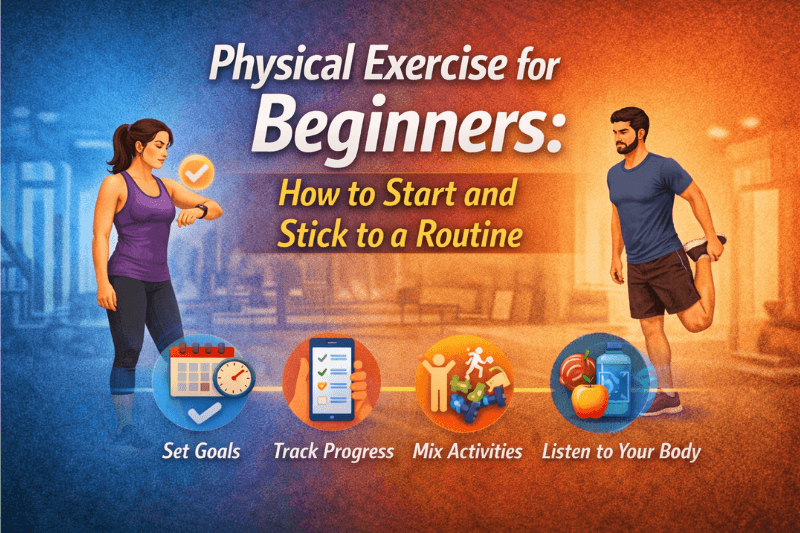
Physical Exercise for Beginners: How to Start and Stick to a Routine
What Is Physical Exercise for Beginners?
Physical exercise for beginners means simple, low-impact movements designed to improve health, energy, and strength without overtraining or injury. It focuses on consistency, safety, and gradual progress rather than intensity.
How Should Beginners Start Exercising?
Beginners should start exercising by following three simple rules:
- Start small(10–20 minutes per session)
- Choose easy, enjoyable activities
- Exercise consistently, not intensely
This approach helps build long-term habits while reducing injury and burnout.
Why Is Physical Exercise Important for Beginners?
Physical exercise helps beginners improve both physical and mental health.
Key Benefits:
- Improves heart health and circulation
- Increases daily energy levels
- Reduces stress, anxiety, and low mood
- Supports healthy weight management
- Improves sleep quality
According to the World Health Organization, even moderate physical activity significantly lowers the risk of chronic disease.
What Are the Best Exercises for Beginners?
The best exercises for beginners are simple, low-impact, and easy to repeat.
Beginner-Friendly Exercises:
- Walking
- Light jogging or cycling
- Chair squats
- Wall push-ups
- Stretching or gentle yoga
These exercises build strength, mobility, and confidence without overwhelming the body.
How Often Should Beginners Exercise?
Beginners should exercise
3 to 5 days per week.
Recommended Schedule:
- Start with short sessions
- Allow rest days
- Gradually increase duration
- Consistency matters more than workout length.
How Long Should Beginner Workouts Last?
Beginner workouts should last
15 to 30 minutes per session.Short workouts are easier to maintain and still provide health benefits when done regularly.
How Can Beginners Stick to an Exercise Routine?
Beginners stick to exercise routines by making them simple and predictable.
Proven Tips:
- Exercise at the same time each day
- Attach workouts to daily habits (after meals, before bed)
- Track how you feel, not just time or calories
- Accept missed days and restart without guilt
Habit formation is more effective than motivation.
Is It Normal to Feel Sore After Starting Exercise?
Yes,
mild muscle soreness is normal when starting a new routine.However:
- Sharp pain is not normal
- Dizziness or joint pain means you should stop
- Rest days help muscles recover and grow
Always listen to your body.
Common Beginner Mistakes (and How to Avoid Them)
| Do’s | Don’t |
| Start slow and build weeklyCompare yourself to yesterdayResume without guilt | Doing too much too fast Comparing yourself to others Quitting after a missed day
|
Simple Weekly Exercise Plan for Beginners
| Day | Activity | Time |
| Monday | Walking | 20 minutes |
| Tuesday | Bodyweight exercises | 15 minutes |
| Wednesday | Stretching or yoga | 20 minutes |
| Thursday | Walking or light jog | 20 minutes |
| Friday | Strength training | 15 minutes |
| Saturday | Fun activity | 30 minutes |
| Sunday | Rest or mobility | 10 minutes |
This plan can be adjusted to fit any schedule.
Final Answer: How Should Beginners Approach Exercise?
Beginners should approach exercise by focusing on
small steps, simple movements, and consistency. Starting slow and exercising regularly leads to better health, improved energy, and long-term success.
Frequently Asked Questions
How often should beginners exercise?
3–5 days per week is ideal.
Can beginners exercise at home?
Yes, bodyweight exercises and walking are enough to start.
What is the easiest exercise for beginners?
Walking is the easiest and most effective beginner exercise.
Do beginners need gym equipment?
No. Most beginner routines require no equipment.
Final Thoughts
Exercise isn’t a punishment for your body — it’s a signal of care.For beginners, success comes from:
- Small steps
- Simple movements
- Repetition over time
Start where you are. Move a little. Repeat tomorrow.That’s how lasting change happens.
FAQs
How often should beginners exercise?
3–5 days per week is ideal.
How long should beginner workouts last?
15–30 minutes is more than enough.
Is soreness normal?
Yes, mild soreness is normal. Pain is not.
What if I miss a workout?
Nothing happens — resume the next day.
References
World Health Organization – Physical Activity Guidelines
https://www.who.int/news-room/fact-sheets/detail/physical-activityHarvard Medical School – Exercise and Mental Health
https://www.health.harvard.edu/mind-and-mood/exercise-is-an-all-natural-treatment-to-fight-depressionCDC – Benefits of Physical Activity
https://www.cdc.gov/physicalactivity/basics/pa-healthAbout the Author
Jesuraj is a dedicated wellness researcher and health optimization enthusiast specializing in the intersection of ancient herbalism and modern neuroscience. With a passion for evidence-based supplementation, Jesuraj spends hundreds of hours analyzing clinical studies and lab reports to help readers cut through the marketing noise. Through this platform, they aim to empower individuals to reclaim their mental clarity and physical vitality using the world’s most potent natural adaptogens.