
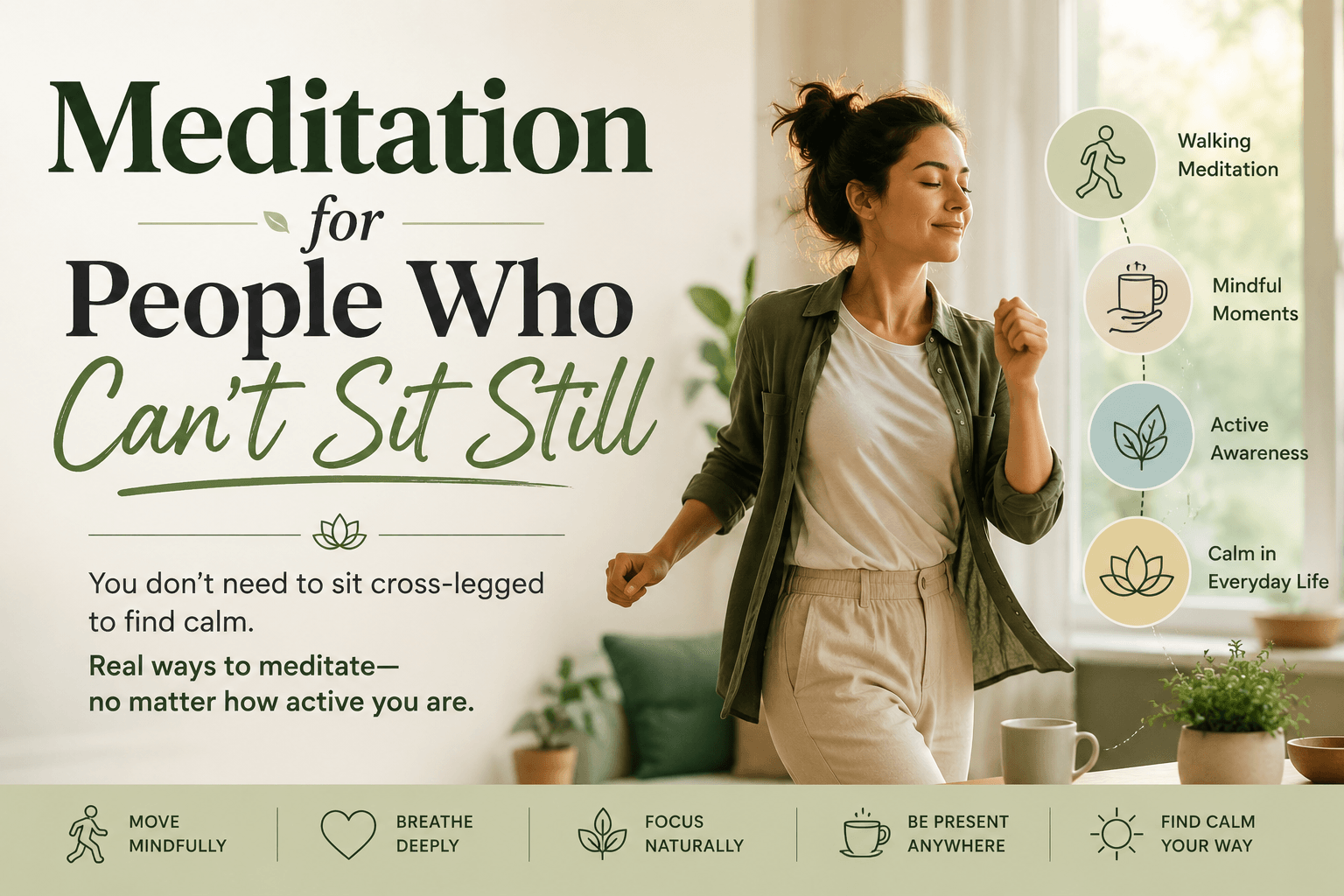
Meditation for People Who Can’t Sit Still
You don’t need to stop thinking to start meditating—you only need to notice when your mind wanders and gently bring it back.
The Biggest Myths About Meditation
If you’ve ever tried meditation and given up after a few minutes because your mind wouldn’t stop racing or your body felt restless, you aren’t alone. Many people abandon the practice because of common misconceptions that set them up for frustration:
Myth 1: “I need to empty my mind.” Your brain is designed to think. Meditation isn’t about eliminating thoughts; it’s about becoming aware of them without getting carried away. Every time you notice your attention has wandered and gently guide it back, you are strengthening your mental focus.
Myth 2: “I must sit perfectly still like a statue.” Stillness isn’t a requirement for mindfulness. If sitting still makes you anxious or fidgety, movement-based techniques like walking or gentle stretching work just as well.
Myth 3: “Longer sessions are always better.” Committing to 30 minutes right away often leads to burnout. Consistency matters far more than duration—five focused minutes every day build a stronger habit than a long session once a month.
Myth 4: “Meditation is strictly spiritual.” While it has roots in ancient traditions, modern mindfulness is widely used in healthcare, athletic performance, and workplaces simply to lower stress, improve focus, and sharpen emotional regulation.
Think of meditation like exercising a muscle. The benefit doesn’t come from holding a weight perfectly still, but from the repeated motion of lifting and returning it. In meditation, the “rep” is simply noticing a distraction and bringing your attention back to the present moment.
How Meditation Actually Works: Attention Training
Many beginners try to force their minds into silence, but the harder you try to stop thinking, the louder your thoughts seem to get. A better approach is to treat meditation as attention training.
Imagine watching clouds drift across the sky. Instead of chasing a cloud or trying to push it away, you simply observe it passing by. Thoughts work the same way: they naturally arise, stay for a moment, and fade. Your role isn’t to fight them, but to notice them and gently return your focus to an anchor, such as your breath, movement, or physical surroundings.
Why Our Minds Wander So Easily
Have you ever noticed how quickly your thoughts jump from your breath to an unfinished email or tomorrow’s schedule? This is completely normal.
A landmark study from Harvard University revealed that people spend nearly 47% of their waking hours thinking about something other than what they are currently doing. Meditation doesn’t stop this natural tendency—it simply helps you recognize it faster so you spend less time lost in thought.
Active & Movement-Based Techniques for Restless Minds
If sitting in silence feels impossible, traditional seated focus isn’t your only option. These active techniques let you train your attention without forcing physical stillness.
1. Walking Meditation (Best for Restless Energy)
Walking meditation transforms physical movement into an anchor for mindfulness. Instead of walking to reach a destination, your focus rests entirely on the physical experience of moving.
How to practice:
Choose a quiet path—a hallway, backyard, or local park.
Walk at a slow, comfortable pace.
Pay close attention to physical sensations: your feet contacting the ground, the weight shift between steps, your breathing, and the breeze on your skin.
When your mind drifts to daily worries, acknowledge the thought and gently bring your attention back to your next step.
Key Takeaway: Mindfulness isn’t about sitting still—it’s about being fully present, whether you’re sitting, standing, or moving.
2. Micro-Meditations in Daily Life (Best for Busy Schedules)
You don’t need a meditation cushion to practice mindfulness. You can build mental presence during ordinary daily activities by turning routine moments into 1- to 2-minute focus resets:
Morning Tea or Coffee: Focus entirely on the warmth of the mug, the aroma, and the taste of each sip without checking your phone.
Washing Dishes or Chores: Notice the feeling of warm water, the sound of the tap, and the movement of your hands.
Waiting in Line: Use idle waiting time to take three slow, deliberate breaths and release physical tension in your shoulders and jaw.
3. Mindful Breathing
Your breath is an anchor you carry everywhere, making it the simplest tool for active focus.
How to practice:
Find a comfortable position: Sit, stand, or lie down—wherever you feel supported. Relax your shoulders and keep your posture naturally upright.
Observe the flow: Notice the sensation of air entering your nose, the expansion of your chest, and the fall of your abdomen. Don’t force your breath; let it find its natural rhythm.
Use a simple count: Inhale, exhale, and silently count “one.” Continue up to ten. If your mind wanders, simply acknowledge it without frustration and restart at one.
4. The Body Scan
Many of us carry tension without noticing it. A body scan reconnects your mind with physical sensations, giving a busy brain something concrete to track.
Slowly move your attention through your body, starting from your toes and moving up through your legs, abdomen, chest, shoulders, and face. At each area, simply ask, “What do I feel here?” Look for tightness, warmth, or pressure without trying to fix anything. Shifting attention to physical sensations naturally helps calm racing thoughts.
A Simple 5-Minute Daily Routine
To build confidence without feeling overwhelmed, try this simple 5-minute structure:
Minute 1: Settle into a comfortable position and notice your natural breath.
Minute 2: Begin counting each breath from one to ten.
Minute 3: When distractions arise, silently acknowledge them and return to your count.
Minute 4: Shift attention to your body—relax your shoulders, unclench your jaw, and release physical tightness.
Minute 5: Take three slow, deep breaths, notice how you feel, and transition back into your day.
The Neuroscience Behind the Practice
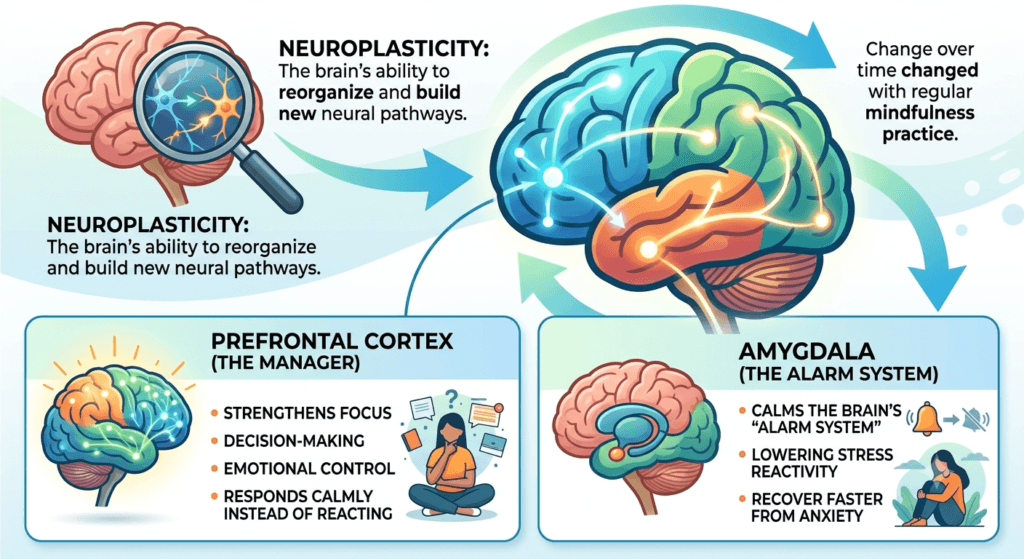
Modern brain imaging shows that regular mindfulness practice physically alters brain structure over time through neuroplasticity—the brain’s ability to reorganize and build new neural pathway.
Regulating Your Stress Response
When you experience stress, your body activates its “fight-or-flight” response—releasing cortisol, accelerating your heart rate, and tensing muscles. While useful in emergency situations, chronic daily stress keeps this system overactive.
Meditation activates the body’s relaxation response, slowing your breathing and lowering muscle tension. Over time, this trains your nervous system to recover much faster after high-stress events.
How to Build a Sustainable Habit
Creating a lasting meditation routine relies on small, repeatable actions rather than drastic lifestyle overhauls:
Start Small: Begin with just 2 to 5 minutes a day. It is far better to complete a brief session daily than to attempt 30 minutes and abandon the practice.
Anchor to Existing Habits: Pair your practice with established daily routines—like meditating right after brushing your teeth, before your morning coffee, or right after returning from work.
Set Up Your Environment: Pick a relatively quiet spot, turn off phone notifications, and choose a comfortable seat or posture.
Celebrate Showing Up: Don’t judge a session by how “peaceful” you felt. Measure success purely by the fact that you took time to practice.
Common Challenges & Practical Solutions
“My mind won’t stop thinking.”
Solution: That means you are becoming aware of your mental activity. Acknowledging a thought and refocusing is the exercise.
“I don’t have enough time.”
Solution: Practice micro-meditations for 60 seconds while waiting for water to boil, riding an elevator, or sitting in traffic.
“I keep falling asleep.”
Solution: Meditate earlier in the day, sit upright instead of lying down, or switch to walking meditation.
“I feel too restless to sit.”
Solution: Skip seated practice entirely and use movement-based methods like walking meditation or mindful stretching.
Frequently Asked Questions
Is it normal to keep thinking during meditation?
Yes. Thinking is what the brain naturally does. Meditation isn’t about stopping thoughts, but changing your relationship with them so you aren’t swept away by every idea that pops up.
How long should a beginner meditate?
Start with 5 minutes a day. Once that feels natural and automatic, you can gradually increase the duration if you choose.
Can people with ADHD practice meditation?
Absolutely. Individuals with ADHD often thrive with shorter sessions, movement-based mindfulness (like walking or yoga), and guided practices rather than long, silent, seated sessions.
How long does it take to notice results?
Some people feel an immediate sense of calm after a single session. Lasting structural changes in focus, stress recovery, and emotional regulation typically develop over 4 to 8 weeks of consistent daily practice.
Key Takeaways
Awareness over Silence: Success in meditation is measured by noticing when your mind drifts, not by forcing absolute silence.
Movement Counts: Walking meditation and daily micro-moments are highly effective alternatives to sitting still.
Consistency Wins: Five minutes of daily practice rewires the brain more effectively than sporadic long sessions.
Physical Benefits: Regular practice dampens reactivity in the amygdala and strengthens circuits in the prefrontal cortex for better stress recovery.
Continue Your Mindfulness Journey
Explore more guides to support your mental and physical well-being:
Join the Conversation
Have you ever felt that meditation wasn’t for you because you couldn’t sit still? What movement-based or micro-mindfulness techniques work best for you? Share your experience in the comments below!

