
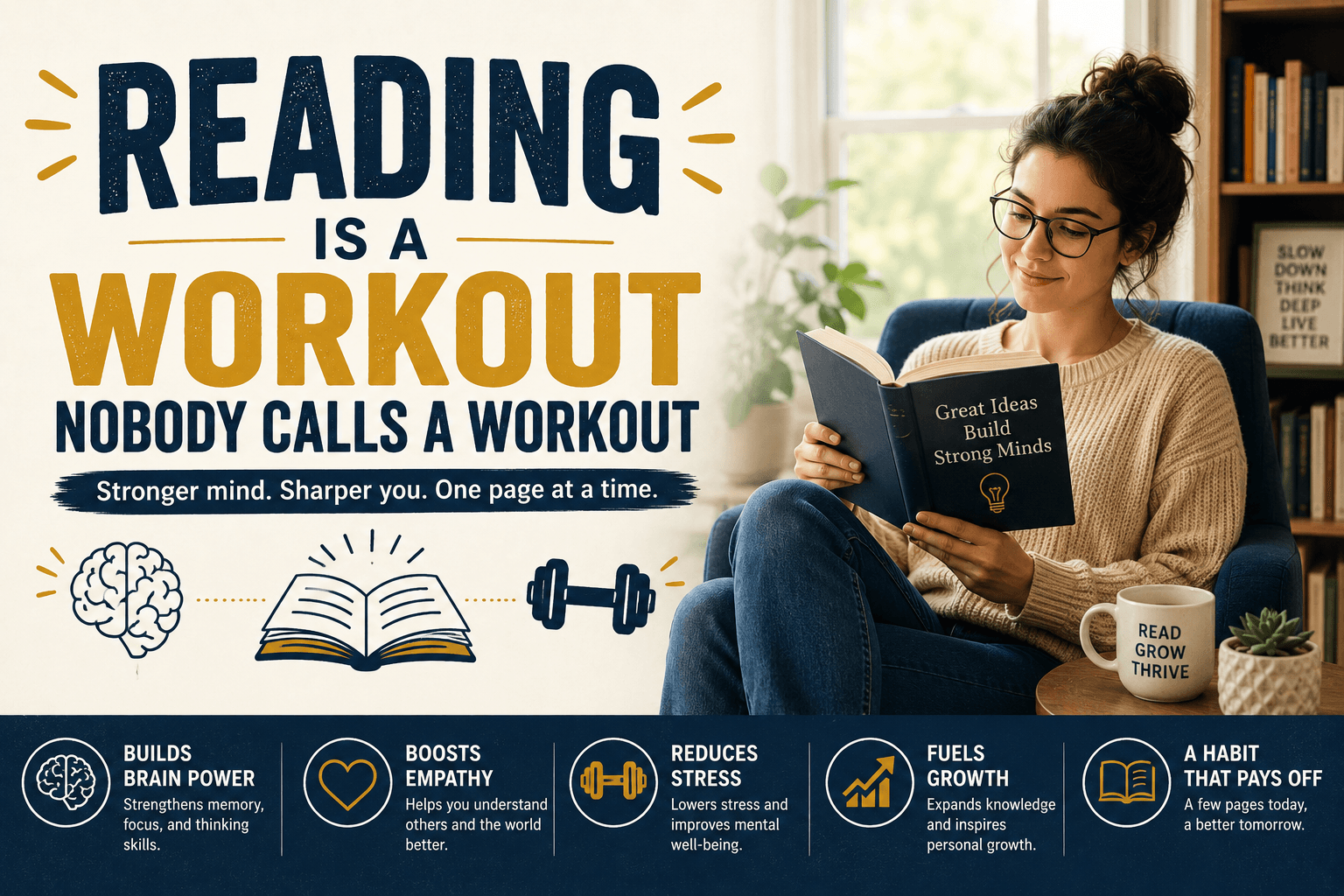
We have a strange habit of treating reading as either a leisure activity or a chore, and almost never as what it actually is — one of the more demanding things we ask our brains to do. Watching a film hands you the faces, the setting, the pacing, all assembled for you. A book hands you black marks on a page and asks you to build the entire world yourself, sound by sound, image by image. That’s not a small ask. It’s closer to full-body exercise for the mind.
What’s Actually Happening While You Read
Functional MRI studies have shown that reading narrative fiction activates regions of the brain associated with movement and sensation — not just the language centers you’d expect. Describing a character running seems to light up some of the same neural territory as actually running would. Researchers at Emory University found this effect could linger for days after finishing a novel, which suggests the brain doesn’t fully distinguish between reading an experience and, in some limited sense, living it.
There’s also a well-documented link between regular reading and what’s sometimes called theory of mind — the capacity to infer what someone else is thinking or feeling. A study published in Science found that reading literary fiction specifically, more than genre fiction or nonfiction, improved participants’ performance on tests of social understanding immediately afterward. Fiction, unlike most media, asks you to sit inside a perspective that isn’t yours for hours at a time. That’s a rare kind of practice.
Why It’s Getting Harder to Do
None of this means much if the habit has quietly disappeared from your week, and for a lot of people, it has — not from lack of interest, but because reading requires a kind of sustained attention that constant notifications have made unfamiliar. Psychologist Maryanne Wolf, who has spent decades studying the reading brain, has warned that heavy exposure to fragmented digital text may be reshaping how we read even print books, making deep, slow reading harder to access even when we want it.
If your attention feels scattered the moment you open a book — rereading the same paragraph three times, itching to check your phone — that’s not a personal failing. It’s closer to a specific kind of fitness that atrophies when it goes unused, the same way a person who’s been sedentary for months would struggle on their first run.
Building the Habit Back Without Making It a Chore
The advice to “read more” tends to fail because it’s vague and moralizing. What actually works is smaller and more specific.
Start with something genuinely enjoyable rather than something you feel obligated to read. A gripping thriller does more for rebuilding attention than a dense classic you’re forcing yourself through out of guilt — you can earn your way to harder books later.
Protect a short, specific window rather than a vague intention to “read more.” Ten minutes before bed, without a phone in the room, tends to survive longer than an ambitious hour that competes with everything else in your day.
And give yourself permission to abandon a book that isn’t working. Finishing every book you start isn’t a virtue; it’s often the exact habit that makes people dread picking up the next one.
Reading won’t feel like exercise while you’re doing it, which might be its best quality. But the mind that comes out the other side — more patient, more able to hold someone else’s perspective, more resistant to distraction — has done something that closely resembles training, even if it never once felt like effort.

