
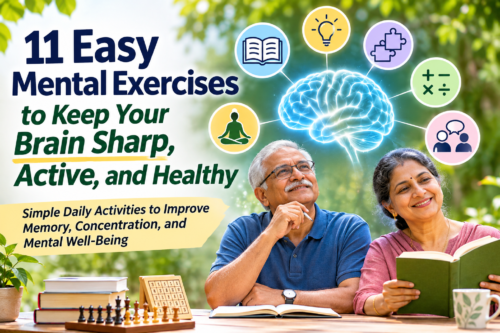
11 Easy Mental Exercises to Keep Your Brain Sharp, Active, and Healthy
Easy Exercises for Brain Health to Improve Memory, Concentration, and Mental Well-Being
Written by: Jesu Raj Athisayam
Founder & Editor, BenVitalFive
Medically Reviewed by: Dr. Visalam Ramanathan
MBBS, MD | Functional Medicine and Integrative Medicine Practitioner
Medical Reviewer & Honorary Editorial Board Member – BenVitalFive
Medical and editorial review date: 13 Nov 2026
Introduction: Easy exercises for the brain. Why the Brain Needs Exercise Too
Mental exercises for brain health are very important, as we often remember to exercise our body. We walk, practice yoga, stretch, eat healthy food, and try to maintain a healthy weight. But how often do we give the same attention to our brain?
Our brain is one of the most important organs in the body. It helps us think, learn, remember, make decisions, understand emotions, and respond to the world around us.
Just as our muscles benefit from regular physical activity, our brains benefit from mental stimulation, learning and meaningful activities.
The good news is that keeping your mind active does not require expensive equipment, complicated programmes or hours of training. You can exercise your brain through simple activities such as reading a book, learning a new word, solving a puzzle, remembering something from your day or having an interesting conversation.
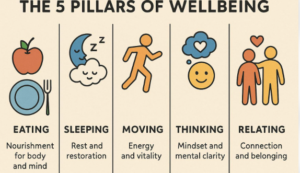
These everyday practices are closely connected to a balanced approach to well-being. Explore the five pillars of wellness to discover how reading, physical activity, yoga, meditation, and nutrition work together
In this article, we explore 11 easy mental exercises you can add to your daily routine to support memory, concentration, learning, and overall brain health.
Why Is It Important to Keep Your Brain Active?
Our brain continues to adapt and form connections throughout life. This ability is called neuroplasticity.
Learning something new, practicing a skill, and challenging ourselves mentally can stimulate different areas of the brain. A holistic approach to healthy living explores the importance of keeping the brain active
Mental activities may help us:
- Practise memory and recall.
- Improve attention and concentration.
- Develop problem-solving skills.
- Encourage creativity and curiosity.
- Maintain interest in learning.
- Support emotional and social well-being.
However, no single brain exercise can guarantee better intelligence or prevent dementia. Research into cognitive training is still developing.
The World Health Organization’s 2026 guidelines encourage cognitive stimulation and social engagement as part of broader approaches to reducing the risk of cognitive decline. They also emphasise physical activity and the management of important health conditions.
Let us look at some practical exercises that almost anyone can try.
11 Easy Mental Exercises for Brain Health to Keep Your Brain Sharp
1. Read Something New Every Day
Reading is one of the simplest ways to give your brain a workout.
When you read, you follow ideas, understand information, connect different thoughts and imagine situations. Reading also introduces you to new vocabulary and different perspectives.
You do not need to read for hours. Start with just 10–15 minutes every day. Reading is also an important part of lifelong learning and personal development. Discover more about the five pillars of wellness
Try these activities:
- Read a newspaper article.
- Explore a new subject in a book.
- Read a short biography.
- Learn about science, history or nature.
- Read an educational article online.
An Indian example: Read a short article about traditional Indian food, the history of your hometown, or the nutritional value of familiar vegetables such as keerai.
After reading, ask yourself: What are the three most important things I learned?
This simple habit encourages understanding and memory recall.
2. Learn a New Word Every Day
Learning new words is a small but useful mental exercise.
It encourages you to understand meanings, remember information and express your thoughts more clearly.
You can learn a word in English, Tamil or another language.
Try this exercise:
- Choose one unfamiliar word.
- Find its meaning.
- Say it aloud.
- Write it in a notebook.
- Use it in a sentence.
For example, learn the word resilience.
Resilience means the ability to recover and move forward after difficulties.
Try using it in a sentence: “Resilience helps us face life’s challenges with courage.”
You can also learn a new Tamil word and understand its English meaning.
Learning languages is an enjoyable way to keep your curiosity alive.
3. Practise Mental Mathematics
You do not always need a calculator to perform simple calculations.
Try solving small mathematical problems in your head.
For example:
- What is 27 + 15?
- What is 100 minus 37?
- What is 15% of 200?
- If one vegetable costs ₹40, how much will three cost?
You can practise while shopping, travelling or waiting for an appointment.
A simple daily challenge:
Calculate the total cost of three items before checking the bill.
Start with easy numbers and gradually increase the difficulty.
Mental mathematics encourages concentration, number sense and problem-solving.
Do not worry about making mistakes. The purpose is to practise thinking, not to compete with anyone.
4. Play Memory Games
Memory games are enjoyable activities that encourage you to pay attention and recall information.
You can practise them at home without purchasing anything.
Try the five-object memory game:
- Place five everyday objects on a table.
- Look at them carefully for 30 seconds.
- Cover the objects with a cloth.
- Try to remember all five.
- Check how many you recalled correctly.
For example, use a spoon, key, pen, cup and notebook.
As you become comfortable, increase the number of objects.
Another activity is to remember a short shopping list without looking at it.
You can also try remembering the names of people you met during the day.
These activities provide opportunities to practise attention and recall.
5. Solve Puzzles and Brain Teasers
Puzzles encourage us to think differently and look for solutions.
They can be enjoyable ways to spend free time while practising reasoning and problem-solving.
Try:
- Crossword puzzles.
- Sudoku.
- Word searches.
- Jigsaw puzzles.
- Number games.
- Simple riddles.
For example:
A small brain teaser:
What has keys but cannot open a lock?
Answer: A piano.
You can also play traditional games such as chess, carrom and certain strategy-based board games.
The important thing is to choose activities that you enjoy and that offer an appropriate level of challenge.
6. Practise Mindful Breathing
Mental sharpness is not only about solving problems. It is also about learning to pause, relax and pay attention.
When our minds are filled with worries, distractions and constant information, concentrating on one task can become difficult.
Mindful breathing offers a simple opportunity to bring attention back to the present moment.
Try this two-minute breathing exercise:
- Sit comfortably.
- Relax your shoulders.
- Breathe gently through your nose.
- Notice the natural movement of your breath.
- When your attention wanders, gently bring it back to breathing.
Do not force your breathing or hold your breath unnecessarily.
You can practise this in the morning, during a work break or before going to sleep.
Mindful breathing may support relaxation and stress management. It should not be presented as a treatment for memory problems or a guaranteed way to improve intelligence.
7. Use Your Non-Dominant Hand
Most people perform everyday activities using their dominant hand.
If you are right-handed, try using your left hand for a simple, safe activity. If you are left-handed, try your right hand.
For example:
- Write a few simple letters.
- Draw a small picture.
- Move lightweight objects.
- Practise a simple hand movement.
This may feel unusual at first.
That is part of the challenge. You are practising coordination, attention and a new movement pattern.
Safety note: Do not use your non-dominant hand for activities involving sharp objects, hot liquids, driving or machinery.
You do not need to force yourself to become equally skilled with both hands. Enjoy the experience of learning something unfamiliar.
8. Recall Three Details from Your Day
Memory is an important part of everyday life.
We remember people’s names, conversations, places we visit and things we need to do.
A simple way to practise recall is to spend a few minutes remembering the events of your day.
Try this before bedtime:
Think about three things:
- What did I eat for breakfast?
- Whom did I speak to today?
- What new thing did I learn?
You can also write these details in a small diary.
For example:
- I spoke with an old friend.
- I learned something about healthy nutrition.
- I noticed a beautiful tree during my evening walk.
This exercise encourages you to pay attention to daily experiences and recall them later.
It can also become a meaningful gratitude practice.
9. Take a Different Route and Observe Your Surroundings
Our daily routines can become repetitive.
We often travel along the same road, visit the same shops and see familiar surroundings without paying much attention.
Try taking a different safe walking route occasionally.
Observe:
- The names of streets.
- Trees and plants.
- Buildings and landmarks.
- Shops and signboards.
- Changes in your surroundings.
After returning home, try remembering five things you noticed.
This activity combines physical movement, observation and memory.
A short walk in a garden, park or familiar neighbourhood can become an opportunity to engage both your body and mind.
Always choose a safe route and remain aware of traffic.
10. Explain Something You Have Learned
One of the best ways to understand a subject is to explain it to someone else.
When you explain an idea, you need to organise your thoughts, select the important information and communicate it clearly.
Try this simple exercise:
- Read a short article.
- Identify its main message.
- Explain it to a family member or friend.
- Try to describe it without looking at the article.
For example, after reading about vitamin D, explain what it does in the body and name a few dietary sources.
You can also explain a traditional recipe, a historical event or something interesting you learned from a book.
Teaching is not only about sharing knowledge. It also gives you an opportunity to check how well you understand something.
11. Connect with Someone Through Meaningful Conversation
Human beings are social by nature.
A meaningful conversation encourages us to listen, understand, remember, respond and share our experiences.
Social interaction is also important for emotional well-being.
Instead of spending every free moment looking at a mobile phone, make time to speak with someone.
Try these activities:
- Call an old friend.
- Talk with your grandparents.
- Share memories with family members.
- Discuss a book or an interesting subject.
- Join a community or reading group.
- Learn something from another person’s experience.
Ask open-ended questions such as:
“What was the most interesting experience in your childhood?”
“What is one lesson life has taught you?”
“What would you like to learn next?”
These conversations can strengthen relationships and encourage mental engagement.
Research also recognises social participation as an important part of healthy ageing and brain health.
A Simple 15-Minute Daily Brain Exercise Routine
You do not need to practise all 11 exercises every day.
Choose a few activities and make them part of your normal routine.
Here is a simple example:
| Time | Activity |
|---|---|
| 3 minutes | Learn a new word |
| 3 minutes | Mental mathematics |
| 3 minutes | Memory exercise |
| 3 minutes | Read something new |
| 3 minutes | Recall and explain what you learned |
You can change the activities according to your interests.
Some days, you may prefer solving a puzzle. On other days, you may enjoy reading, drawing or talking with a friend.
Consistency and enjoyment are more important than following a strict schedule.
Beyond Mental Exercises: Five Habits That Support Brain Health
Mental exercises are only one part of maintaining a healthy brain.
Our brain health is connected to our overall physical, mental and social well-being.
Here are five important lifestyle habits to include.
1. Stay Physically Active
Walking, cycling, swimming, yoga and other suitable physical activities support general health.
Regular physical activity is particularly important for cardiovascular health, which is closely connected to brain health.
Even simple activities such as gardening, household work and walking can help reduce sedentary time.
Choose activities appropriate for your age and physical condition.
2. Eat a Balanced Diet
The brain needs nutrients to function properly.
Include a variety of foods in your daily diet:
- Green leafy vegetables such as murungai keerai and agathi keerai.
- Fruits such as guava, papaya and oranges.
- Nuts and seeds.
- Pulses, beans and lentils.
- Whole grains.
- Milk, curd, eggs or other suitable protein sources.
- Fish, if part of your diet.
There is no single food that can make the brain exceptionally sharp overnight.
A balanced dietary pattern, rather than depending on one so-called superfood, is the better approach. Making nutritious food choices easier begins with everyday kitchen habits. Read our guide to simple changes that make healthy eating easier
3. Get Enough Quality Sleep
Sleep is essential for physical and mental well-being.
It supports memory processing, attention and emotional regulation.
Develop a regular sleeping routine. Reduce unnecessary screen use before bedtime and create a comfortable sleeping environment.
If you regularly experience sleep difficulties, seek appropriate medical advice. For practical suggestions on developing healthy bedtime habits, explore our guide to a healthy evening routine for better sleep
4. Manage Stress
Long-lasting stress can affect concentration, mood and everyday functioning.
Make time for activities that help you relax.
You may choose:
- Meditation.
- Gentle yoga.
- Mindful breathing.
- Gardening.
- Reading.
- Listening to music.
- Spending time with family.
Find what helps you feel calm and balanced.
5. Monitor Your Overall Health
Conditions such as high blood pressure, diabetes and high cholesterol are important risk factors to manage.
Hearing and vision difficulties, depression and other health concerns can also affect everyday functioning and quality of life.
Regular health check-ups and timely medical care are important, particularly as we grow older.
Does Doing Brain Exercises Prevent Memory Loss or Dementia?
This is an important question.
Brain exercises can encourage learning, mental stimulation and the practice of specific cognitive skills.
However, we should not claim that reading, Sudoku, memory games or mental mathematics can prevent Alzheimer’s disease or dementia.
The World Health Organization’s 2026 guidelines recognise cognitive training and cognitive stimulation as possible components of broader risk-reduction strategies. The recommendations are conditional, and the certainty of evidence varies.
The National Institute on Aging also notes that some forms of cognitive training have shown benefits in research, but commercially available brain-training applications should not automatically be assumed to provide the same benefits.
The most sensible approach is to combine mental activity with physical activity, balanced nutrition, adequate sleep, social connection and good management of health conditions.
Remember: A healthy brain is supported by a healthy lifestyle, not by one exercise or one product.
When Should You Seek Medical Advice About Memory Problems?
Occasionally forgetting a name or misplacing an object can happen to anyone.
However, persistent or worsening memory difficulties should not automatically be dismissed as normal ageing.
Consider consulting a healthcare professional if you or a family member experiences:
- Frequently forgetting important recent events.
- Difficulty managing familiar everyday tasks.
- Repeatedly asking the same questions.
- Getting confused in familiar places.
- Difficulty following conversations.
- Noticeable changes in judgement or behaviour.
Memory difficulties can have several possible causes, some of which may be treatable. Early assessment can help identify the reason.
Sudden confusion, especially when accompanied by weakness, difficulty speaking or other new neurological symptoms, requires urgent medical attention.
Conclusion: Keep Learning, Keep Moving, Keep Connecting
A sharp and active mind is not built in a single day.
It develops through curiosity, learning, meaningful experiences and healthy everyday habits.
You do not need to solve complicated puzzles or spend hours on brain-training applications. Start with something simple.
Read a few pages. Learn a new word. Calculate a shopping bill mentally. Remember three things from your day. Take a walk and observe your surroundings. Talk to someone and listen carefully.
Most importantly, never stop being curious.
Age should not prevent us from learning something new, exploring new ideas or developing meaningful relationships.
Your body needs movement, and your brain needs engagement. Give both the attention they deserve.
Healthy living is not about doing extraordinary things occasionally. It is about practising small, meaningful habits consistently.
Jesu Raj Athisayam
Founder & Editor, BenVitalFive
Frequently Asked Questions (FAQs)
1. What are the best mental exercises for the brain?
Reading, learning new words, solving puzzles, mental mathematics, memory games, mindful breathing and meaningful conversations are simple activities that encourage mental engagement.
2. How many minutes should I exercise my brain daily?
There is no universally established number of minutes that guarantees better memory. You can begin with 10–15 minutes of enjoyable mental activities and gradually develop a regular routine.
3. Can brain exercises improve memory?
Practising memory-related tasks can improve performance on those particular activities. Whether the benefits transfer to everyday memory or prevent long-term cognitive decline is less certain.
4. Which games are good for keeping the brain active?
Chess, Sudoku, crosswords, jigsaw puzzles, word games and strategy-based board games can provide enjoyable mental challenges.
5. Is reading good for brain health?
Reading encourages language processing, attention, comprehension and learning. It is a valuable way to keep the mind engaged throughout life.
6. Can older adults also practise these mental exercises?
Yes. Older adults can enjoy reading, puzzles, music, learning languages, storytelling and social activities. Choose activities according to individual ability, comfort and interests.
7. Is physical exercise important for brain health?
Yes. Regular physical activity supports cardiovascular health and is recommended as part of strategies to maintain cognitive health and reduce the risk of cognitive decline.
Medical Disclaimer
This article is intended for general educational and informational purposes. It does not provide medical advice, diagnosis, or treatment. Mental exercises are not a substitute for medical evaluation or treatment of memory problems, cognitive impairment, or neurological conditions. Consult a qualified healthcare professional if you experience persistent or worsening changes in memory, thinking, or behaviour.
Reference :
Recommended authoritative external references
Include these in the article’s references section:
World Health Organization – Risk Reduction of Cognitive Decline and Dementia: 2026 Guidelines.
National Institute on Aging – Cognitive Health and Older Adults.
World Health Organization – New WHO Guidelines on Dementia Risk Reduction.

