
Introduction
Of all the meditation techniques I have encountered in my four decades of studying wellness and community living, Vipassana stands apart. It is not merely a relaxation technique or a stress-management tool. It is, as its Pali name suggests, a practice of insight — a direct, unfiltered observation of reality as it is, moment by moment.
Vipassana is one of India’s oldest meditation traditions, said to have been rediscovered and taught by Gautama Buddha over 2,500 years ago. It was preserved in Myanmar for centuries and brought back to India and the world through the teachings of S.N. Goenka in the 20th century. Today, it is practiced by millions worldwide, in both 10-day silent retreats and daily personal practice.
In this guide, I will explain exactly what Vipassana is, the science that supports it, how to begin a personal practice, and what to honestly expect — including the challenges.
What Is Vipassana?
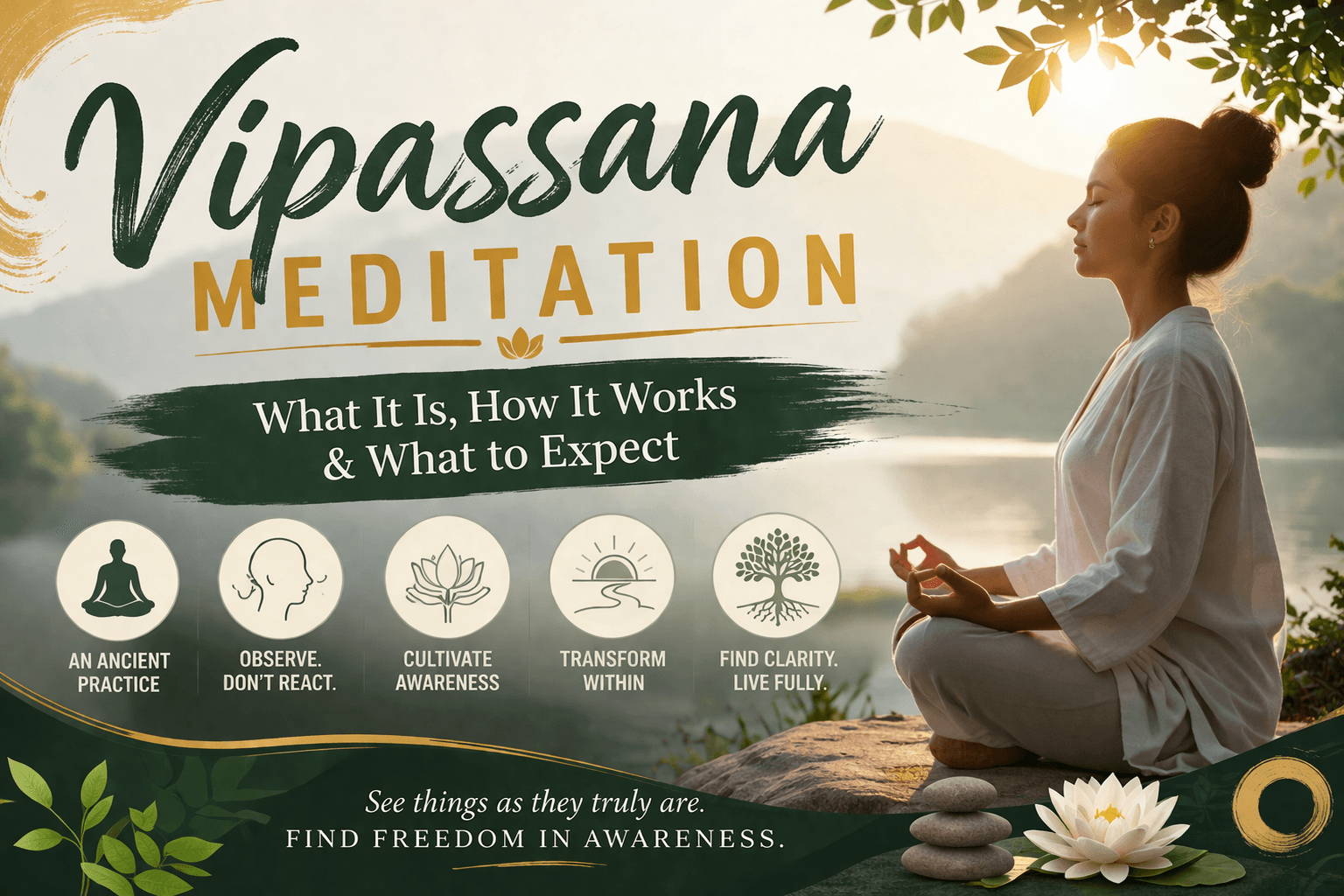
Vipassana means ‘to see things as they really are’ in Pali, the ancient language of the Theravada Buddhist canon. Unlike concentration meditation (which focuses the mind on a single object), Vipassana is an insight practice. It trains the practitioner to observe the moment-to-moment arising and passing of physical sensations, thoughts, and emotions without reacting to them.
The core insight Vipassana develops is the understanding of impermanence — that every sensation, emotion, thought, and experience arises and passes. Nothing is permanent. When the mind truly understands this experientially — not just intellectually — the compulsive habit of craving pleasant sensations and avoiding unpleasant ones weakens. This, according to the tradition, is the root of mental suffering.
The Science Behind Vipassana
Modern neuroscience has validated many of the effects that Vipassana practitioners have reported for centuries:
- A study at Harvard Medical School led by Sara Lazar found that long-term meditation practitioners showed increased cortical thickness in areas of the brain associated with attention, interoception, and sensory processing
- Research published in Frontiers in Human Neuroscience found that a 10-day Vipassana retreat significantly reduced depression, anxiety, and stress scores in participants
- A 2018 study in Mindfulness journal found that Vipassana training improved emotional regulation by increasing activity in the prefrontal cortex — the brain region responsible for rational decision-making — while reducing reactivity in the amygdala
- Studies show that regular Vipassana practice reduces inflammatory markers, lowers cortisol, and improves heart rate variability
Vipassana vs. Other Meditation Styles
It is helpful to understand how Vipassana differs from other popular forms of meditation:
- Mindfulness meditation (MBSR): Mindfulness-Based Stress Reduction draws from Vipassana but is adapted for clinical settings. Vipassana is the deeper, more immersive traditional form.
- Transcendental Meditation (TM): Uses a mantra for concentration. Vipassana uses body sensations as the object of observation.
- Loving-Kindness (Metta): Focuses on cultivating compassion and positive emotion. Vipassana focuses on equanimous observation of all experience.
- Focused Attention meditation: Trains concentration on one object. Vipassana is Open Monitoring — observing the flow of all experience.
How to Practice Vipassana at Home
The traditional entry point for Vipassana is a 10-day silent retreat (Dhamma centers exist across India and worldwide, and the courses are offered free of charge). However, a personal daily practice can be begun at home using the following technique:
Step 1: Anapana (Preparing the Mind)
Begin with 5 to 10 minutes of Anapana — focused awareness of the natural breath at the area just below the nose and above the upper lip. Do not control the breath. Simply observe it coming and going. This develops concentration before the insight practice begins.
Step 2: Body Scanning (The Core Practice)
Once the mind is settled, begin a systematic scan of the body. Start at the top of the head and move slowly down to the toes, then back up. At each area, simply observe whatever sensation is present — warmth, tingling, pressure, throbbing, numbness, or nothing at all. Do not label, analyze, or try to change what you feel. Simply observe with equanimity.
Step 3: Equanimity Toward All Sensations
When you encounter pleasant sensations, observe them without craving. When you encounter unpleasant sensations (pain, pressure, discomfort), observe them without aversion. Simply note: this is a sensation. It will change. This equanimous observation is the heart of Vipassana.
Suggested Daily Practice Schedule
- Morning — 20 to 30 minutes of body scanning after a 5-minute Anapana sit
- Evening — 20 minutes of body scanning to release the day’s accumulated tensions
- As you progress — extend sessions to 45 or 60 minutes
What to Honestly Expect
Vipassana is not always comfortable, especially in the beginning. Here is an honest account of what many practitioners experience:
In the First Few Weeks
- A restless or wandering mind is completely normal — this is what an untrained mind does
- You may become more aware of physical pain or emotional discomfort as you observe rather than distract from it
- Sleep quality often improves even if the sitting practice feels difficult
- Moments of deep calm begin to emerge between the restlessness
After 1 to 3 Months
- Greater emotional stability and less reactive behavior in daily life
- Improved ability to observe stress without being overwhelmed by it
- A natural inclination toward simplicity, silence, and wholesome habits
The Connection to BenVitalFive’s Philosophy
At BenVitalFive, Vipassana perfectly embodies our core vision: to live long and live quietly. It is not about escaping the world but about changing one’s relationship with it. A person who has trained themselves to observe experience without compulsive reaction carries an inner sanctuary of calm no matter what their external circumstances are.
Vipassana is the deepest expression of our Meditation and Mindfulness pillar — and one of the most transformative practices available to any human being willing to commit to the work.
Key Takeaways
- Vipassana is an ancient Indian insight meditation practice with over 2,500 years of tradition and strong modern scientific validation
- It develops equanimity — the ability to observe all experience without craving or aversion — which reduces anxiety, stress, and emotional reactivity
- You can begin at home with 20 to 30 minutes daily of Anapana and body scanning
- A 10-day residential retreat (offered free worldwide at Dhamma centers) is the most powerful way to establish the practice

