
Table of Contents
ToggleFocused Meditation: A Practical Guide to Building Deep Concentration
Introduction: Why Focus Is the New Superpower
In today’s hyperconnected world, distraction is the default. Notifications, multitasking, and constant information overload have made sustained attention rare—and incredibly valuable. The ability to concentrate deeply is no longer just a productivity skill; it’s a competitive advantage for your mind.
This is where focused meditation comes in.
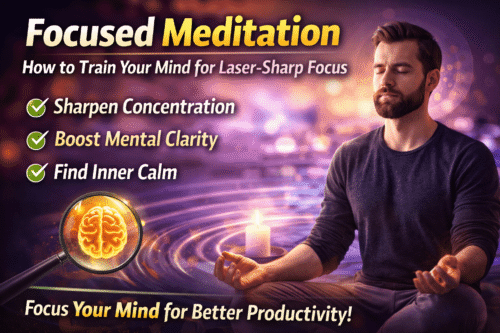
Focused meditation, also known as concentration meditation. It is a powerful mental training technique that strengthens your ability to direct and sustain attention. Focused Meditation actively trains your mind to stay anchored to a single point—building clarity, discipline, and inner calm.
In this practical guide, you’ll learn:
- What focused meditation really is
- The science behind concentration
- Step-by-step techniques to practice
- Common obstacles and how to overcome them
- Real-world applications for work and life
Let’s begin.
What Is Focused Meditation?
Focused meditation is a practice where you direct your attention to one object. When your mind wanders, you gently bring it back.

Common Objects of Focus:
- Your breath
- A candle flame
- A mantra (e.g., “Om”)
- A sound or image
- Bodily sensations
The goal is not to eliminate thoughts but to train your attention.
Focused Meditation vs Mindfulness
| Focused Meditation | Mindfulness Meditation |
|---|---|
| Narrow attention | Open awareness |
| One object | Multiple experiences |
| Active training | Observational awareness |
Both are valuable, but focused meditation is particularly effective for building deep concentration.
If you’re new to meditation, you may also benefit from exploring this beginner’s guide to mindfulness meditation, which focuses on developing open awareness before narrowing attention.
The Science Behind Deep Concentration
Modern neuroscience confirms what ancient traditions have known for centuries: the brain can be trained.
Key Brain Mechanisms
- Default Mode Network (DMN): Active during mind-wandering
- Prefrontal Cortex: Responsible for focus and decision-making
- Anterior Cingulate Cortex: Regulates attention and error detection
Studies show that regular meditation:
- Reduces DMN activity (less distraction)
- Strengthens attention networks
- Improves emotional regulation
Research Insight
Harvard neuroscientist Sara Lazar found that people who meditate for a long time have a thicker brain cortex. This thicker area is in parts of the brain linked to attention and self-awareness.
What this means for you:
With consistent practice, focused attention becomes your brain’s default mode—not distraction.
How to Practice Focused Meditation (Step-by-Step)
Step 1: Choose Your Focus Object
Start simple. The breath is ideal because it is
- Always available
- Natural and rhythmic
- Easy to observe
Step 2: Create a Distraction-Free Space
- Quiet environment
- Minimal digital interruptions
- Comfortable seating
Step 3: Sit with Proper Posture
- Spine upright but relaxed
- Hands resting comfortably
- Eyes closed or softly open
Step 4: Focus Your Attention
Bring your awareness to your chosen object:
- If breathing: feel air at your nostrils
- If candle: observe the flame gently
Step 5: Handle Distractions
Your mind will wander. This is normal.
When it does:
- Notice it
- Don’t judge it
- Gently return to focus
This “return” is the core of the training.
Step 6: Build Duration Gradually
- Start: 5–10 minutes
- Progress: 15–30 minutes
- Advanced: 45+ minutes
Practical Tips to Improve Your Focused Meditation
1. Use a Timer
Avoid checking the clock. Set a gentle alarm.
2. Label Distractions
Mentally note: “thinking,” “planning,” or “worrying.”
3. Keep It Daily
Consistency beats intensity.
4. Anchor with Breath Counting
Count breaths from 1 to 10, then repeat.
5. Start Small, Win Big
Even 5 minutes daily can rewire your brain over time.
My Personal Insight: The “Micro-Focus” Trick
One of the most effective techniques I’ve found is what I call micro-focus training.
Instead of forcing long sessions:
- Focus intensely for just 3 minutes
- Take a short break
- Repeat 3–5 cycles
This builds mental endurance without burnout—especially helpful for beginners.
Applying Focused Meditation in Daily Life
Focused meditation doesn’t stop when you leave the cushion.
Everyday Examples
1. Deep Work Sessions
Work on one task without switching for 25 minutes.
2. Mindful Eating
Focus entirely on taste, texture, and smell.
3. Focused Listening
Give someone your full attention without interrupting.
4. Skill Practice
Whether coding, writing, or music—apply single-task focus.
Over time, your entire life becomes more intentional and less scattered.
To make meditation a lasting habit, it helps to integrate it into a structured plan—learn how to build a daily wellness routine that supports focus and consistency.
Common Obstacles in Concentration Meditation

1. Restlessness
Solution: Take a few deep breaths before starting.
2. Sleepiness
Solution: Sit upright, open your eyes slightly.
3. Overthinking
Solution: Return to the object—again and again.
4. Doubt
Solution: Trust the process. Progress is gradual.
5. Impatience
Solution: Focus on consistency, not perfection.
Advanced Practice: Deep States of Concentration
As your practice deepens, you may experience:
- Strong mental clarity
- Reduced effort
- A sense of calm absorption
In traditional meditation systems, these are known as deeper concentration states. While not necessary for beginners, they demonstrate how powerful focused meditation can become.
The Benefits of Concentration Training Over the Long Run
Mental Benefits
- Improved attention span
- Better memory retention
- Enhanced problem-solving
Emotional Benefits
- Reduced stress
- Greater emotional control
- Increased resilience
Productivity Benefits
- Faster task completion
- Better decision-making
- Less procrastination
Unique Insight: Focus Is a Trainable Muscle
Think of attention like a muscle:
- Weak with neglect
- Strong with training
Focused meditation is your daily “mental gym.”
Integrating Focused Meditation with Supplements
For those exploring cognitive optimization, certain adaptogens and nootropics may support focus.
Examples include:
- Bacopa Monnieri
- Rhodiola Rosea
- L-Theanine
Always choose products backed by clinical research and third-party testing.
For a deeper look at evidence-backed herbal support, explore our guide on top adaptogens for brain health that can complement your meditation practice.
FAQ: Focused Meditation
1. How long does it take to see results?
Most people notice improved focus within 2–4 weeks of consistent practice.
2. Can beginners practice focused meditation?
Yes. It’s one of the simplest and most effective entry points into meditation.
3. What if I can’t stop thinking?
You’re not supposed to. The goal is to return to focus, not eliminate thoughts.
4. Is focused meditation better than mindfulness?
It depends on your goal. For concentration, focused meditation is more direct.
5. Can I practice without sitting?
Yes. Walking meditation or focused tasks can also build concentration.
Conclusion: Train Your Mind, Transform Your Life
Focused meditation is more than a technique—it’s a lifelong skill.
In a world that constantly pulls your attention outward, this practice brings it back under your control. With just a few minutes a day, you can build a mind that is:
- Calm
- Clear
- Deeply focused
Start small. Stay consistent. Trust the process.
Your attention is your most valuable resource—train it wisely.
About the Author
Jesuraj is a wellness researcher and health optimisation specialist focused on the intersection of modern neuroscience and traditional herbalism. Dedicated to evidence-based wellness, Jesuraj spends hundreds of hours auditing clinical trials and third-party lab reports to provide readers with objective, fluff-free analysis.
By bridging the gap between ancient botanical wisdom and contemporary brain science, Jesuraj empowers individuals to optimise their mental clarity and vitality through the strategic use of adaptogens and targeted supplementation.
References
- Harvard Health Publishing – Meditation and Brain Structure
https://www.health.harvard.edu - National Institutes of Health – Meditation Research
https://www.nih.gov - Frontiers in Psychology – Attention and Meditation Studies
https://www.frontiersin.org

