
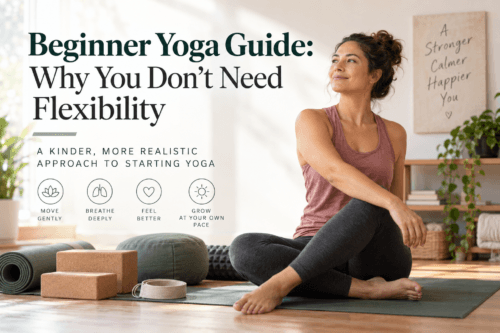
Beginner Yoga Guide: Why You Don’t Need Flexibility
Think you’re too stiff, too old, too unfit, or simply “not flexible enough” for yoga? That’s exactly why you may want to begin.
A friend once told me she’d never try yoga because she “wasn’t flexible enough.”
I hear some version of this surprisingly often.
And every time, I want to gently turn the sentence around.
You don’t need flexibility to start yoga. Yoga can be one of the ways you gradually develop flexibility.
That distinction matters.
Search for yoga online and you’ll often see people balancing effortlessly on their hands, folding their bodies into impressive shapes, or touching their toes with seemingly no effort. The photographs are beautiful, but they can create an unfortunate impression: that yoga is something you do after becoming flexible.
It isn’t.
Those advanced poses are the result of practice, not the entrance requirement.
Yoga can begin with a stiff back, tight hamstrings, limited mobility, poor balance, or simply a body that hasn’t moved much lately. You don’t have to look like a yoga teacher. You don’t even have to be particularly fit.
You just have to begin where you are.
And perhaps that’s one of the most valuable lessons yoga offers: your starting point doesn’t have to be your finishing point.
What Is Yoga, Really?
Yoga is much broader than a collection of stretches and impressive physical poses.
Yoga has ancient roots in Indian philosophy and developed as a multifaceted practice. Modern yoga commonly combines physical postures, breathing techniques, and meditation, although traditional yoga includes a much broader range of practices and philosophical ideas.
The physical postures are called asanas.
Breathing practices are known as pranayama.
Meditation and focused awareness are also important parts of many yoga traditions.
In modern Western fitness culture, however, the physical side of yoga often receives most of the attention.
That’s understandable. A photograph of someone performing a beautiful pose is easier to share than a photograph of someone quietly paying attention to their breathing.
But the physical pose is only part of the picture.
Yoga can be a way of learning how to move, breathe, pay attention, slow down, and become more aware of what your body is telling you.
That makes it very different from simply trying to become more flexible.
The Biggest Beginner Yoga Myth: “I’m Not Flexible Enough”
Let’s start with the most common misconception.
Myth: You need to be flexible before you can do yoga.
Reality: You can begin yoga at your current level of flexibility.
Imagine someone saying:
“I can’t walk because I’m not fit enough to walk.”
It doesn’t make much sense.
Walking itself can be part of becoming fitter.
Yoga works in a similar way.
You don’t have to touch your toes. You don’t have to put your leg behind your head. You don’t have to sit comfortably in a perfect cross-legged position.
Your version of a pose may look completely different from someone else’s.
And that’s okay.
Flexibility isn’t a competition.
Your body has its own structure, history, proportions, injuries, habits, and limitations. Two people can perform the same pose and look completely different while both practicing correctly.
The goal isn’t to force your body into somebody else’s shape.
The goal is to gradually become more comfortable and capable in your own body.
Yoga Is a Practice, Not a Performance
Social media has changed the way many people see yoga.
We see:
- Perfectly straight legs
- Deep backbends
- Handstands
- Beautiful studios
- Matching yoga outfits
- Athletic bodies
- Complicated poses
What we don’t see as often are the thousands of ordinary moments that make up a real yoga practice:
Someone breathing quietly for five minutes.
Someone using a block because their hand can’t reach the floor.
Someone modifying a pose because their knee doesn’t feel comfortable.
Someone wobbling and laughing.
Someone practicing in an old T-shirt in the living room.
Someone doing ten minutes before work.
That is yoga too.
The practice matters more than the photograph.
A beginner who practices consistently for ten minutes may gain far more from yoga than someone who spends an hour occasionally trying to achieve advanced poses.
What Can Yoga Do for You?
Yoga isn’t a cure-all, and its effects vary according to the style practiced, the individual, and the consistency of practice.
But research suggests that yoga may support several aspects of physical and mental well-being.
The National Center for Complementary and Integrative Health (NCCIH) notes evidence suggesting benefits related to stress management, sleep, balance, general wellness, and mental and emotional well-being. Research has also examined yoga for conditions including low-back pain, neck pain, headaches, and knee osteoarthritis.
For a beginner, some of the most relevant potential benefits include:
1. Flexibility
Regular movement through a comfortable range can help you develop greater mobility over time.
But flexibility shouldn’t be the only goal.
Being able to move comfortably and confidently may be more useful than being able to perform a spectacular pose.
2. Balance
Yoga challenges your ability to control your body in different positions.
Balance becomes particularly important as we get older, and research suggests yoga can improve aspects of balance.
3. Strength
Yoga isn’t simply stretching.
Depending on the style, poses can require your legs, core, arms, shoulders, and back to support your body.
4. Stress Management
Yoga combines movement with breathing and attention.
Research summarized by NCCIH suggests that yoga may help with perceived stress and other measures of stress management.
That doesn’t mean one yoga session will eliminate every stressful thought.
Instead, regular practice may give you a structured opportunity to slow down and reconnect with your body.
5. Body Awareness
Perhaps one of the less obvious benefits is learning to notice what your body is actually doing.
You begin to recognize:
“My shoulders are tense.”
“I’m holding my breath.”
“That stretch feels different on my left side.”
“I’m pushing too hard.”
That awareness can become valuable both on and off the mat.
Different Types of Yoga: Which One Is Right for a Beginner?
One reason people decide they “don’t like yoga” is that they tried a style that didn’t suit them.
Yoga isn’t one single experience.
There are many different approaches, from gentle practices to physically demanding ones.
Here are some common styles.
| Yoga Style | What It Generally Feels Like | Often Suitable For |
|---|---|---|
| Hatha | Slower, posture-focused | Beginners building foundations |
| Vinyasa | Continuous movement linked with breath | People who enjoy more movement |
| Yin | Longer-held, mostly passive poses | People who enjoy stillness |
| Restorative | Supported, gentle poses | Relaxation and recovery |
| Chair Yoga | Poses adapted using a chair | People who need additional support |
| Gentle Yoga | Lower-intensity movement | Beginners and people wanting a softer practice |
These categories aren’t rigid. Classes can differ considerably between instructors.
The important question isn’t:
“Which yoga style is the best?”
It’s:
“Which style fits my body, goals, experience, and personality?”
Hatha, Vinyasa, Yin or Restorative?
Imagine four beginners.
The first wants to learn the basics slowly.
A beginner-friendly Hatha class may be a good place to start.
The second loves movement and gets bored sitting still.
A gentle Vinyasa class may feel more engaging.
The third wants to slow down after a stressful day.
Yin or restorative yoga may be more appealing.
The fourth has limited mobility and wants additional support.
Chair yoga or a gentle class may be worth exploring.
There is no prize for choosing the hardest class.
The right practice is the one that encourages you to come back.
Beginner Yoga Poses to Explore
You don’t need to master dozens of poses when you’re starting.
A few simple movements can provide a foundation.
Mountain Pose
Stand comfortably with your feet grounded and your spine naturally upright.
Rather than thinking about “perfect posture,” simply notice how you are standing.
Where is your weight?
Are your shoulders tense?
Are you holding your breath?
Mountain Pose can become an exercise in body awareness.
Cat-Cow
From a comfortable hands-and-knees position, gently alternate between rounding and extending the spine.
Move slowly.
There’s no need to push toward the largest possible movement.
Think:
comfortable range, controlled breathing, steady movement.
Child’s Pose
Child’s Pose can provide a gentle resting position between movements.
Use whatever modification makes you comfortable.
If your hips don’t move easily toward your heels, don’t force them.
Bridge Pose
Lying on your back with your knees bent, gently lift your hips while keeping the movement controlled.
This can introduce beginners to strengthening movements for the lower body and trunk.
Downward-Facing Dog
Downward Dog is one of the poses people often associate with yoga.
But beginners don’t need to achieve the picture-perfect version.
Your knees can remain bent.
Your heels don’t need to touch the floor.
Your hands can be supported appropriately.
The goal is to work within a comfortable range rather than chase an aesthetic shape.
Your First Week of Yoga Doesn’t Need to Be Complicated
If you’re completely new, resist the temptation to do too much.
Try something like this:
Day 1 — 10 minutes
Gentle breathing and simple standing movements.
Day 2 — 10 minutes
Cat-Cow, Child’s Pose and gentle mobility.
Day 3 — Rest
Let your body recover.
Day 4 — 10–15 minutes
A beginner-friendly Hatha or gentle yoga session.
Day 5 — Rest or light walking
Yoga doesn’t have to be your only form of movement.
Day 6 — 15 minutes
Repeat movements that felt comfortable during the week.
Day 7 — Reflection
Ask yourself:
How does my body feel compared with the beginning of the week?
Don’t measure success by whether you can touch your toes.
Notice whether you feel more comfortable moving, more aware of your body, or simply more willing to practice again.
That is progress too.
Starting Without the Pressure
If you’re beginning yoga now, here’s the most useful advice I can offer:
Your edge is not the same as someone else’s edge.
And your edge can change from day to day.
Sleep, stress, physical activity, fatigue, and ordinary daily life can all influence how your body feels.
A pose that felt easy last Tuesday may feel different today.
That doesn’t necessarily mean you’ve lost progress.
Bodies aren’t linear.
Start with ten minutes if that’s what you have.
You don’t need to wait for a free hour.
You don’t need the perfect mat.
You don’t need the perfect clothes.
And you certainly don’t need to become flexible first.
One important distinction, however, is worth learning early:
Hard and painful are not the same thing.
A stretch may feel challenging. That’s different from sharp, intense, or concerning pain.
Don’t try to “push through” pain simply because you think that is what yoga requires.
If something hurts, stop or modify the movement.
And if you have an injury, medical condition, are pregnant, or have other circumstances that may affect exercise safety, speak with an appropriate healthcare professional and a qualified yoga instructor about modifications. NCCIH recommends additional caution for people with certain health conditions and for beginners attempting advanced practices.
Simple Yoga Accessories That Can Make Beginners More Comfortable
You don’t need a shopping list to start yoga.
Your body and a little floor space are enough.
But a few simple tools can make your practice more comfortable and accessible.
1. Yoga Mat
A yoga mat gives you a stable surface for standing, kneeling, sitting, and lying down.
For a beginner, look for:
- Good grip
- Comfortable cushioning
- A stable surface
- Easy cleaning
- Appropriate size for your space
You don’t need the most expensive mat on the market.
Choose one that makes you feel comfortable enough to practice consistently.
2. Yoga Blocks
Yoga blocks are among the most useful beginner accessories.
They aren’t a sign that you’re inflexible.
They’re tools for bringing the floor closer to you.
If your hand can’t comfortably reach the floor in a pose, a block can provide support without forcing you to bend farther than your body is ready for.
Experienced practitioners use props too.
3. Yoga Strap
A yoga strap can extend your reach during certain stretches and help you maintain a comfortable position.
Instead of pulling aggressively to reach your feet, you can use the strap to create a little more space.
Think of the strap as a support—not a way to force flexibility.
4. Meditation Cushion
If you want to include breathing or meditation in your practice, sitting comfortably matters.
A meditation cushion can raise your hips and make seated practice more comfortable for some people.
You don’t have to meditate for thirty minutes.
Start with two or five minutes.
The important thing is learning to sit, breathe, and notice.
5. Foam Roller
A foam roller isn’t essential for yoga, but it can be a useful addition to a broader mobility and recovery routine.
It may help some people manage muscle tightness and feel more comfortable after physical activity.
Use it gently and avoid rolling directly over painful areas or injured tissue.
6. Comfortable Yoga Clothing
You don’t need expensive yoga clothes.
Wear something that allows you to move freely and doesn’t constantly need adjusting.
Comfort is more important than fashion.
A simple pair of flexible trousers or shorts and a comfortable top may be all you need.
Don’t Turn Yoga Into Another Shopping Hobby
There’s an amusing irony in wellness culture.
We can start looking for the perfect:
- Mat
- Outfit
- Blocks
- Strap
- Cushion
- Bottle
- Bag
- Accessories
And suddenly we’ve spent more time preparing to do yoga than actually doing it.
Remember:
The equipment supports the practice. It isn’t the practice.
If you’re buying your first item, a comfortable, non-slip yoga mat is a sensible starting point.
Add blocks or a strap if they solve an actual problem for you.
Add a meditation cushion if seated practice becomes part of your routine.
Let your needs guide your purchases.
Common Beginner Yoga Mistakes
Trying to Become Flexible Too Quickly
Flexibility takes time.
Forcing your body into positions doesn’t automatically make progress faster.
Copying Someone Else’s Pose
Your proportions and mobility are different from another person’s.
Use demonstrations as guidance, not as a standard you must reproduce exactly.
Choosing the Hardest Class
More difficult doesn’t mean more beneficial.
Start at a level where you can learn.
Holding Your Breath
Beginners sometimes become so focused on a pose that they forget to breathe.
Keep breathing naturally unless a qualified instructor specifically guides a breathing technique.
Practicing Through Pain
Discomfort and pain aren’t interchangeable.
If something hurts, stop and reassess.
Expecting Immediate Results
You may feel different after one session, but meaningful physical changes generally require consistency.
Give yourself time.
Yoga at Home: Is It Enough?
Yes, home practice can be a perfectly reasonable way to begin.
You can create a small practice area in your bedroom, living room, balcony, or any safe space where you have enough room to move.
A beginner home setup can be remarkably simple:
A mat + comfortable clothing + 10 minutes + a beginner-friendly class or sequence.
That’s enough.
However, beginners may benefit from learning with a qualified instructor, particularly when learning unfamiliar movements. NCCIH notes that practicing yoga without supervision has been associated with increased injury risk.
If you’re learning online, choose instructors who demonstrate modifications and encourage you to work within a comfortable range rather than pushing through pain.
What If You Are Older or Have Limited Mobility?
Yoga isn’t limited to young, athletic people.
Practices can be modified.
For example, chair yoga adapts many familiar movements so they can be performed while seated or standing with chair support. Harvard Health describes chair yoga as a modified approach that can make traditional movements more accessible to people with limited mobility.
Older adults and people with health conditions may need individualized modifications.
If that applies to you, don’t treat limitations as a reason to give up on movement. Treat them as a reason to find the right version of movement.
Is Yoga Only for Women?
Absolutely not.
The modern image of yoga can sometimes make it appear as though yoga belongs to one particular demographic.
It doesn’t.
Men, women, older adults, younger adults, athletes, office workers, beginners, and people with limited mobility can all practice different forms of yoga.
The practice should be adapted to the person—not the person forced to fit the practice.
Is Yoga a Form of Exercise?
It can be.
The intensity varies considerably depending on the style and sequence.
Some forms are gentle and restorative.
Others can be physically demanding.
Yoga can contribute to flexibility, balance, strength, mobility, and overall physical activity, but it doesn’t necessarily replace every other type of exercise.
A well-rounded movement routine may include aerobic activity, strength training, mobility work, balance exercises, and recovery.
Think of yoga as one useful tool in the larger toolbox of healthy movement.
The Deeper Lesson of Yoga
Perhaps the most useful thing yoga teaches isn’t how to touch your toes.
It’s how to pay attention.
You notice when you’re forcing something.
You notice when you’re holding your breath.
You notice when your mind is rushing ahead.
You notice the difference between effort and strain.
And slowly, you begin carrying that awareness outside the yoga mat.
You may notice your shoulders tightening while you’re working.
You may take a deeper breath before reacting to something frustrating.
You may realize that your body needs movement after several hours at a desk.
You may become more patient with yourself.
These things don’t make for impressive photographs.
But they may be among the most valuable parts of the practice.
Frequently Asked Questions About Beginner Yoga
Can I start yoga if I’m not flexible?
Yes.
Flexibility is not a prerequisite for yoga. Beginners can modify poses and use props such as blocks and straps to work within their current range of motion.
How often should a beginner do yoga?
There is no single perfect schedule.
Starting with two or three manageable sessions per week can be more sustainable than attempting an intense daily routine and quitting after a week.
Even short sessions can help establish the habit.
How long should a beginner yoga session be?
You can start with 10–15 minutes.
As your comfort and interest grow, you can gradually increase the duration.
Consistency matters more than making every session long.
Can yoga help improve flexibility?
Yoga can help improve flexibility and mobility over time, particularly when practiced consistently. The amount of change varies between individuals.
Don’t judge your progress by how quickly you can perform advanced poses.
Can yoga help with stress?
Research suggests yoga may help with stress management and perceived stress.
For many people, the combination of movement, breathing, and focused attention makes yoga a useful part of a broader stress-management routine.
What should I wear for yoga?
Wear comfortable clothing that allows unrestricted movement.
You don’t need expensive specialist clothing.
Do I need a yoga mat?
Not necessarily, but a suitable mat can provide grip, cushioning, and a consistent surface for practice.
Should yoga hurt?
Yoga shouldn’t be treated as a test of how much pain you can tolerate.
Some poses may feel challenging or create a gentle stretching sensation, but sharp or significant pain is a reason to stop and modify the movement.
Can I do yoga at home?
Yes.
A simple home practice can be a convenient way to begin. Beginners may benefit from guidance from a qualified instructor, especially when learning unfamiliar poses.
What yoga style is best for beginners?
There isn’t one universal answer.
Hatha, gentle yoga, restorative yoga, and beginner-focused classes can all be reasonable starting points. The best option depends on your fitness, mobility, goals, and preferences.
A Beginner’s Yoga Checklist
Before your first session, remember:
☐ You don’t need to be flexible.
☐ You don’t need expensive equipment.
☐ You don’t need to perform advanced poses.
☐ You don’t need to compete with anyone.
☐ You can modify poses.
☐ You can use props.
☐ You can rest.
☐ You can start with ten minutes.
☐ You should stop if something causes pain.
☐ Consistency matters more than perfection.
Your First Goal Isn’t Flexibility
Perhaps the biggest mistake a beginner can make is choosing flexibility as the only measure of success.
Instead, try measuring something else.
Did you practice today?
Did you breathe?
Did you pay attention?
Did you move without forcing yourself?
Did you learn something about your body?
Did you finish feeling better—or at least more aware—than when you started?
Those are meaningful measures of progress.
Flexibility may come.
Strength may come.
Better balance may come.
But the first thing you are building is a relationship with your own body.
And that takes time.
Start Where You Are
You don’t have to wait until you’re flexible.
You don’t have to wait until you’re fitter.
You don’t have to wait until you lose weight.
You don’t have to wait until you have the perfect equipment.
You don’t have to wait until your life becomes less busy.
You can start with what you have.
Ten minutes.
A little floor space.
A comfortable mat if you have one.
A few simple movements.
And enough patience to let your body learn.
Yoga isn’t about forcing yourself into someone else’s idea of perfection.
It’s about learning to meet yourself where you are—and then gently growing from there.
So if you’ve been thinking, “I’m not flexible enough for yoga,” perhaps it’s time to change the sentence.
Try:
“I’m not flexible yet. That’s why I’m beginning.”
A Note on Safety
Yoga is generally considered safe for healthy people when practiced appropriately, but injuries can still occur, particularly strains and sprains. Beginners should avoid forcing advanced poses or breathing practices and should learn proper technique. People who are pregnant, older, injured, or living with health conditions may need individualized modifications and should discuss appropriate practice with a healthcare professional and qualified instructor.
Yoga can complement a healthy lifestyle, but it should not be considered a substitute for appropriate medical care.
Suggested Further Reading
For readers who want to explore the science behind yoga, the National Center for Complementary and Integrative Health (NCCIH) provides an evidence-based overview of yoga, its potential benefits, and safety considerations.
For a broader perspective on physical benefits such as flexibility, strength, balance, and mobility, Harvard Health also provides useful background on yoga.
Begin gently. Practice consistently. And remember: you don’t have to become flexible to begin yoga. Beginning is how the journey starts.

