
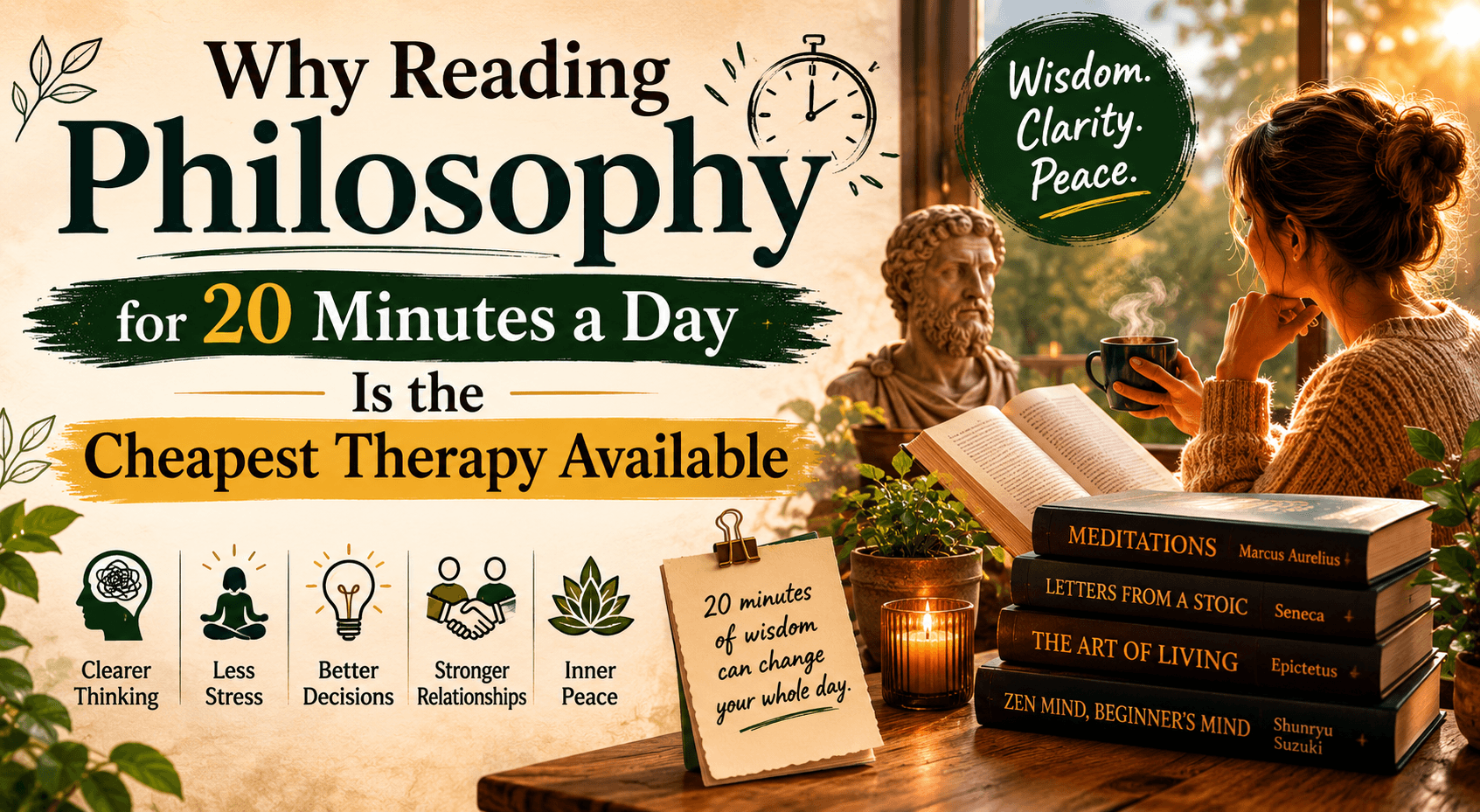
Therapy addresses what’s broken. Philosophy addresses how you think. Both are necessary, and only one requires a copay.
I want to be clear from the start: this piece isn’t anti-therapy. Professional therapeutic support, for those who need it, does things that no book can do. It provides a relationship, a witness, a skilled guide through material that’s often too charged to navigate alone.
But for the ordinary, persistent stress of being human — the chronic dissatisfaction, the difficulty with impermanence, the relationship friction, the recurring anxieties that aren’t disorders but are genuinely wearing — philosophy is an underused resource.
And twenty minutes a day is enough to begin.
What Philosophy Actually Does
Most people imagine philosophy as abstract argument about things that don’t matter. Academic philosophy is often that. But the ancient philosophical traditions — Stoicism, Buddhism, Epicureanism, Taoism — were primarily practical. They were guides to how to live, how to suffer less, how to engage with other people, how to face death without panic.
Their central project was what we’d now call cognitive restructuring: examining the beliefs and assumptions that cause suffering, testing whether those beliefs are actually true, and replacing distorted thinking with clearer thinking. Cognitive-behavioural therapy, developed in the 20th century, draws explicitly on this ancient tradition. Aaron Beck, who created CBT, credited the Stoics.
The Specific Things Philosophy Changes
Your Relationship with Impermanence
One of the deepest sources of chronic anxiety is the refusal to accept that everything changes — relationships, health, status, life itself. Philosophy across traditions addresses this directly. The Stoics practised memento mori (the acknowledgement of mortality). Buddhism placed impermanence at the centre of its analysis of suffering.
Reading these perspectives regularly doesn’t make you morbid. It does the opposite — it reduces the low-level dread that comes from trying to hold things in place that can’t be held.
Your Relationship with Other People
Much of interpersonal frustration comes from the assumption that other people should behave differently than they do. Epictetus wrote about this with particular clarity: we suffer not from the actions of others, but from our judgments about those actions.
This is not passive acceptance of mistreatment. It’s a distinction between what you can and cannot influence — and the freedom that comes from genuinely understanding that other people’s choices are, at their core, up to them.
Your Relationship with Failure and Setback
The philosophical reframe of obstacles — from Marcus Aurelius’s view that the impediment to action advances action, to the Buddhist concept of difficulty as a teacher — doesn’t make failure painless. But it does make it less conclusive. Failure becomes information rather than verdict.
Twenty Minutes: What to Actually Read
For someone beginning this practice, here’s a practical starting sequence:
Weeks 1–4: Meditations by Marcus Aurelius — 1–2 entries each morning
Weeks 5–8: Letters from a Stoic (Seneca) — 3–4 pages in the evening
Weeks 9–12: The Art of Living by Epictetus (Sharon Lebell translation) — short, very direct
Ongoing: Return to whichever text felt most alive
The Practice, Not Just the Reading
Reading philosophy is useful. Sitting with it briefly afterward is more useful. After your twenty minutes, ask yourself one question: What did I read that applies to something actual in my life right now?
Not in theory. Not to someone else’s situation. To yours, specifically, today.
That move — from the abstract to the particular — is what converts philosophical reading from intellectual exercise into genuine self-examination.
On Cost
Most of the primary Stoic texts are in the public domain. They’re available free through Project Gutenberg. A physical copy of Meditations costs less than a cup of coffee.
The investment isn’t financial. It’s attentional. Twenty minutes taken from social media, from half-watching something, from the ambient noise of the evening — given instead to a text that has genuinely helped people navigate being alive.
Philosophy won’t fix what’s broken. But twenty minutes a day of honest thinking, guided by people who thought about these things more carefully than most of us have time to, changes the quality of everything else.
