
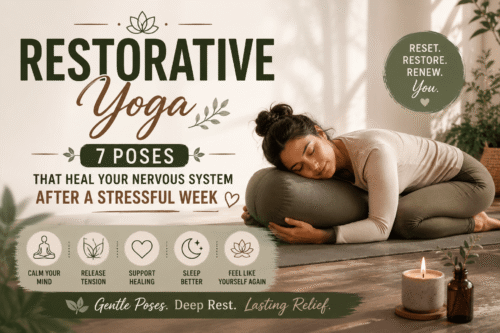
Restorative Yoga: 7 Gentle Poses to Calm Your Nervous System Naturally
Modern life teaches us how to stay busy but rarely teaches us how to truly recover. After a stressful week filled with deadlines, responsibilities, screen exposure, and constant mental activity, people try to relax by watching television or scrolling through their phones. These activities provide a temporary distraction. They often do not give the body and mind the deep recovery they actually need.
This is where restorative yoga offers a different approach.
Restorative yoga is a gentle practice designed to help your body slow down, release accumulated tension, and enter a state of deep relaxation. Unlike active yoga styles that focus on strength, flexibility, or movement, restorative yoga focuses on stillness, support, mindful breathing, and allowing the nervous system to settle.
Using simple props like blankets, pillows, yoga bolsters, or blocks, restorative yoga poses allow your muscles to relax completely. The body receives a powerful message:
“You are safe. You can rest.”
Over time, practicing restorative yoga may support better stress management, emotional balance, sleep quality, and overall wellness.
If you enjoy gentle wellness practices, try restorative yoga with simple daily yoga for energy and natural wellness. This creates a balanced routine that supports movement and deep relaxation.
In this guide, you will discover:
- What restorative yoga is
- How it helps your nervous system recover
- The science behind deep relaxation
- 7 beginner-friendly restorative yoga poses
- A simple 45-minute recovery routine
- Helpful yoga accessories
- Safety tips for beginners
What Is Restorative Yoga?
Restorative yoga is a slow, relaxing style of yoga where the body is fully supported in comfortable positions for several minutes at a time.
The goal is not stretching harder.
The goal is letting go.
In many traditional yoga practices, your muscles actively work to hold poses. In restorative yoga, pillows, bolsters, blankets, blocks, or even household items provide support so your muscles can soften naturally.
A single restorative pose may be held for:
- 5 minutes
- 10 minutes
- Sometimes even longer
During this time, you focus on:
- Slow breathing
- Body awareness
- Relaxing physical tension
- Calming mental activity
This makes restorative yoga especially helpful for people experiencing the following:
- Daily stress
- Mental tiredness
- Poor sleep quality
- Physical tension from sitting
- Emotional exhaustion
It is also beginner-friendly because you do not need advanced flexibility or previous yoga experience.
A quiet space, comfortable support, and willingness to slow down are enough.
For people looking to build a complete wellness lifestyle, restorative yoga works beautifully alongside daily wellness habits for a balanced lifestyle, where small daily choices support long-term health.
How Restorative Yoga Supports Stress Recovery
Stress is not only something you feel emotionally. Your body experiences stress physically.
When life becomes overwhelming, your body activates its survival system.
This response is useful during real danger, but modern challenges often keep people in this alert state for too long.
Examples include:
- Work pressure
- Financial worries
- Lack of sleep
- Digital overload
- Constant multitasking
Your body may respond with:
- Tight shoulders
- Shallow breathing
- Neck tension
- Racing thoughts
- Digestive discomfort
- Difficulty sleeping
Restorative yoga encourages the opposite response.
Through supported relaxation, gentle breathing, and mindful stillness, the body gradually shifts from a stress-dominant state toward recovery.
Restorative yoga supports:
1. Muscle Relaxation
When your body feels safe and supported, tight muscles naturally begin releasing unnecessary tension.
Areas that commonly soften include:
- Neck
- Shoulders
- Lower back
- Hips
2. Better Breathing Patterns
Stress often creates short, shallow chest breathing.
During restorative yoga, slow breathing encourages deeper movement of the diaphragm.
This type of breathing is closely connected with relaxation.
You can improve this effect by combining your practice with simple breathing practices and pranayama techniques for relaxation.
3. Mental Calmness
Stillness gives your mind space.
Instead of constantly processing information, restorative yoga creates moments of quiet awareness.
Many practitioners combine restorative poses with body scan meditation for stress relief and better sleep to deepen relaxation.
Science Behind Nervous System Relaxation
Your nervous system controls how your body responds to stress and relaxation.
A major part involved in this process is the autonomic nervous system, which has two important branches.
The Sympathetic Nervous System: Your Activity Mode
The sympathetic nervous system is often called the “fight-or-flight” system.
It prepares your body for action.
When activated, it may:
- Increase heart rate
- Speed breathing
- Increase alertness
- Tighten muscles
This response can be useful temporarily.
However, staying in this mode continuously may leave you feeling tired, tense, and emotionally drained.
The Parasympathetic Nervous System: Your Recovery Mode
The parasympathetic nervous system is commonly known as the “rest-and-digest” system.
It helps support:
- Relaxation
- Digestion
- Recovery
- Restful sleep
Restorative yoga uses:
- Comfortable supported positions
- Slow breathing
- Mindfulness
- Reduced stimulation
to encourage this natural recovery state.
The Relaxation Response
Scientists who study mind-body practices describe a state called the relaxation response. In this state, the body shows changes that are opposite to stress.
Research suggests relaxation techniques may support:
- Lower stress levels
- Improved emotional regulation
- Better overall well-being
External authority reference:
Scientific research on yoga and stress management explores how yoga and relaxation practices influence stress, mental well-being, and quality of life.
Another helpful resource explains how relaxation techniques may positively affect the mind-body connection.
The National Center for Complementary and Integrative Health also provides scientific evidence on yoga benefits and wellness-based information about yoga research.
Restorative yoga is not about forcing your body to change.
It is about creating the right environment where your body naturally remembers how to relax.
7 Restorative Yoga Poses to Calm Your Nervous System Naturally
Restorative yoga does not require advanced flexibility or physical strength. The main purpose is to create comfort, safety, and deep relaxation.
Before starting:
- Choose a quiet place
- Turn off unnecessary distractions
- Use comfortable support
- Breathe slowly and naturally
- Never force your body into discomfort
Allow each posture to become a place of recovery rather than another exercise goal.
1. Supported Child’s Pose (Balasana)
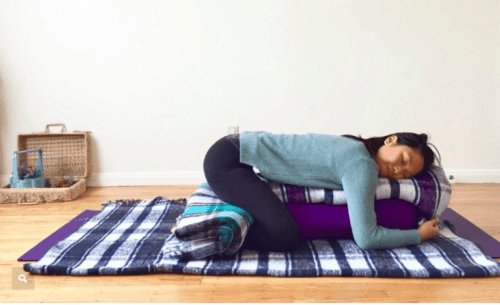
How to Do It: Kneel on the floor, open your knees wide, and place a long, firm pillow or folded blankets between your thighs. Fold forward from the hips, letting your entire torso rest completely on the support. Turn your head to one comfortable side. Hold for 5–10 minutes.
Why It Works: This position creates a comforting “coiled” shape that instantly makes the body feel safe, while gently stretching and releasing the lower back, hips, and shoulders simultaneously.
The Science: The physical pressure of the support against your abdomen provides a gentle, direct stimulation to the vagus nerve via your gut, sending an immediate “all clear” signal to your brain.
2. Legs-Up-the-Wall (Viparita Karani)
How to Do It: Sit sideways with one hip flush against a wall. In one smooth motion, swing your legs up onto the wall as you lower your back and head to the floor. Your sitting bones should be as close to the wall as comfortable, with your legs resting vertically. Let your arms rest wide. Hold for 10–15 minutes.
Why It Works: This is one of the most clinically studied restorative poses. Regular practitioners frequently report rapid drops in daily anxiety levels and drastically improved sleep quality.
The Science: Reversing the physical effects of gravity pools blood from the lower extremities back toward the heart, which activates baroreceptors (blood pressure sensors) that tell your cardiovascular system to slow down and chill out.
3. Supported Bridge Pose
How to Do It: Lie flat on your back with your knees bent and feet flat on the floor. Lift your hips just high enough to slide a block, a firm yoga prop, or a thick stack of books directly under your sacrum (the flat, hard bone at the very base of your spine). Lower your weight completely onto the support. Hold for 5–10 minutes.
Why It Works: This very gentle inversion opens up the chest and shoulders, perfectly counteracting the slouched, forward-folded posture most of us hold over keyboards and steering wheels all day.
The Science: This mild backbend stretches and releases the psoas muscle (the deep hip flexor). The psoas is one of the primary physical muscles that automatically tenses and locks up during a chronic fight-or-flight stress response.
4. Reclined Bound Angle (Supta Baddha Konasana)
How to Do It: Lie down on your back. Bring the soles of your feet together to touch, and let your knees gently fall open to the sides like a book. To prevent straining, place pillows or folded blankets underneath the outside of each knee. Rest one hand over your belly and one hand over your heart. Hold for 10 minutes.
Why It Works: This is the ultimate restorative posture for emotional anxiety. The physical hand placement anchors your awareness, encouraging immediate diaphragmatic (deep belly) breathing.
Mindfulness research explores how awareness-based practices may support stress management and mental wellness. The open-hip shape targets and relaxes the adductor muscles of the inner thighs. Because of how our pelvis works, the inner thighs hold a lot of hidden postural tension.This tension links to our instinctive “curl into a ball” defense reflex.
5. Side-Lying Savasana
How to Do It: Lie down comfortably on your right side. Place a supportive bed pillow between your knees to keep your hips aligned, and another pillow under your head so your neck stays relaxed. Keep your spine in a loose, natural curve. Hold for 10–15 minutes.
Why It Works: This is the preferred deep relaxation posture for anyone who experiences lower back pain, tension, or general discomfort when lying perfectly flat on their back.
The Science: Resting specifically on your right side optimizes your body’s blood flow and circulation, leaving your heart in a slightly less gravity-pressured position while physically supporting healthy digestion.
6. Supported Seated Forward Fold
How to Do It: Sit up on the floor with your legs extended straight out in front of you. Pile a couple of bed pillows or folded blankets along the tops of your legs. Fold your upper body forward from the hips, resting your torso and your forehead entirely onto the soft support. Hold for 5–8 minutes.
Why It Works: Forward-folding positions naturally quiet down a racing mind. This fully supported variation removes the intense hamstring and lower back pulling that makes a standard stretch feel like hard work.
7. Full Savasana with an Eye Mask
How to Do It: Lie completely flat on your back. Place a rolled-up blanket under your knees to take all the pressure off your lower back. Place a dedicated eye pillow, sleep mask, or a soft washcloth over your closed eyes. Let your feet splay open, and your palms turn up. Do absolutely nothing. Hold for 15 minutes.
The Science: Blocking ambient light while adding a slight, gentle weight to your eyelids can trigger the oculocardiac reflex. This reflex sends a message through your cranial nerves. It slows your heart rate and lowers your blood pressure.
If you want to create a complete home practice space, read How to choose the best organic yoga accessories for your yoga routine
Putting a Session Together
You don’t need to struggle through all seven poses in a single evening to feel the shift. A perfect, highly effective 45-minute weekend decompression routine looks like this:
| Order | Restorative Pose | Time Commitment |
| 1 | Supported Child’s Pose | 7 Minutes |
| 2 | Reclined Bound Angle | 10 Minutes |
| 3 | Legs-Up-the-Wall | 12 Minutes |
| 4 | Full Savasana | 15 Minutes |
That’s it. There are no transitions to worry about, no complex flows to memorize, and zero muscular effort required. It is simply a smart, intentional sequence of supported shapes designed to progressively pull your body out of survival mode and slide it back into balance.
The week carries weight. Restorative yoga is how you finally set it down.
45-Minute Restorative Yoga Routine for Deep Relaxation
One of the beautiful things about restorative yoga is that you do not need complicated sequences or hours of practice to experience its benefits.
Even a simple weekly routine can create space for your body and mind to slow down.
Unlike intense workouts where progress is measured by effort, restorative yoga teaches you the opposite lesson:
Recovery is also part of health.
The goal is not to stretch further or achieve the perfect pose. The goal is to create enough comfort that your nervous system receives the message that it is safe to relax.
Before Starting Your Practice
Prepare your environment:
- Reduce bright lighting
- Silence your phone notifications
- Wear comfortable clothing
- Keep blankets nearby
- Practice slow breathing
You may also add calming background sounds, nature sounds, or a short meditation before beginning.
For a deeper relaxation experience, combine your yoga practice with guided body scan meditation for stress relief and peaceful sleep.
This combination helps bring awareness from a busy mind back into the present moment.
Best Restorative Yoga Accessories for a Comfortable Home Practice
You can practice restorative yoga without expensive equipment. Pillows, blankets, and household items work well.
However, proper yoga accessories can improve comfort, alignment, and relaxation—especially if you plan to practice regularly.
1. Restorative Yoga Bolster
Best restorative yoga bolster for deep relaxation
2. Organic Yoga Mat
3. Yoga Blocks
Beginner-friendly yoga blocks for home practice
4. Meditation Cushion
For complete mind-body wellness, explore the power of mindfulness and breath awareness in yoga.
5. Eye Pillow or Sleep Mask
This simple accessory can transform your final relaxation practice.
Safety Tips Before Practicing Restorative Yoga
Restorative yoga is gentle, but practicing with awareness is important.
Follow these beginner safety guidelines.
1. Never Force a Position
Restorative yoga should never feel painful.
Remember:
Comfort first.
Flexibility second.
If your body feels uncomfortable, add more support.
2. Use Enough Props
Many beginners use too little support.
The purpose of restorative yoga is not holding yourself up.
Your blankets, pillows, and props should do the work.
3. Breathe Naturally
Avoid forcing deep breathing.
Simply observe:
- Slow inhale
- Gentle exhale
- Natural rhythm
Relaxation improves when breathing feels effortless.
4. Listen to Your Body
Modify poses if you experience:
- Joint discomfort
- Pressure
- Pain
- Dizziness
People with injuries or medical concerns should seek guidance from a qualified professional.
Frequently Asked Questions About Restorative Yoga
1. Is restorative yoga good for beginners?
Yes. Restorative yoga is one of the most beginner-friendly yoga practices.
You do not need:
- Advanced flexibility
- Strong muscles
- Previous yoga experience
The body is fully supported, making the practice accessible for many fitness levels.
2. How often should I practice restorative yoga?
Many people benefit from practicing:
- 10–20 minutes daily
or
- A longer 45–60 minute weekly session
Consistency matters more than duration.
3. What is the best time to practice restorative yoga?
Restorative yoga can be practiced anytime.
Morning practice may help create calm focus.
Evening practice may help release stress accumulated during the day.
4. Can restorative yoga help with sleep?
Restorative yoga may support better sleep preparation by helping the body relax before bedtime.
Gentle movement, slow breathing, and reduced stimulation can create a peaceful nighttime routine.
5. Is restorative yoga the same as meditation?
No.
They are different but complementary.
Meditation mainly trains awareness of the mind.
Restorative yoga combines:
- Physical support
- Relaxed postures
- Breath awareness
- Mindfulness
Together, they create a powerful relaxation practice.
6. Can seniors practice restorative yoga?
Yes.
Because restorative yoga is gentle and adaptable, many older adults enjoy it.
Props can make poses easier and more comfortable.
Conclusion: Restorative Yoga Is the Art of True Recovery
In a world that constantly encourages movement, achievement, and productivity, slowing down can feel unfamiliar.
But true wellness is not created only through doing more.
Sometimes healing begins when we allow ourselves to pause.
Restorative yoga teaches us that relaxation is not laziness—it is a necessary part of maintaining physical, mental, and emotional balance.
Through simple supported poses like
- Supported Child’s Pose
- Legs-Up-the-Wall
- Reclined Bound Angle
- Restorative Savasana
You create moments where your body can release tension and your mind can return to stillness.
You do not need expensive equipment.
You do not need advanced skills.
You only need:
A quiet space.
A few minutes.
A willingness to slow down.
The stress of the week may feel heavy—but restorative yoga gives you a gentle way to finally set it down.

