
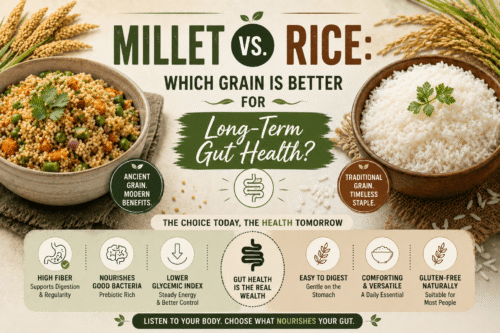
Millet vs. Rice: Which Grain Is Better for Gut Health, Digestion & Long-Term Wellness?
For thousands of years, grains have been at the centre of human nutrition. From traditional Asian kitchens to ancient farming communities, grains have provided energy, comfort, and nourishment. Among these grains, rice and millet hold a special place.
Rice is more than just food in many cultures. Across India and Southeast Asia, rice represents tradition, family meals, festivals, and daily comfort. A simple bowl of rice with vegetables, lentils, or traditional curries has supported generations.
Millet, however, tells a different story.
Our ordinary village food, or a forgotten traditional grain, millet, is now returning as a powerful nutritional choice. Ancient grains—finger millet (ragi/kezhvaragu), pearl millet (bajra/kambu), foxtail millet (thinai), and little millet (samai)—are becoming popular. Because of their potential benefits for digestion, blood sugar balance, and overall wellness.
Improving gut health is not only about choosing the right grains. A balanced lifestyle with a simple, balanced diet for holistic wellness supports better digestion, energy, and overall health.
This growing interest has created an important question:
Millet vs. rice—which grain is truly better for long-term gut health?
The answer is not about completely removing rice from your plate. Instead, it is about understanding how different grains influence your gut microbiome, digestion, energy levels, and long-term health..
What Makes a Grain Healthy for Your Gut?
A healthy digestive system is much more than simply avoiding stomach discomfort. Modern research shows that gut health influences many areas of wellness, including:
- Nutrient absorption
- Immune function
- Metabolism
- Inflammation control
- Energy levels
- Overall well-being
Inside your digestive system lives a large community of microorganisms known as the gut microbiome. Along with fiber-rich foods, traditional cultures use natural herbal remedies for daily wellness to support a balanced lifestyle.
A balanced gut microbiome needs the following:
- Different types of dietary fibre
- Prebiotic foods
- Plant diversity
- Slow-digesting carbohydrates
- Nutrient-rich foods
This is where the comparison between millet and rice becomes interesting.
Both provide carbohydrates, but their effects on gut bacteria and digestion can be different.
Millet vs Rice Nutrition Comparison
Rice and millet both provide energy, but their nutritional profiles are not identical.
| Nutrition Factor | Millet | White Rice |
|---|---|---|
| Fibre | Higher | Lower |
| Protein | Moderate | Lower |
| Minerals | Rich source | Reduced after polishing |
| Glycemic response | Usually lower | Often higher |
| Gut bacteria support | Better | Limited |
| Digestibility | Moderate | Very easy |
Polished white rice loses many nutrients during processing because the outer fiber-rich layers are removed.
Millets, especially whole-grain varieties, naturally retain more fiber, minerals, and beneficial plant compounds.
This makes millet a strong choice for people looking for a high-fiber traditional grain for digestive health.
Millet vs Rice: Fibre and Gut Health
One of the biggest differences between millet and rice is dietary fiber.
Fiber is not just important for bowel movements. It also acts as food for beneficial gut bacteria.
When healthy bacteria digest fiber, they produce compounds called short-chain fatty acids (SCFAs). These compounds support:
- Intestinal lining health
- Gut barrier function
- Balanced inflammation response
- Colon health
Millets naturally contain significantly more fiber than polished white rice. The exact amounts depend on the variety and cooking method. Whole grains are widely studied for their role in wellness, including the health benefits of whole grains in a balanced diet.
Examples of fiber-rich millets include:
Finger Millet (Ragi)
Known traditionally as kezhvaragu in Tamil Nadu, ragi contains the following:
- Dietary fibre
- Calcium
- Polyphenols
- Slow-digesting carbohydrates
Pearl Millet (Kambu/Bajra)
Pearl millet is valued for:
- Fibre content
- Mineral richness
- Satiety support
Little Millet (Samai)
Little millet is often preferred because it is:
- Light
- Easy to prepare
- Suitable for beginners switching from rice
For people aiming to naturally improve digestion, adding different millet varieties can increase dietary diversity. Learn more about natural ways to improve digestion and daily wellness.
Prebiotic Benefits: How Millet Supports Gut Bacteria
Your gut bacteria need the right food to survive.
Foods that feed beneficial bacteria are called prebiotics.
Millets contain compounds such as the following:
- Resistant starch
- Dietary fibre
- Certain plant carbohydrates
These compounds may support beneficial bacteria, including:
- Lactobacillus species
- Bifidobacterium species
A diverse gut microbiome is often associated with better digestive balance and overall health.
Scientific research on dietary fiber and gut microbiome health shows a strong link between fiber intake and gut bacteria. Trusted nutrition review studies report that fiber intake has dropped over recent centuries. This drop has harmed gut health and contributed to obesity, type 2 diabetes, and other metabolic disorders. The gut microbiota’s responses to dietary changes vary based on the type, amount, and duration of fiber intake. Understanding this interplay can inform effective intervention strategies for managing type 2 diabetes and other noncommunicable diseases. The paper emphasizes the importance of specific dietary fiber thresholds for optimizing gut microbiota and related metabolic health outcomes.
Rice can also develop some resistant starch when cooked and cooled. This is why leftover cooled rice may have a different effect compared with freshly cooked hot rice.
However, millet naturally provides a wider range of fiber types.
Millet vs Rice for Blood Sugar Balance
Blood sugar balance is closely connected with digestive health.
Frequent large blood sugar spikes may influence:
- Metabolic function
- Energy stability
- Inflammatory responses
White rice, especially highly polished varieties, usually has a higher glycemic impact.
The glycemic index (GI) measures how quickly a carbohydrate-containing food raises blood sugar.
Many millet varieties generally have a lower glycemic response because they contain:
- More fibre
- More protein
- Slower-digesting carbohydrates
However, blood sugar response also depends on:
- Portion size
- Cooking method
- Food combinations
- Overall lifestyle
For example:
Eating rice with vegetables, lentils, healthy fats, and protein creates a different response compared with eating a large serving of plain white rice alone. Combining healthy grains with movement, such as understanding daily walking benefits for holistic health, can support metabolism and long-term wellness.
Is Rice Bad for Gut Health?
A common misunderstanding is that millet is good and rice is bad.
That is not true.
Rice has supported traditional diets for thousands of years.
White rice has some advantages:
- Easy digestion
- Gentle on the stomach
- Quick energy source
- Suitable during digestive recovery
This is why plain rice preparations are often used when someone has digestive discomfort.
Problems usually appear when the modern diet depends heavily on large portions of polished rice with:
- Low vegetable intake
- Low fibre intake
- Highly processed foods
- Limited food variety
The goal should not always be replacing rice completely.
The healthier approach is creating grain diversity.
Digestibility: Where Rice Has an Advantage
When discussing millet vs rice, digestion speed matters.
White rice is one of the easiest grains to digest.
This makes it useful for:
- Sensitive digestion
- Recovery periods
- Times when the gut needs gentle foods
Millets contain more fibre, which is beneficial long-term but may initially cause:
- Gas
- Fullness
- Bloating
This happens especially when someone suddenly changes from a low-fiber diet to a high-fibre diet.
The solution is simple:
Introduce millet slowly.
Allow your gut bacteria time to adjust.
How to Prepare Millet for Better Digestion
Traditional preparation methods make millet easier on the stomach.
1. Wash Properly
Always rinse millet before cooking.
This removes:
- Dust
- Natural residues
- Bitter taste
2. Soak Millet Before Cooking
Soaking for 6–8 hours can improve preparation quality.
Traditional soaking may help:
- Improve texture
- Reduce some naturally occurring antinutrients
- Make cooking easier
3. Cook Until Soft
Avoid undercooked millet.
For soft millet:
Use approximately:
1 cup millet
2.5–3 cups water
Adjust based on the variety.
4. Combine With Gut-Friendly Foods
Traditional combinations work beautifully:
Examples:
- Millet + vegetables
- Millet + lentils
- Millet + fermented foods
- Millet + curd/yogurt
Discover more about healthy morning nutrition habits for better wellness.
Traditional Millet Wisdom from India
Before polished rice became dominant, many Indian communities regularly consumed different grains.
Traditional Tamil foods included:
- Kambu koozh
- Ragi kali
- Thinai dishes
- Samai preparations
These diets naturally provided:
- More plant diversity
- More fibre sources
- Seasonal eating habits
Modern nutrition science increasingly recognizes the importance of dietary diversity for supporting gut microbial health.
Traditional food wisdom and modern research often meet at the same point. Research published in Circulation indicates that increasing whole grain consumption may lower the risk of premature death.
An analysis of 12 studies with 786,076 participants found clear benefits from whole grains. People who ate 70 grams daily, about four servings, had lower death risks. They had a 23% lower risk of death from cardiovascular disease. They also had a 20% lower risk of cancer death.
This was compared to people with little or no whole-grain intake. The study emphasizes that while 70 grams is optimal, even 50 grams can be beneficial. Whole grains are rich in nutrients such as fiber and vitamins that contribute to heart and cancer health. Simple food options to achieve this intake include whole-grain bread and oatmeal.
Eat a variety of natural, whole foods.
Which Millet Is Best for Gut Health?
Different millets offer different benefits.
Finger Millet (Ragi)
Best known for:
- Fibre
- Calcium content
- Traditional use
Good for:
- General wellness diets
- Traditional recipes
Pearl Millet (Kambu/Bajra)
Useful because of:
- Fibre
- Minerals
- Long-lasting fullness
Good for:
- Active lifestyles
Foxtail Millet (Thinai)
Popular because it is:
- Versatile
- Mild tasting
- Easy to include in meals
Little Millet (Samai)
A good beginner millet because it is:
- Softer
- Easier to cook
- Similar to rice texture
Practical Millet vs Rice Diet Plan
A balanced weekly approach:
Monday:
Millet breakfast + rice lunch
Tuesday:
Rice meal with vegetables and protein
Wednesday:
Ragi or kambu recipe
Thursday:
Traditional rice meal
Friday:
Foxtail millet preparation
Saturday:
Mixed grains
Sunday:
Your preferred traditional meal
Balance is more sustainable than restriction.
Product Opportunity
For readers interested in adding millet to their lifestyle:
Consider:
- Organic ragi flour
- Traditional pearl millet
- Foxtail millet packs
- Millet breakfast mixes
- Millet cookbooks
- Healthy cooking equipment
Choose minimally processed products whenever possible.
Frequently Asked Questions
Is millet healthier than rice?
Millet usually contains more fibre and minerals compared with polished white rice. However, both can be part of a balanced diet.
Can I eat millet every day?
Yes, many people can include millet regularly. Rotating between different grains provides better nutritional diversity.
Which millet is easiest to digest?
Little millet and foxtail millet are often easier options for beginners, especially when soaked and cooked properly.
Is millet better than rice for weight management?
Millet’s higher fibre content may increase fullness, which can support healthy eating habits. Weight management depends on the complete diet and lifestyle.
Should diabetic people replace rice with millet?
Many millets have a lower glycemic impact than polished rice, but individual needs vary. People managing diabetes should follow personalised medical nutrition advice.
Final Thoughts: Millet vs. Rice—Which Wins for Gut Health?
When comparing millet vs rice for long-term gut health, millet has several advantages because of its fibre, plant compounds, and ability to support dietary diversity.
Rice, however, remains a valuable traditional food with excellent digestibility.
The healthiest choice is not about removing one grain completely.
A balanced approach is:
Eat millet regularly.
Enjoy rice mindfully.
Increase vegetables and natural foods.
Respect traditional food wisdom.
Your gut benefits most from variety—and both ancient grains can have a place on a healthy plate.

