
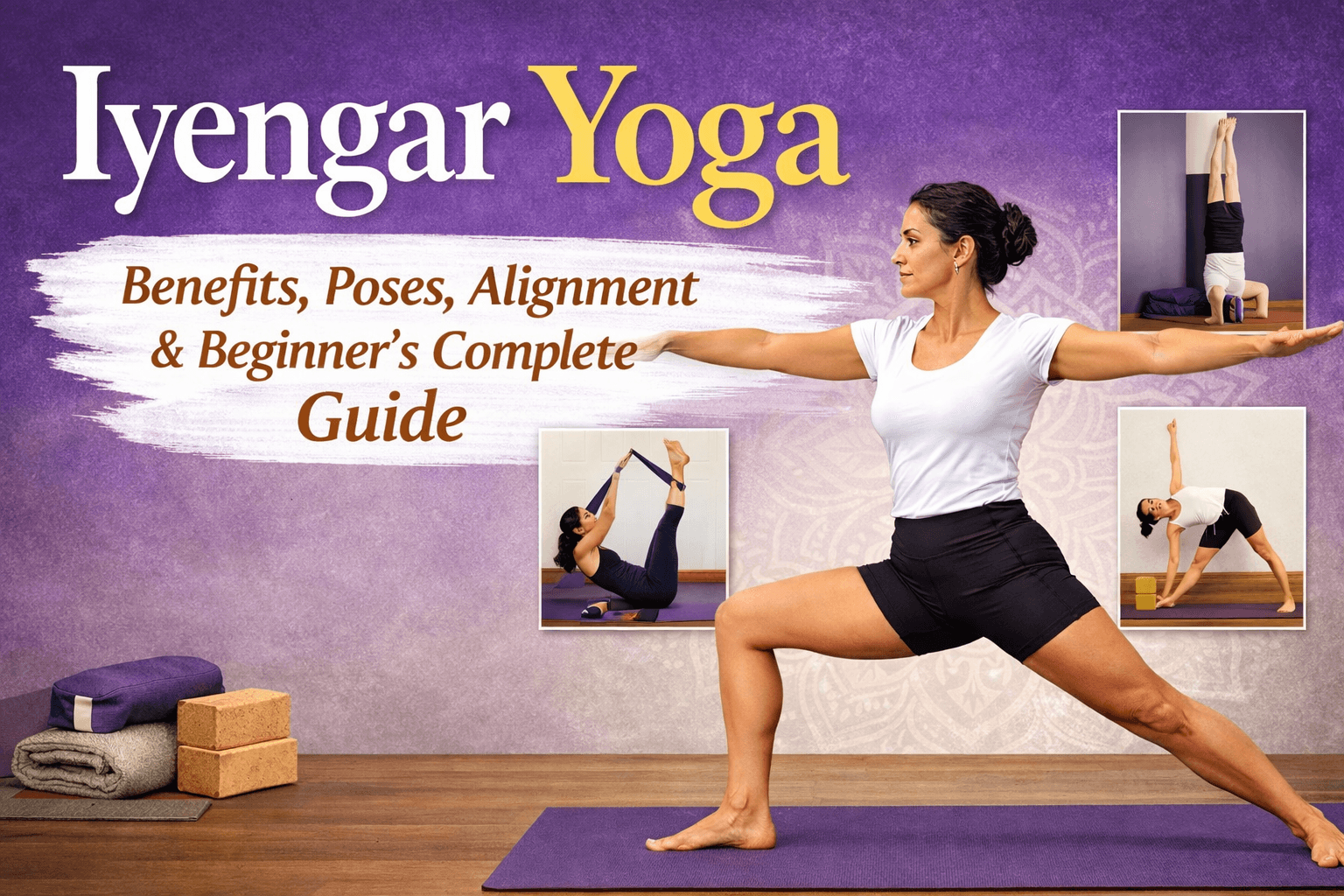
Iyengar Yoga Guide: Benefits, Poses & Alignment for Beginners
Introduction
Yoga has evolved into dozens of styles, from sweat-inducing flows to quiet meditations. But if you have ever felt “lost” in a fast-paced class or worried about whether your posture was actually doing more harm than good, you aren’t alone.
Among the many paths of Hatha Yoga, Iyengar Yoga stands out as the “gold standard” for precision. Developed by B.K.S. Iyengar, this method prioritizes correct alignment and mindful movement, making it a powerful therapeutic tool for beginners, seniors, and those recovering from injuries.
If you’re exploring different yoga styles, you may also find it helpful to read The Ultimate Guide to Yoga for Health, Flexibility, and Mental Wellness, which explains how various yoga practices support overall well-being.
Iyengar Yoga is a form of Hatha Yoga that focuses on precise alignment, controlled breathing, and the use of props like blocks, straps, and bolsters to perform poses safely and effectively.
Here’s a personal, authentic, and engaging blog-style piece on your experience with Iyengar Yoga. It’s written to feel real, reflective, and relatable
What is Iyengar Yoga
Iyengar Yoga is a form of Hatha Yoga developed by the renowned yoga teacher B.K.S. Iyengar. This method emphasizes:
- Precise body alignment
- Controlled breathing
- Use of props for support
The goal is to perform each pose safely and effectively, regardless of age or physical ability.
Props such as blocks, straps, bolsters, chairs, and blankets are commonly used to:
- Improve posture
- Reduce strain
- Make poses accessible
“Unlike fast-flow styles like Vinyasa Yoga for Weight Loss: The Complete Guide to Fat Burning and Fitness. Iyengar Yoga focuses on holding poses longer to improve strength and awareness.”
My Journey: From “Doing” Yoga to “Understanding” It
When I started yoga, I just wanted to become more flexible and feel less stressed in my daily life. Like many beginners, I hopped through various classes, often feeling overwhelmed by the speed. I was “doing” the poses, but I didn’t truly understand them.
That changed the moment I walked into my first Iyengar session.
The “Slow” Revelation I still remember the immediate shift in atmosphere. There was no loud music or rapid-fire sequences. Instead:
- The Pace Was Deliberate: People held poses significantly longer than I was used to.
- The room was a laboratory: blocks, straps, blankets, and bolsters were everywhere—not as “crutches,” but as precision tools.
- The Focus Was Microscopic: The instructor didn’t just say “stand up straight”. They taught me how to engage the four corners of my feet and align my pelvic bowl.
At first, I wondered, “Why is everything so slow?” But within twenty minutes, I realised something profound: I had never actually been fully aware of my body before.
What Makes Iyengar Yoga Unique?
The shift I experienced wasn’t accidental—it is the core philosophy of the practice. The dynamic styles of Vinyasa Flow focus on the transition between poses. But Iyengar focuses on the integrity of the pose itself.
1. The Power of Alignment
In Iyengar, alignment isn’t about looking “perfect”; it’s about muscle efficiency and safety. When your bones are stacked correctly, energy flows better, and the risk of injury vanishes. This awareness eventually follows you off the mat. I found myself sitting taller at my desk and standing with more balance in my daily life.
2. Props: The Great Equalizers
One of my biggest hurdles was the ego. I initially thought using a block meant I “wasn’t flexible enough.” Iyengar flipped that script. Props allow you to:
- Experience the full benefit of a pose without straining.
- Reach depths that your current range of motion wouldn’t otherwise allow.
- Build confidence by removing the fear of falling or overextending.
3. Strength Through Stillness
Holding a pose for two minutes is often harder than moving through ten poses in sixty seconds. This “slowness” is where the transformation happens. It builds deep, stable muscle strength. It also develops a level of patience and mental clarity that fast-paced styles often miss.
The Science Behind the Stillness
It isn’t just a personal feeling—clinical research supports why this meticulous approach works. Research in the Annals of Internal Medicine shows yoga improves flexibility, strength, and back pain. It also increases body awareness and helps relax the mind and muscles.
By focusing on the “Right Way” to do a pose, we aren’t just exercising; we are re-programming our nervous system for better health.
The 4 Pillars of Iyengar Yoga
To understand how transformative this practice is, you have to look at the four specific elements that define every session:
- Alignment: Ensuring the body is anatomically correct to settle the mind and protect the joints.
- Precision: Every movement is intentional. You don’t just “do” a pose; you refine it
- Sequencing: Poses are taught in a specific order to build heat safely and open the body systematically.
- Timing: Holding poses longer than in a “Flow” class to build deep cellular strength and endurance.
This differs from flowing styles like Ashtanga Yoga: A Complete Guide for Strength, Discipline, and Mind-Body Balance
1. Scientifically Proven Benefits
While the personal feeling of “calm” is wonderful, the medical community has extensively studied Iyengar Yoga for its clinical applications.
| Benefit | How it Works | Evidence |
| Corrects Posture | Strengthens the deep stabilizers of the spine and core. | Annals of Internal Medicine (Reduced chronic back pain). |
| Increases Flexibility | Uses props to achieve deep stretches without “snapping” the muscle. | International Journal of Yoga (Improved balance & range). |
| Reduces Stress | Long holds combined with pranayama (breath) lower cortisol. | Journal of Alternative & Complementary Medicine. |
| Heart Health | Improves circulation and can help lower resting blood pressure. | American Heart Association (Cardiovascular risk reduction). |
Essential Poses for Beginners
If you are ready to start, these four foundational asanas (poses) are the best place to begin. In an Iyengar class, you will likely use props to ensure these are done with 100% accuracy.
1. Mountain Pose (Tadasana)
The blueprint for all other poses. It teaches you how to stand with equal weight on both feet and an elongated spine.
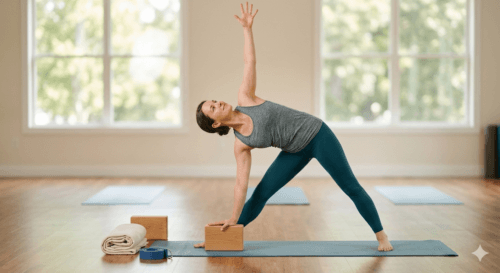
2. Triangle Pose (Trikonasana)
A powerful stretch for the legs and hips. The Iyengar Way: Use a wooden block under your bottom hand so your chest stays open toward the ceiling rather than collapsing forward.
3. Downward Facing Dog (Adho Mukha Svanasana)
The ultimate full-body rejuvenator. The Iyengar Way: If your hamstrings are tight, placing your hands on “bricks” or a chair can help you find the necessary length in your spine.
4. Bridge Pose (Setu Bandhasana)
Opens the heart and strengthens the back. The Iyengar Way: Placing a bolster or block under the sacrum (lower back) turns this into a “restorative” pose that deeply calms the nervous system.
How to Start Your Iyengar Journey
Because of its focus on detail, I always recommend starting with a structured approach rather than “winging it.”
- Find a Certified Teacher: Iyengar certification is one of the most rigorous in the world (often taking years). Look for the “IYENGAR®” trademark.
- Invest in “The Basics”: You don’t need a home studio, but a pair of foam blocks and a sturdy cotton strap will change your practice overnight.
- Listen to Your Body: Iyengar isn’t about “no pain, no gain.” It’s about “no strain, more gain.” If a pose feels sharp or pinching, back off and use a prop.
- Be Patient: As I learned, slow progress is often the most permanent.
Scientifically Proven Benefits of Iyengar Yoga
Regular practice offers both physical and mental benefits.
Improves Posture
Iyengar Yoga strengthens muscles that support the spine, helping correct poor posture—especially useful for people who sit for long hours. Research from the Annals of Internal Medicine shows that yoga can reduce chronic lower back pain and improve spinal alignment.
Iyengar Yoga is particularly effective due to its focus on posture correction.
Increases Flexibility
Slow, supported stretching allows muscles and joints to become more flexible over time without strain. A study in the International Journal of Yoga found that regular yoga practice improves:
- Muscle strength
- Flexibility
- Balance
Builds Strength
Holding poses engages multiple muscle groups, improving:
- Muscle tone
- Stability
- Overall strength
Enhances Concentration
The detailed focus required improves:
- Mental clarity
- Awareness
- Mindfulness
Reduces Stress and Anxiety
Controlled breathing and mindful movement calm the nervous system.A study published in the Journal of Alternative and Complementary Medicine found that yoga practices, including Iyengar Yoga, significantly reduce cortisol levels (stress hormone) and improve mental well-being.
For deeper relaxation techniques, explore Yoga for Stress and Anxiety: A Natural Way to Calm the Nervous System.
Supports Heart Health
According to the American Heart Association, yoga may help:
- Lower blood pressure
- Improve circulation
- Reduce cardiovascular risk
How to Start Iyengar Yoga (Beginner Tips)
Iyengar Yoga is ideal for beginners because of its structured and safe approach.
Tips to get started:
- Use props for support and alignment
- Focus on slow, steady breathing
- Practice poses mindfully (avoid rushing)
- Be consistent with practice
- Listen to your body and avoid overexertion
If you’re completely new to yoga, you may also benefit from Hatha Yoga for Beginners: Benefits, Poses, and Complete Guide, which provides a solid foundation.
How Iyengar Yoga Differs from Other Yoga Styles
| Style | Key Feature |
| Iyengar Yoga | Precision, alignment, props |
| Vinyasa Yoga | Flowing, fast-paced sequences |
| Ashtanga Yoga | Structured, intense routines |
| Hatha Yoga | Basic, slower-paced practice |
Iyengar Yoga is particularly effective for:
Rehabilitation
- Injury recovery
- Posture correction
For fat-burning workouts, explore Vinyasa Yoga for Weight Loss: The Complete Guide to Fat Burning and Fitness.
Why Iyengar Yoga is Unique
What makes Iyengar Yoga stand out is its deep focus on detail and accessibility.
- Suitable for all age groups
- Adaptable to physical limitations
- Emphasizes both physical and mental discipline
It’s not just about performing poses—it’s about understanding how and why each movement affects the body.
Final Thoughts: The Fastest Way to Grow
Sometimes, slowing down is the fastest way to grow. For me, Iyengar Yoga was more than just a workout; it was a shift in how I understand my body and my mind. It moved me away from “doing more” and guided me toward “doing better.”
Whether you are looking to heal an old injury or simply want to feel more “in” your body, this practice offers a safe, structured, and deeply rewarding path.
Whether you’re a beginner or someone seeking a more therapeutic yoga style, Iyengar Yoga offers a safe and effective path to overall well-being.
Frequently Asked Questions (FAQ)
Is Iyengar Yoga good for absolute beginners?
Yes! In fact, it is often considered the best style for beginners because it focuses on learning the “DNA” of each pose. The use of props makes even the most difficult-looking poses accessible to everyone, regardless of their current flexibility.
How is Iyengar different from Hatha or Vinyasa?
While all are forms of Hatha Yoga, Vinyasa focuses on fluid movement and “flow” linked to breath. Iyengar focuses on the static technical alignment of the pose and holding that position for a longer duration to build structural strength.
Do I need to buy a lot of equipment?
While Iyengar studios are famous for having “ropes and chairs,” you only need the basics to start at home: a yoga mat, two foam or wooden blocks, and a cotton yoga strap. Even a sturdy household chair or a firm blanket can serve as a prop.
Can Iyengar Yoga help with back pain?
Absolutely. Because of its focus on spinal alignment and strengthening the core stabilizers, many practitioners use Iyengar Yoga as a therapeutic tool for chronic back and neck tension. Always consult with a certified instructor if you are practicing for rehabilitation.
How many times a week should I practice?
For noticeable changes in posture and mental clarity, aim for 2–3 sessions per week. However, even 15 minutes of daily mindful alignment (like Tadasana) can create a lasting impact on your body awareness.

