
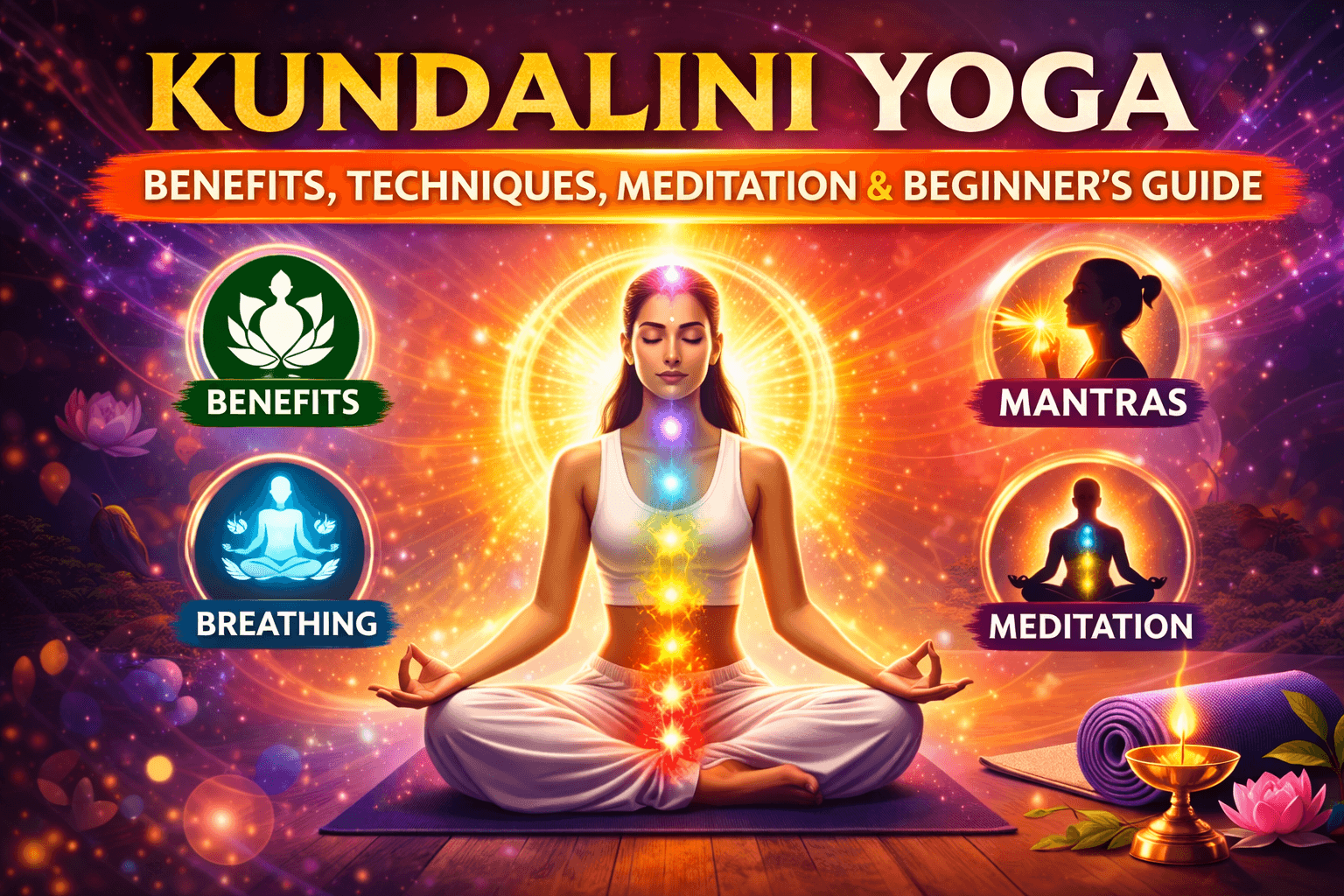
Kundalini Yoga: A Beginner’s Guide to Awakening Energy and Emotional Balance
Disclaimer: The information on BenVitalFive is for educational purposes and is not a substitute for professional medical advice. Always consult a healthcare provider before starting a new physical or intense breathing practice. Do this especially if you have health conditions or are pregnant.Introduction
Over the years, yoga has evolved into many styles. Each style offers unique benefits for physical health, mental clarity, and emotional balance. Among them, Kundalini Yoga stands out as one of the most powerful and spiritually focused practices.
Kundalini yoga is often called the “Yoga of Awareness.” Kundalini Yoga combines breathwork, movement, meditation, and chanting to awaken inner energy and expand consciousness.
Unlike many modern yoga styles that emphasize physical postures. Kundalini Yoga focuses on the integration of mind, body, and energy, helping practitioners:
Build self-awareness
Reduce stress
Enhance emotional balance
Experience a deeper sense of well-being
Kundalini Yoga is a spiritual form of yoga. It combines breathing techniques, movement, meditation, and chanting to awaken energy at the base of the spine. It also promote mental, physical, and emotional well-being.Explore The Five Pillars of Wellness Journey—Holistic Wellness GuideWhat is Kundalini Yoga?
Kundalini Yoga is a spiritual and energetic practice. It aims to awaken dormant energy believed to reside at the base of the spine (root chakra).
The word “Kundalini” comes from Sanskrit, meaning “coiled snake,” symbolizing this latent energy. When activated, it is said to rise up the spine. It passes through energy centres called chakras. This occurrence can lead to greater awareness and vitality.
Yogi Bhajan popularized modern Kundalini Yoga in the West in the late 1960s. Today, it is practised worldwide for both personal transformation and holistic wellness.
Why I Chose Kundalini Yoga –My Personal Experience
There are many styles of yoga available today, and most people only have the time or energy to explore one or two. Now I share my personal journey with Kundalini Yoga and how it has impacted my life.A Practice Focused on Emotional Healing
For me, Kundalini Yoga has been much more than a physical exercise. It is a powerful tool for emotional healing and inner transformation.While many yoga styles emphasize flexibility and strength, Kundalini Yoga focuses more on emotional balance and spiritual growth. After making yoga part of my daily routine, I notice I handle my emotions better. I also respond more calmly to daily events.Letting Go of Anger and Emotional Weight
One of the biggest changes I noticed was in how I deal with anger.In everyday situations, even for a simple happening, I get angry suddenly, even if I want to stop it. Before practising Kundalini Yoga, I was often ashamed of such emotions and sometimes reacted in ways I later regretted.But with consistent practice, I began to notice something different:- The intensity of anger reduced
- My reactions became calmer
- Emotional triggers lost their hold on me
A Shift in Emotional Experience
Kundalini Yoga didn’t change who I am—it changed how I experience things.Situations that once affected me for hours now pass much more quickly. What used to feel overwhelming now feels manageable.To put it simply:- Before: emotions felt like a heavy weight
- Now: they feel lighter and easier to process
Not About Flexibility or Fitness
One of the most encouraging things about Kundalini Yoga is that you don’t need to be physically fit or flexible.I personally wasn’t (and still am not) particularly flexible, yet I still experienced meaningful benefits. This practice is accessible to anyone who is willing to show up consistently.Understanding Kundalini and Chakras (In Simple Terms)
Kundalini Yoga is often associated with concepts like energy and chakras, which can seem unfamiliar at first.You don’t need to fully understand these ideas to benefit from the practice. Think of chakras as ways to describe emotional and mental patterns in the body.The techniques themselves—breathing, movement, and meditation—naturally work on these aspects without requiring deep theoretical knowledge.Simple Practices, Powerful Results
Kundalini Yoga includes:- Gentle movements
- Breathing techniques
- Meditation
- Mantra chanting
Practicing at Home
Most of my practice has been at home, as Kundalini Yoga classes are not widely available everywhere.I’ve followed guided sessions, particularly beginner-friendly ones, which helped me stay consistent without feeling overwhelmed.A Personal Transformation
The changes I experienced have been profound:- Greater emotional stability
- Increased sense of peace
- Better ability to handle stress
- Less mental overwhelm
Is Kundalini Yoga for Everyone?
You don’t need to be deeply spiritual or knowledgeable about yoga philosophy to benefit from Kundalini Yoga.All you need is:- An open mind
- A willingness to practice
- A desire for positive change
Key Elements of Kundalini Yoga
Kundalini Yoga blends several powerful techniques into a complete mind-body practice:1. Kriyas (Structured Yoga Sets)
 Kriyas are specific sequences of postures, breathwork, and meditation designed to achieve particular outcomes.They may help:
- Strengthen the nervous system
- Improve digestion
- Reduce stress
- Boost energy levels
Kundalini Yoga is a combination of various techniques that awaken energy and balance the mind and body. All of these components combine to enable a complete yoga experience.
Pranayama (Breathing Techniques)
Breathwork is central to Kundalini Yoga and is used to control energy flow.One of the most popular techniques is Breath of Fire, a rapid, rhythmic breathing pattern that:- Energizes the body
- Improves oxygen circulation
- Clears mental fog
Meditation
 Meditation in Kundalini Yoga helps quiet the mind and deepen self-awareness.It often includes:
- Breath focus
- Visualization
- Mantra chanting
Mantras (Chanting)
Mantras are repeated sounds or phrases that help focus the mind and elevate awareness.A common mantra:- “Sat Nam”— meaning “Truth is my identity.”
Top Benefits of Kundalini Yoga for Mind and Body
Once again, benefiting your mental and physical health is the regular practice of Kundalini Yoga. This is awesome for your general wellbeing, keeps you balanced and helps you maintain healthy levels of energy.
Reduces Stress and Anxiety
Kundalini Yoga activates the parasympathetic nervous system, helping the body relax and recover from stress.A 2017 study examined the effects of Kundalini Yoga (KY) on psychological stress and biomarkers like cortisol and alpha-amylase in saliva.The study included 26 participants aged 18–45, divided into a KY group and a control group. Researchers measured stress levels and collected saliva samples before and after the intervention.Results showed that Kundalini Yoga led to an immediate reduction in cortisol levels and a significant decrease in perceived stress, although no notable changes were observed in alpha-amylase activity.Another major 2021 study by Drs Simon and Hofmann found that Kundalini Yoga is a “helpful and moderately potent” intervention for Generalized Anxiety Disorder (GAD), significantly outperforming standard stress education.Improves Mental Clarity
Meditation and Breathing Exercise Increases Focus and Concentration. Kundalini Yoga teaches the mind to remain in the present moment, which trains and hones mental clarity and productivity.
Meditation and breathwork enhance focus, concentration, and mindfulness, making it ideal for people with demanding lifestyles. To further support your cognitive goals, you can pair your practice with natural nootropics; explore our guide on Brahmi benefits for memory and focus to see how this herb complements mental discipline.”The systematic review of 15 studies by Roy, Biswas, and Sharma (2025) highlights Kundalini Yoga (KY) as a potent intervention for both neurological and psychological health. The research indicates that KY significantly enhances memory, executive functioning, and hippocampal structure, while effectively alleviating symptoms of anxiety, PTSD, OCD, and depression.
Beyond mental health, it improves sleep quality and emotional regulation, and physical benefits are observed in blood pressure and fatigue management. While the study concludes that KY is a safe and beneficial holistic tool, it emphasizes the need for more large-scale, standardized randomized controlled trials using biomarkers to fully map its long-term clinical impact.
This makes it particularly advantageous for people with busy lives and mental fatigue.
Boosts Energy Levels
Unlike more passive or purely stretching-based styles, Kundalini Yoga is specifically designed to increase vitality and reduce fatigue. A clinical trial on the Effect of Kundalini Yoga showed a significant reduction in serum cortisol levels (the “stress hormone”) and perceived stress scores over a 24-week period
By combining rhythmic movement with rapid diaphragmatic breathing (like Breath of Fire), the practice:
- Oxygenates the Blood: Rapidly increases oxygen circulation to the brain and vital organs.
- Balances the Glandular System: Stimulates the endocrine system to regulate energy-related hormones.
- Clears “Mental Fog”: Provides an immediate shift from lethargy to alertness, making it an ideal “mid-day reset” for those with demanding intellectual lifestyles.
Strengthens the Nervous System
Kundalini Yoga is also perfect for building a strong and resilient nervous system. As a result, the body can better cope with stress and maintain optimal psychological balance. Just as Kundalini strengthens the nervous system through movement, certain adaptogens provide a similar biological shield. Read about the 7 science-backed benefits of Brahmi for a holistic approach to stress resilience.”
A more resilient nervous system also enhances the body’s adaptability to stressors and promotes health.
Enhances Emotional Balance
Kundali namaste seeks your awakenings and mental healing too. Meditation and mantra chanting aids the release of negative emotions and the manifestation of positivity.
With time, practitioners become more emotionally stable and achieve a greater sense of inner peace.
Common Kundalini Yoga Practices
Kundalini Yoga is a holistic approach to practice that includes a variety of practices working together for the cultivation of energy and well-being.
1. Breath of Fire (Agni Pran)
Breath of Fire is the foundational breath of Kundalini Yoga. It is a rhythmic, rapid breath that energizes the nervous system and clears the mind.How to do it:- Sit Comfortably: Sit in Easy Pose (cross-legged) with a straight spine and hands in Gyan Mudra (thumb and index finger touching).
- The Pattern: Inhale and exhale rapidly through the nose with equal emphasis.
- The Navel Point: As you exhale, pull your navel point (belly button) sharply back toward your spine. As you inhale, relax the belly—the breath will flow in naturally.
- Consistency: Aim for 2–3 breaths per second. Ensure the breath is coming from the diaphragm, not the chest.
- To Finish: Inhale deeply, hold for 5–10 seconds, and exhale completely to relax
- Detoxifies the body
- Increases lung capacity
- Boosts alertness
Spinal Flex
The Spinal Flex is a foundational Kundalini exercise designed to stimulate the flow of energy and improve the flexibility of the lumbar and thoracic spine. It acts as a “physical tune-up” for the nervous system.How to do it:- The Starting Position:Sit in Easy Pose (cross-legged) on the floor. Grab your shins with both hands. Keep your arms straight and your chin level with the ground—do not tip your head up or down.
- The Inhale (Forward):Inhale deeply through the nose as you lift your chest and arch your lower spine forward. Imagine pushing your heart toward the front of the room.
- The Exhale (Backward):Exhale powerfully through the nose as you round your spine, tucking your tailbone and collapsing your chest slightly.
- The Movement:Continue this rhythmic “rocking” motion. Keep the head steady; the movement should originate from the base of the spine and travel up to the shoulders.
- To Finish:Inhale deeply to the center, hold the breath for a few seconds while sitting perfectly tall, and exhale to relax.
- Improves spinal flexibility
- Stimulates energy flow
Sat Kriya
Sat Kriya is known as the “everything kriya.” It is designed to balance the lower three chakras and circulate energy throughout the entire system.How to do it:- The Posture: Sit on your heels (Vajrasana/Rock Pose). Stretch your arms straight up over your head so they hug your ears.
- The Mudra: Interlace your fingers, except for the index fingers, which point straight up. Cross your thumbs (right over left for men, left over right for women).
- The Mantra:* As you chant “Sat” (rhymes with “but”), pull your navel sharply in.
- As you chant “Nam”(rhymes with “mom”), relax the navel.
- The Focus: Keep your eyes closed and focused at the “Third Eye” point (between your eyebrows).
- To Finish: Inhale, hold the breath, and gently contract your pelvic muscles (Mulbandh). Exhale. Repeat this once more, then sit and feel the energy circulate.

Sat Kriya is one of the most powerful practices to awaken Kundalini. It incorporates chanting the mantra “Sat Nam” along with rhythmic movement and breath control.
This kriya builds core strength and harmonizes the energy body.
Meditation with Mantras
Kundalini Yoga practices mantras, which are widely practiced in spiritual centers worldwide. Reciting mantras while concentrating on breath brings about a calm mindset and increased focus.
It facilitates emotional healing and spiritual growth.
How to Get Started with Kundalini Yoga
Kundalini Yoga can be practiced by both beginners and experienced practitioners. But, you can take it a step back and learn the basics in detail.
- Here are some tips for beginners:
- Look for classes or guided sessions suitable for beginners.
- Condition your breath.
- Practice meditation regularly for improved mental focus.
- Hear the signals from your body and know when not to go further than you can.
- Practice regularly & you will see long-term benefits.
Kundalini Yoga is less about physical prowess than inner transformation, quite in contrast to the physically intense yogas. Over time and with practice, people notice an improving in the body as well as happiness.
Kundalini Yoga with Other Styles of Yoga
Kundalini Yoga
- Focus: Energy, breath, meditation
- Goal: Awareness and transformation
Hatha Yoga
- Focus: Physical postures
- Pace: Slow and beginner-friendly
Ashtanga Yoga
- Focus: Structured sequences
- Pace: Physically intense and dynamic
Why Kundalini Yoga is Unique
Kundalini Yoga goes beyond physical exercise—it is a holistic system for self-discovery and transformation.By combining:- Breathwork
- Movement
- Meditation
- Sound (mantras)
Frequently Asked Questions
1. Is Kundalini Yoga suitable for beginners?
Yes, Kundalini Yoga is beginner-friendly. You can start with simple breathing exercises, short meditations, and guided sessions.2. What is Kundalini energy?
Kundalini energy is believed to be a dormant spiritual energy located at the base of the spine that rises through the chakras when activated.3. How often should I practice Kundalini Yoga?
Beginners can start with 10–20 minutes daily, gradually increasing duration as they become comfortable.4. What are the main benefits of Kundalini Yoga?
- Reduces stress and anxiety
- Improves focus and clarity
- Boosts energy levels
- Enhances emotional balance
5. Is Kundalini Yoga safe?
Yes, when practiced mindfully. Beginners should follow guided instructions and avoid overexertion.Conclusion
Kundalini Yoga is a powerful practice that works on awakening inner energy and expanding consciousness. Through consistent practice, it can:- Improve mental clarity
- Enhance emotional balance
- Boost physical vitality
Start Your Kundalini Yoga Journey Today
Ready to experience the benefits of Kundalini Yoga? Start with just 10 minutes a day and build a consistent practice for long-term transformation.Explore more in ourFinal Checklist for Beginners:
[ ] Wear comfortable clothing: Loose, natural fabrics (like cotton) are best for energy flow.
[ ] Create a quiet space: Even 5 feet of floor space is enough.
[ ] Stay hydrated: Drink water before and after to help with the “detox” effects of breathwork.
[ ] Empty stomach: Try to wait at least 2 hours after a heavy meal before practicing.
[ ] Be patient: The emotional shifts often happen subtly over time, not just in one session.

