
Raja Yoga Meditation 101: The Ultimate Beginner’s Guide to Inner Peace
Modern life can feel like a relentless storm of sensory overload. Between demanding work schedules, constant digital notifications, and personal responsibilities, finding a moment of genuine stillness is incredibly rare.
If you have tried mainstream mindfulness apps only to find your mind drifting back to your to-do list within seconds, you are not alone. Traditional meditation systems look beyond quick fixes.
Raja yoga meditation offers a structured, time-tested approach to reclaiming control over your thoughts, emotions, and life direction. Known historically as the “King of Yogas,” this practice focuses entirely on mastering the mind.
In this comprehensive beginner’s guide, we will unpack the foundations of Raja yoga meditation, walk through a step-by-step practice routine, and explore how to seamlessly integrate this mental discipline into your daily life.
What is Raja Yoga meditation?
Raja yoga meditation is an ancient practice of mental discipline. It aims to calm the mind. It also helps connect the self with universal consciousness. Unlike modern postural yoga (Hatha yoga), which focuses primarily on physical movements and breathing exercises, Raja yoga centers entirely on internal mental control.
The word Raja translates directly to “king” or “royal.” Therefore, Raja yoga is the royal path of meditation—a practice where your intellect learns to govern your unruly thoughts and emotions like a wise monarch ruling a kingdom.
What is the primary focus of Raja yoga meditation?
The primary focus of Raja yoga meditation is to achieve complete mastery over the mind through concentration, self-realization, and silent reflection. Unlike physical yoga practices, it relies on silent contemplation to detach the mind from external distractions and awaken the soul’s natural qualities of peace, purity, and bliss.
The Eight Limbs of Raja Yoga:
To understand how Raja yoga operates, we must look at its foundational structure. Formulated by the sage Patanjali in the Yoga Sutras, Raja yoga is divided into eight developmental stages or “limbs.”
These stages provide a holistic framework that transitions a practitioner from basic ethical living to deep, meditative absorption.
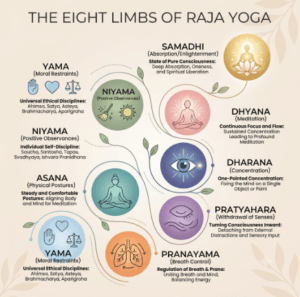 While the first four limbs prepare the body and energy channels, the last four focus fully on the inner landscape. In everyday practice, the terms “Raja yoga meditation” typically emphasize the transition from sensory withdrawal (Pratyahara) to sustained focus (Dharana) and deep meditation (Dhyana).
The Core Benefits of a Consistent Practice
Committing to Raja yoga meditation delivers substantial mental, emotional, and physical rewards. By sitting in silent reflection daily, you gradually rewire your brain’s response to external stressors.
Heightened Emotional Regulation: By learning to observe your thoughts objectively, you create a buffer between an external event and your internal reaction. Anger, anxiety, and frustration lose their immediate grip over your behavior.
Sharper Focus and Clarity: In an era of fractured attention spans, this practice trains your mind to hold a single point of concentration for extended periods, drastically improving productivity.
Reduced Physical Stress: Chronic stress floods the body with cortisol. Silent contemplation triggers the parasympathetic nervous system, lowering your heart rate, reducing blood pressure, and encouraging deep cellular repair.
Cultivation of Inner Stability: External circumstances change constantly. This practice anchors your sense of identity to your internal qualities rather than your job title, bank account, or social status..
A Practical Guide to Raja Yoga Meditation
Raja Yoga, often called the “Royal Path” of yoga, is a meditative practice that focuses on harnessing control over the mind and intellect to foster a deep connection with the self and the Divine. The goal is spiritual empowerment and inner peace, achievable by anyone regardless of background.
Here is a step-by-step guide to help you begin your practice using your dedicated space at dawn.
Step 1: Preparation of Space and Self
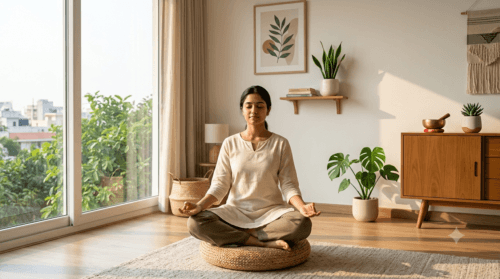
Choose Your Seat: Using the space depicted in the image, decide if you will sit on the floor cushion or the straight-backed wooden chair.
Posture: The most important requirement is a stable, upright posture. Your spine should be straight but relaxed. If on the floor, cross your legs comfortably (Sukhasana or half-lotus). If on the chair, place both feet flat on the ground. Place your hands gently on your lap.
The Dawn Advantage: Practicing at dawn (known as Brahmamuhurata in yoga tradition) is ideal because the world is naturally quiet, the energy is pure, and the mind is less cluttered by the day’s upcoming demands.
Step 2: Settling the Body and Breath
Stillness: Allow your body to become physically still. This stillness is the foundation for mental stillness.
Rhythmic Breathing: Unlike some breath-retention yoga techniques, Raja Yoga uses natural, calm breathing. Take a few slow, conscious breaths to relax any residual tension.
Gentle Focus: While you can close your eyes, Raja Yoga often recommends a soft, open-eyed gaze (as shown by the inviting lighting in the corner). You might focus your vision on a point (like the potted plant or simply the light) to keep the mind awake and present.
Step 3: Directing the Thoughts (Pratyahara and Dharana)
Raja Yoga does not ask you to fight your thoughts or force the mind empty. Instead, you guide the mind in a positive way.
Become the Observer: Start by observing the flow of your thoughts. Do not judge them; simply note that they are happening and acknowledge that you are the observer of the thoughts, detached from them.
Redirect Internal Dialogue: Begin a gentle, positive internal commentary. A simple, core thought in Raja Yoga is “Om Shanti”—I am a peaceful soul.
Affirmations: Remind yourself of your true nature. Gently tell yourself: “I am a point of spiritual light. Peace is my original nature.” If your mind wanders, gently bring it back to this central theme without frustration.
Step 4: The Experience of Meditation (Dhyana)
As you hold the awareness of yourself as a being of light, you begin to experience the inherent qualities of that state.
Experiencing Peace: Feel the stillness settling within. It’s not just an absence of noise, but a proactive sense of tranquility.
Experiencing Power: Feel the innate inner strength that comes from self-control and clarity.
Step 5: Connecting with the Source (Samadhi / Yoga)
This is the ultimate aim: the union (yoga) of the individual soul with the Supreme Soul (God/The Divine), often visualized as a perfect ocean of peace or a source of pure, unlimited light.
The Remembrance: Visualize this source of pure light and power.
The Link: Create a connection of remembrance. Allow your mind to become absorbed in the awareness of this connection.
Absorbing Qualities: Like a light bulb drawing power from a socket, allow yourself to absorb peace, love, and power from this source.
Tips for a Consistent Practice
Start Small: Begin with just 10–15 minutes each morning in your dedicated space.
Consistency is Key: Practicing for a short time every single day is far more effective than an hour once a week.
The End of the Session: When you finish, do not rush away. Spend a moment feeling the peace you have cultivated. Intend to carry that feeling of stable peace with you throughout your daily activities.
Common Mistakes Beginners Make (and How to Fix Them)
It is completely natural to encounter friction when you begin meditating. Recognizing these common pitfalls early will save you time and prevent unnecessary frustration.
1. Expecting an Instant “Blank Mind”
Many beginners quit because they cannot stop thinking. The human brain is hardwired to generate thoughts. Raja yoga meditation is not about forcing your mind to be empty; it is about changing your relationship with your thoughts. View your mind like a busy highway—watch the cars (thoughts) pass by without jumping into the driver’s seat of any of them.
2. Meditating with Inconsistent Timing
Practicing for an hour once a week does very little for your long-term mental well-being. True progress comes from consistency.
| Metric | Ideal Approach | Why It Matters |
| Frequency | Daily (Morning preferred) | Builds a strong, predictable neurological habit. |
| Duration | 10 to 15 minutes | Manageable for beginners; prevents physical restlessness. |
| Focus | Quality over length | 10 minutes of alert focus beats 45 minutes of daydreaming. |
3. Using Aggressive Force
If you try to violently suppress your thoughts, your mind will naturally rebel. Treat your mind like an energetic puppy. When it wanders off, gently pick it up and place it back on the training mat. Patience always yields better results than frustration.
If you want to maximize your overall wellness journey, explore how to pair your mental practice with a structured Brain exercise routine for longevity
Actionable Tips to Deepen Your Practice
To move past the beginner stage and experience the deeper layers of Raja yoga, apply these practical adjustments to your routine:
Utilize the Power of the “Golden Hour”: Practice first thing in the morning (Amrit Vela or dawn). The atmosphere is naturally quiet, and your mind is not yet cluttered by the daily news or incoming emails.
Integrate Traffic Light Pauses: Do not confine your practice to your morning seat. Set a gentle timer on your phone to ring every three hours. Stop what you are doing for just 60 seconds to take three deep breaths, detach from your tasks, and reset your inner peace.
Document Your Progress: Keep a simple journal dedicated to your wellness journey. Write down how long you meditated, the level of mental restlessness you experienced, and how your emotional reactions evolve throughout the day.
Frequently Asked Questions
Is Raja yoga meditation a religious practice?
No. While Raja yoga has its roots in ancient Indian philosophy, the modern practice of Raja yoga meditation is entirely universal and non-religious. It is a mental training methodology centered on self-observation and inner governance that anyone can practice, regardless of their cultural or spiritual background.
Can I practice Raja yoga meditation sitting on a chair?
Absolutely. The physical posture limb (Asana) simply requires a stable, steady, and comfortable position where your spine can remain straight. If sitting cross-legged on the floor causes knee or back pain, sitting on a supportive chair is highly recommended to prevent distraction.
What is the difference between Raja yoga and Hatha yoga?
Hatha yoga focuses primarily on the physical body using postures (Asanas), energy locks, and breathing techniques to prepare the body for stillness. Raja yoga focuses directly on the mind, using internal concentration and contemplation to achieve mental mastery. Hatha is often considered a preparatory tool for the deeper mental work of Raja yoga.
Conclusion: Reclaim Your Inner Kingdom
Mastering your mind is a lifelong journey, not a weekend destination. Raja yoga meditation provides the exact tools, structure, and philosophy needed to step away from chronic stress and step into a life governed by clarity, stability, and enduring inner peace.
Remember, there is no such thing as a “perfect” meditation session. Some days your mind will be as calm as a still lake; other days it will feel like a stormy ocean. The victory lies entirely in your willingness to show up, sit down, and observe the process without judgment.
Commit to just ten minutes tomorrow morning. Give yourself the gift of silence, and begin the rewarding process of mastering your inner kingdom.
About the Author
Jesu Raj Athisayam is the founder of BenVitalFive, a wellness blog dedicated to helping people live healthier lives through five simple pillars: Yoga, Meditation, Physical Exercise, Reading, and Healthy Nutrition. Drawing on decades of experience in community development and a passion for natural living, he shares practical, research-based tips to inspire readers to build healthy habits, prevent disease, and achieve lifelong well-being.

