
Table of Contents
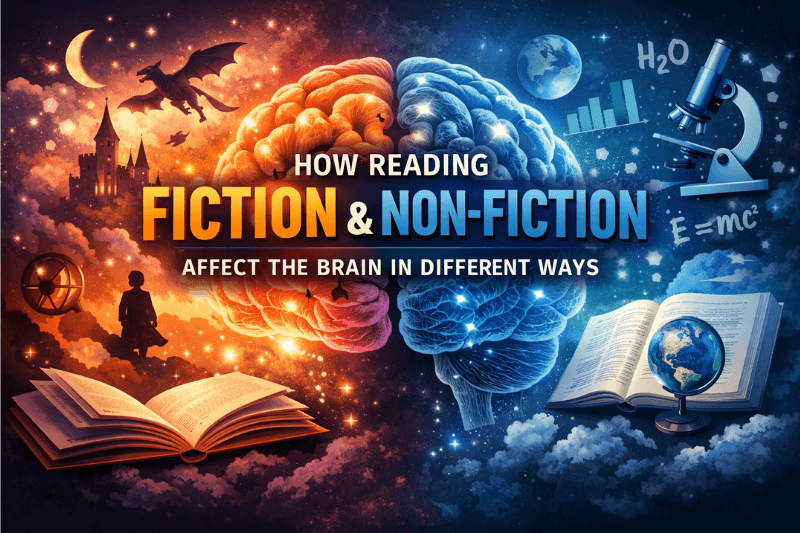
ToggleHow Reading Fiction and Non-Fiction Affect the Brain in Different Ways
Table of Contents
- How the Brain Responds When We Read
- How Reading Fiction Affects the Brain
- How Reading Non-Fiction Affects the Brain
- Fiction vs Non-Fiction: Brain Impact Comparison
- Which Type of Reading Is Better for Brain Health?
- Actionable Reading Recommendations
- Reading in the Digital Age
- Frequently Asked Questions
- Final Thoughts
Introduction
Reading is one of the most powerful yet underrated brain-health habits. But fiction and non-fiction do not affect the brain in the same way. Each activates different neural networks and supports different mental skills.
At BenVitalFive, we explore how simple daily habits—rooted in ancient wisdom and supported by modern science—can transform long-term mental well-being. Reading is one such habit.
How the Brain Responds When We Read
Reading activates multiple brain systems at once:
- Language centers decode words and meaning
- Memory networks store and organize information
- Emotional circuits respond to stories
- Executive regions analyze logic and ideas
What changes is which system becomes dominant, depending on whether you read fiction or non-fiction.
Related internal read:
How Daily Habits Shape Long-Term Brain Health
/daily-brain-health-habits/
How Reading Fiction Affects the Brain
Fiction includes novels, short stories, and imaginative narratives. Brain imaging studies show that reading fiction activates the default mode network, which is linked to imagination, empathy, and emotional awareness.
Brain Benefits of Reading Fiction
- Improves empathy and social understanding
- Activates mirror neurons involved in emotional learning
- Enhances creativity and perspective-taking
- Reduces stress and mental overload
A study published in Science found that readers of literary fiction showed improved ability to understand other people’s emotions and intentions.
“Reading fiction is a training ground for social cognition.”
— Dr. Keith Oatley, Cognitive Psychologist
Human Insight from the Field
During community work in rural Tamil Nadu, storytelling traditions naturally strengthened emotional balance and social bonding. Fiction works similarly for the modern brain—it allows us to experience life lessons safely through narrative.
Best for: Emotional growth, creativity, empathy, and stress reduction.
Internal link:
Natural Ways to Reduce Mental Stress Without Medication
/reduce-stress-naturally/
How Reading Non-Fiction Affects the Brain
Non-fiction includes self-help, psychology, science, history, and educational books. These activate the prefrontal cortex, responsible for logic, planning, and decision-making.
Brain Benefits of Reading Non-Fiction
- Strengthens analytical and critical thinking
- Improves factual memory and recall
- Enhances problem-solving skills
- Builds structured knowledge systems
Harvard Medical School reports that learning-based reading supports neuroplasticity, helping the brain stay adaptable with age.
Best for: Learning, focus, career growth, and decision-making.
Internal link:
How to Improve Focus and Concentration Naturally
/improve-focus-naturally/
Fiction vs Non-Fiction: Brain Impact Comparison
| Aspect | Fiction | Non-Fiction |
| Emotional engagement | High | Moderate |
| Logical reasoning | Moderate | High |
| Creativity | High | Low to Moderate |
| Memory of facts | Low to Moderate | High |
| Empathy | High | Lower |
Which Is Better for Brain Health?
Neither is better alone.
- Fiction strengthens emotional intelligence and relaxation
- Non-fiction improves reasoning, memory, and clarity
A balanced reading habit supports complete brain health, much like balanced nutrition supports the body.
Internal link:
Holistic Wellness Habits for Mind and Body Balance
/holistic-wellness-habits/
Actionable Reading Recommendations
- Read fiction at night to reduce stress and improve sleep
- Read non-fiction in the morning for better focus
- Alternate genres weekly
- Aim for 20–30 minutes of reading daily
Consistency matters more than book type.
Reading in the Digital Age
Compared to endless scrolling, long-form reading:
- Improves sustained attention
- Encourages deep thinking
- Reduces cognitive fatigue
Books remain one of the simplest tools for long-term brain resilience.
FAQs
Which type of reading improves emotional intelligence?
Fiction improves emotional intelligence by activating empathy-related brain networks and emotional awareness.
Does non-fiction improve memory more than fiction?
Yes. Non-fiction improves memory by strengthening structured information storage and factual recall.
Can reading fiction reduce stress?
Yes. Research shows reading fiction lowers stress by calming the nervous system and engaging imagination.
Conclusion
Reading fiction and non-fiction affects the brain in different but equally important ways. Fiction strengthens empathy, emotional awareness, and creativity, while non-fiction improves logic, memory, and decision-making. When combined, both forms of reading support balanced cognitive health, mental clarity, and long-term brain resilience. Choosing the right type of book based on your current goal—and reading consistently—can be one of the simplest yet most effective brain-health habits.
If you want to improve focus, reduce mental stress, and build long-term brain health naturally, start with small daily habits—like intentional reading.
Explore more science-backed wellness insights at BenVitalFive and learn how ancient wisdom and modern habits can work together for a healthier mind.
References
- Harvard Medical School – Reading and Brain Health
- ScienceJournal – Literary Fiction & Empathy
- National Institutes of Health – Neuroplasticity
- American Psychological Association – Cognitive Benefits of Reading
Author Bio
Jesu Raj Athisayam is the founder of BenVitalFive. With a background in Sociology from Mysore University and over a decade of experience working with rural communities in Tamil Nadu, he specializes in merging ancient natural wisdom with modern wellness habits to promote sustainable brain and lifestyle health.

