
Table of Contents
How Book Reading Improves Decision-Making and Critical Thinking Skills
What Are Decision-Making and Critical Thinking Skills?
2.1 Decision-Making Skills Explained
2.2 Critical Thinking Skills ExplainedHow Book Reading Improves Decision-Making Skills in Daily Life
3.1 Reading Books Trains You to See Multiple Perspectives
3.2 Reading Books Improves Analytical and Logical Thinking
3.3 Reading Builds Focus, Patience, and Mental ClarityHow Book Reading Improves Critical Thinking Skills
4.1 Reading Books Encourages Questioning and Independent Thinking
4.2 Non-Fiction Reading Strengthens Logical Reasoning
4.3 Fiction Reading Improves Emotional Intelligence and JudgmentThe Science Behind Reading and Brain Development
Best Types of Books for Decision-Making and Critical Thinking
How to Start Reading for Better Thinking (Actionable Tips)
Final Thoughts: Reading as Mental Training
Frequently Asked Questions
References
About the Author
Introduction
How reading books improves decision-making and critical thinking skills is not just a motivational idea. It is a proven mental process backed by psychology, neuroscience, and real-life experience.
In a world dominated by fast content, instant opinions, and emotional reactions, many people struggle to pause, analyze, and choose wisely. Over the years, I’ve observed—both personally and while working with communities—that people who read regularly tend to think calmer, decide slower, and choose better.
Book reading is not about intelligence alone. It is about training the mind to think before reacting.
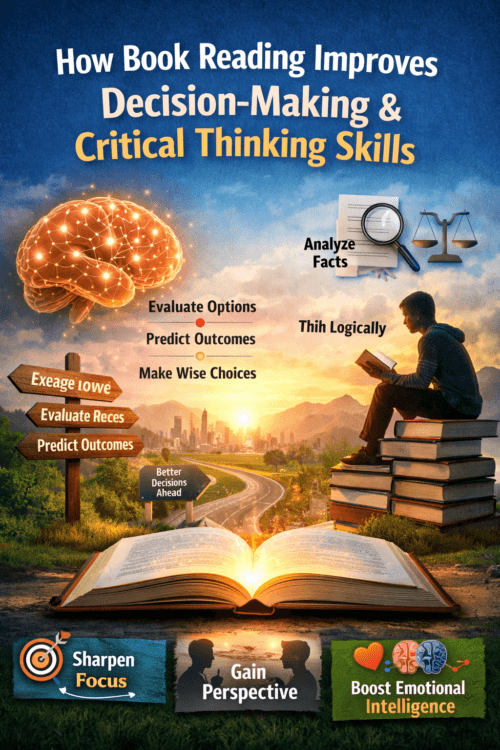
Book reading improves decision-making and critical thinking skills by training the brain to analyze information, evaluate multiple perspectives, predict outcomes, and reflect before acting. Regular reading strengthens focus, reasoning, emotional judgment, and logical thinking, helping individuals make thoughtful and informed decisions in daily life.
This article explains how reading books strengthens decision-making and critical thinking, using science, examples, and actionable habits anyone can follow.
What Are Decision-Making and Critical Thinking Skills?
Decision-Making Skills Explained
Decision-making is the ability to:
- Compare available options
- Predict possible outcomes
- Weigh risks and benefits
- Choose actions aligned with long-term goals
Good decision-making reduces regret, confusion, and emotional impulsiveness.
Critical Thinking Skills Explained
Critical thinking involves the ability to:
- Question information instead of accepting it blindly
- Analyze facts, not opinions
- Understand cause-and-effect relationships
- Think independently and logically
These two skills work together—and reading strengthens both at the same time.
How Book Reading Improves Decision-Making Skills in Daily Life
1. Reading Books Trains You to See Multiple Perspectives
One of the strongest ways book reading improves decision-making skills is by exposing the mind to different viewpoints.
When you read fiction, biographies, or case-based non-fiction, you constantly encounter:
- Characters facing dilemmas
- Leaders making difficult choices
- Consequences unfolding over time
Real-life example:
While working with rural self-help groups, I noticed that individuals who read biographies were more patient when making financial decisions. They discussed options instead of reacting emotionally—because books had trained them to pause and reflect.
This mental habit transfers directly into real-life decisions.
2. Reading Books Improves Analytical and Logical Thinking
While reading, the brain is constantly:
- Connecting ideas
- Remembering earlier details
- Predicting future outcomes
According to cognitive psychology research published by the American Psychological Association, reading strengthens the brain’s executive functions—responsible for reasoning, planning, and judgment.
This improves your ability to:
- Break down complex problems
- Identify patterns
- Evaluate long-term consequences
This is why regular readers often make less impulsive decisions.
(You may also like: internal article on how reading improves problem-solving skills)
3. Reading Builds Focus, Patience, and Mental Clarity
Unlike short-form digital content, books demand sustained attention.
Regular reading trains the brain to:
- Focus deeply
- Resist distractions
- Process information more clearly
A focused mind leads to clearer decisions.
Actionable tip:
Read for 15 minutes before making an important decision. This calms mental noise and improves judgment.
Key Benefits of Reading Books for Decision-Making
- Improves analytical and logical thinking
- Encourages considering multiple outcomes
- Reduces impulsive and emotional reactions
- Strengthens focus and mental clarity
- Improves judgment through experience-based learning
How Book Reading Improves Critical Thinking Skills
4. Reading Books Encourages Questioning and Independent Thinking
Good books do not tell you what to think—they encourage you to think for yourself.
As you read:
- You compare ideas with your own beliefs
- You notice contradictions
- You evaluate arguments
According to educator and philosopher John Dewey, critical thinking develops when individuals actively reflect rather than passively consume information.
This habit protects you from:
- Misinformation
- Emotional manipulation
- Social media-driven opinions
5. Non-Fiction Reading Strengthens Logical Reasoning
Non-fiction books—especially psychology, philosophy, history, and self-development—present:
- Evidence-based arguments
- Cause-and-effect explanations
- Structured reasoning
Research from Stanford University shows that analytical reading improves reasoning accuracy and reduces cognitive bias.
Practical example:
Readers of psychology books often become better at recognizing emotional triggers—helping them make calmer decisions during conflict.
(Internal link suggestion: benefits of reading psychology books)
6. Fiction Reading Improves Emotional Intelligence and Judgment
Fiction is not “just stories.” It is emotional simulation.
When you read fiction, you learn to:
- Understand human emotions
- Predict behavior
- Judge situations with empathy
A study published in Science journal found that literary fiction improves theory of mind—the ability to understand others’ perspectives.
This leads to better decisions in:
- Relationships
- Leadership
- Teamwork
How to Read Books to Improve Critical Thinking Skills
- Read slowly and without distractions
- Question the author’s assumptions
- Reflect on causes and consequences
- Compare ideas with real-life experiences
- Apply lessons to everyday decisions
The Science Behind Reading and Brain Development
Neuroscience studies show that reading:
- Strengthens neural pathways
- Improves memory retention
- Activates brain regions responsible for reasoning and judgment
According to research from Harvard Medical School, regular readers show higher cognitive flexibility—the ability to adapt thinking when situations change.
This directly impacts decision quality.
Best Types of Books for Decision-Making and Critical Thinking
You don’t need difficult books. Start with what feels natural.
Recommended categories:
- Fiction novels (empathy & perspective)
- Biographies (real-life decisions)
- Psychology & self-development
- Beginner philosophy books
- Case-study-based non-fiction
Consistency matters more than complexity.
How to Start Reading for Better Thinking (Actionable Tips)
If you’re new to reading:
- Start with 10–15 minutes daily
- Read without multitasking
- Reflect on decisions made by characters or authors
Ask: Why did this choice work or fail?
Reading is not about speed—it’s about understanding and reflection.
Final Thoughts: Reading as Mental Training
Book reading is not a hobby—it is mental conditioning.
By reading regularly, you:
- Think before reacting
- Analyze situations deeply
- Improve emotional and logical judgment
- Become a confident decision-maker
In a noisy world filled with quick opinions, books teach us how to pause, think, and choose wisely.
If you want to improve your decision-making and critical thinking skills naturally, start with one good book—and stay consistent.
Frequently Asked Questions
- Can reading really improve decision-making skills?
Yes. Reading improves awareness, analysis, and emotional control by exposing the mind to structured thinking, multiple perspectives, and long-term consequences, all of which strengthen real-life decision-making.. - Does reading help reduce impulsive thinking from social media?
Absolutely. Reading trains deep focus and reduces reactive behaviour. - Which is better: fiction or non-fiction?
Both. Fiction builds emotional judgment; non-fiction strengthens logic. - Can beginners develop critical thinking through reading?
Yes. Simple, consistent reading is enough to see improvement. - How long before results appear?
Improved focus in weeks; stronger decision-making within a few months.
References
- American Psychological Association – Reading & cognition studies
- Harvard Medical School – Brain plasticity research
- Stanford University – Analytical reading & reasoning
- ScienceJournal – Theory of mind and fiction studies
About the Author
Jesu Raj Athisayam is the founder and author of BenVitalFive. With a background in Sociology from Mysore University and over a decade of experience working with rural communities in Tamil Nadu, he specialises in integrating ancient natural wisdom with modern wellness and thinking habits. His work focuses on practical, sustainable ways to improve mental clarity, decision-making, and overall well-being.

