
Table of Contents
Toggle5 Traditional Tamil Keerai Varieties: Nutrition, Cooking, and Health Benefits
By Jesu Raj Athisayam | BenVitalFive
Last updated: 23 Nov 2026
Medical Disclaimer & Editorial Transparency
The content published on BenVitalFive is intended solely for informational, educational, and cultural purposes. It should not be interpreted as medical advice, diagnosis, or treatment for any health condition.
- Not Clinical Medical Care: Traditional culinary uses and nutritional descriptions of traditional foods (such as keerai varieties) do not replace professional medical evaluation, diagnosis, or treatment.
- Consult Healthcare Professionals:Readers with specific medical conditions, chronic illnesses, dietary restrictions, or those taking regular prescription medications should consult a qualified physician or registered dietitian before making significant dietary changes or starting new supplement regimens.
- Evidence Standards:BenVitalFive strives to align its nutritional content with established food composition data and peer-reviewed scientific literature, distinguishing cultural food traditions from therapeutic claims.
Introduction: Why Keerai Belongs in a Balanced Diet
In many Tamil households, keerai has long been a familiar part of everyday cooking. From a comforting bowl of keerai masiyal to a simple poriyal served with rice and dal, leafy greens hold an important place in traditional meals because they are versatile, affordable, and nutritious.
Our elders often spoke about the value of eating greens regularly. Such traditional wisdom offers a useful starting point for understanding how everyday food choices can support a balanced diet. Modern nutrition science also recognises leafy vegetables as valuable sources of vitamins, minerals, carotenoids, and dietary fibre. However, nutrient content varies according to plant species, freshness, portion size, and preparation method.
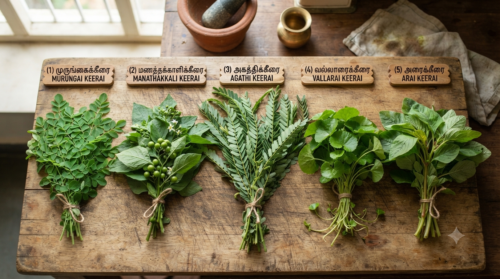
This guide explores five leafy greens familiar to many South Indian kitchens: murungai keerai, manathakkali keerai, agathi keerai, vallarai keerai, and arai keerai. We examine their nutritional contributions, traditional culinary uses, practical preparation ideas, and the scientific evidence behind commonly reported health benefits.
An important distinction runs throughout this article: a nutritious food is not automatically a medicine. Traditional uses deserve respectful discussion, but they should not be confused with proven treatments for anaemia, ulcers, liver disease, anxiety, or other medical conditions. Understanding both the strengths and the limitations of current evidence allows us to honour Tamil food traditions while making safe, informed everyday choices.
Key Reference: Comparison of 5 Traditional Tamil Keerai Varieties
Keerai Variety (Tamil) | Common English Name | Scientific Name | Primary Culinary Uses | Standout Nutrients & Plant Components |
Murungai Keerai | Drumstick Leaves / Moringa Leaves | Moringa oleifera | Poriyal, Dal, Soup, Dosa | Plant Protein, Dietary Fibre, Calcium, Iron, Vitamin C, Beta-carotene, Vitamin K1 |
Manathakkali Keerai | Black Nightshade Leaves | Solanum nigrum (and related edible Solanum spp.) | Kootu, Poriyal, Rasam, Sun-dried Berries (Vathal) | Calcium, Iron, Potassium, Provitamin A carotenoids, Vitamin C |
Agathi Keerai | Hummingbird Tree Leaves | Sesbania grandiflora | Thoroughly cooked Poriyal, Sautéed with Moong Dal | Dietary Fibre, Calcium, Essential Minerals, Bioactive Plant Compounds |
Vallarai Keerai | Indian Pennywort / Gotu Kola | Centella asiatica | Chutney, Thuvaiyal, Mild Herbal Accompaniments | Flavonoids, Polyphenols, Essential Trace Minerals |
Arai Keerai | Green Amaranth Leaves | Amaranthus species (A. dubius / A. gangeticus) | Masiyal, Poriyal, Dal combinations | Dietary Fibre, Potassium, Folate, Iron, Beta-carotene |
Key Practical Takeaways
- Preparation Matters:Cooking methods affect nutrient retention. Fresh greens provide hydration and heat-sensitive vitamins (such as Vitamin C), whereas gentle cooking softens tough fibres and makes greens easy to pair with pulses and grains.
- Variety Over Reliance on One Green:Rotating through these five greens across weekly meals provides a broader spectrum of vitamins, minerals, and plant compounds than relying on a single leaf or concentrated powder.
1. Murungai Keerai: Drumstick Leaves
Scientific name: Moringa oleifera
Murungai keerai, commonly known as drumstick leaves or moringa leaves, comes from a tree widely grown across tropical and subtropical regions, including India. In South Indian kitchens, the leaves are used in traditional dishes such as keerai poriyal, soup, dal, and dosa.
Moringa leaves are valued for their rich nutrient profile, including protein, dietary fibre, minerals, vitamins, and carotenoids. However, their nutritional composition depends on whether the leaves are fresh or dried, growing conditions, and cooking method.
Nutritional value of fresh moringa leaves
The Indian Food Composition Tables (IFCT 2017), published by the Indian Council of Medical Research–National Institute of Nutrition (ICMR–NIN), provide reference nutritional data for 100 g of the edible portion of fresh drumstick leaves:
Nutrient | Amount per 100 g | Nutrient | Amount per 100 g |
Energy | 67 kcal | Potassium | 397 mg |
Water | 75.7 g | Sodium | 9 mg |
Protein | 6.4 g | Copper | 0.44 mg |
Available carbohydrate | 5.6 g | Selenium | 6 µg |
Dietary fibre | 8.2 g | Vitamin C | 108 mg |
Total fat | 1.6 g | Beta-carotene | 17,542 µg |
Saturated fat | 0.56 g | Thiamine (Vitamin B1) | 0.06 mg |
Monounsaturated fat | 0.10 g | Riboflavin (Vitamin B2) | 0.45 mg |
Polyunsaturated fat | 0.67 g | Niacin (Vitamin B3) | 0.82 mg |
Omega-3 (ALA) | 446 mg | Vitamin B6 | 0.87 mg |
Calcium | 314 mg | Folate (Vitamin B9) | 43 µg |
Iron | 4.56 mg | Vitamin E (alpha-tocopherol) | 0.30 mg |
Magnesium | 97 mg | Vitamin K1 | 479 µg |
Zinc | 0.72 mg | Phosphorus | 109 mg |
Source: Longvah T, Ananthan R, Bhaskarachary K, Venkaiah K. Indian Food Composition Tables 2017. National Institute of Nutrition, ICMR, Hyderabad.
Understanding the figures: Fresh drumstick leaves are roughly three-quarters water (75.7 g per 100 g). These values apply specifically to fresh edible leaves and should not be applied directly to dried moringa powder.
Fresh leaves vs. moringa powder
Moringa powder is made by drying the leaves and grinding them into a concentrated form. Removing water increases the concentration of protein, fibre, and minerals per 100 g of weight—often tripling or quadrupling mineral density by weight compared with fresh leaves—while reducing heat- and light-sensitive nutrients such as vitamin C depending on drying and storage conditions.
Because commercial powders vary in moisture content, leaf maturity, and processing standards, published figures differ across products and studies. For everyday nutrition, fresh leaves and dried powder serve different roles: a concentrated powder is not automatically superior to a balanced home-cooked meal featuring fresh greens.
Potential health benefits and what research says
- Contributes to iron intake:Fresh moringa leaves provide non-haem iron, which supports normal haemoglobin production and oxygen transport. Absorption depends on meal composition (for example, pairing with vitamin C-rich foods). Moringa leaves are a supportive dietary source, not a treatment for iron-deficiency anaemia.
- Provides carotenoids and antioxidants:Beta-carotene in moringa leaves can be converted by the body into vitamin A. Laboratory studies have examined antioxidant compounds in moringa, though experimental activity in a lab does not automatically translate into specific clinical outcomes in humans.
- Contributes calcium and magnesium:Fresh leaves supply minerals important for bone and muscle function, though actual absorption depends on portion size and overall diet.
A 2022 systematic review examining moringa leaf supplementation in human and animal studies noted promising nutritional potential alongside a clear need for larger, more rigorous human clinical trials. Claims that moringa cures anaemia, balances hormones, prevents disease, or reliably boosts stamina are not supported by adequate clinical proof.
Pros and considerations
Advantages
- Versatile ingredient for traditional South Indian dishes.
- Contributes plant protein, dietary fibre, iron, calcium, and carotenoids.
- Pairs naturally with pulses and grains for balanced meals.
Considerations
- Slightly bitter, earthy flavour that benefits from balanced seasoning.
- Wash leaves thoroughly and strip tough stems before cooking.
- People taking regular medications (such as blood-pressure or blood-glucose drugs) should consult a healthcare professional before using concentrated moringa supplements.
How to use murungai keerai
- Murungai keerai poriyal:Wash leaves thoroughly, remove stems, and sauté with onion, garlic, mild spices, and a small amount of oil; finish with grated coconut if desired.
- Murungai keerai soup:Simmer leaves with shallots, garlic, cumin, and black pepper until tender; blend if a smooth broth is preferred.
- Murungai keerai dal:Stir washed leaves into cooked toor or moong dal and simmer briefly until tender.
- Murungai keerai dosa:Fold finely chopped washed leaves directly into fermented dosa batter before cooking thoroughly.
2. Manathakkali Keerai: Black Nightshade Leaves
Scientific name: Commonly referred to as Solanum nigrum (regional edible varieties sold as manathakkali in South India may include closely related species such as Solanum americanum or Solanum villosum).
Manathakkali keerai is a familiar leafy green in South Indian home cooking, valued for its mildly bitter flavour and versatility in everyday dishes. In Tamil households and traditional Siddha and Ayurvedic food practices, it has long been associated with soothing digestion and gentle, comforting meals. Modern nutrition approaches it not as a clinical treatment, but as a low-calorie leafy vegetable that contributes useful minerals, vitamins, and plant compounds to a varied diet.
Nutritional value
Like other dark green leafy vegetables, manathakkali keerai is low in calories and provides water, fibre, and essential micronutrients:
Nutrient Category | Key Nutrients | Role in Everyday Nutrition |
Macronutrients | Water, Dietary Fibre, Plant Protein | Adds bulk and hydration to meals while supporting normal digestive regularity |
Minerals | Calcium, Iron, Potassium, Magnesium | Contributes to daily mineral intake needed for bone maintenance, oxygen transport, and normal muscle and nerve function |
Vitamins & Carotenoids | Provitamin A carotenoids, Vitamin C | Supports normal immune function, tissue maintenance, and vision as part of a balanced diet |
Note: Nutrient density varies across regional Solanum cultivars, growing conditions, and cooking methods.
Traditional uses vs. scientific evidence
In Tamil culinary tradition and classical Siddha and Ayurvedic texts, manathakkali leaves and berries are frequently associated with:
- Digestive comfort:Often prepared as a mild kootu with moong dal when a gentle, non-irritating meal is preferred.
- Mouth and stomach soothing:Traditionally included in diets during episodes of mouth soreness or mild digestive discomfort.
- Seasonal “cooling” meals:Regarded in folk food classification as a cooling green suited to warm weather.
What modern research shows: Laboratory and animal studies have investigated extracts of Solanum species for antioxidant and anti-inflammatory properties. However, there is insufficient human clinical evidence to establish that eating manathakkali keerai cures stomach ulcers, treats gastritis, or detoxifies the liver. Traditional food associations can be appreciated as part of regional culinary heritage without treating the dish as a medical therapy.
Popular culinary preparations
- Manathakkali Keerai Kootu:Leaves simmered gently with moong dal, cumin, and a small amount of coconut for a mild, comforting side dish.
- Manathakkali Keerai Poriyal:Washed leaves sautéed briefly with mustard seeds, shallots or onion, and grated coconut.
- Manathakkali Rasam:A light, spiced broth prepared with pepper, cumin, and garlic.
- Manathakkali Vathal:Sun-dried berries from verified edible plants, lightly fried in oil and added to tamarind-based gravies (vatha kuzhambu).
Pros and safety considerations
Advantages
- Adds variety and a distinctive, mildly bitter flavour profile to weekly meal rotation.
- Pairs naturally with pulses such as moong dal and toor dal.
- Preserves regional Tamil culinary traditions using widely available produce.
Safety considerations
- Verify the source:Purchase manathakkali only from trusted vegetable vendors or established cultivation rather than foraging wild nightshade plants, as several wild Solanum species contain toxic glycoalkaloids (such as solanine).
- Use caution with berries and raw parts:Do not consume unripe berries or unfamiliar plant parts unless their food safety is established for the exact cultivated variety, and do not assume cooking neutralizes toxins in misidentified wild species.
- Seek medical evaluation for persistent symptoms:Recurrent mouth ulcers, ongoing abdominal pain, acidity, or digestive bleeding require proper diagnosis by a healthcare professional rather than dietary self-treatment.
3. Agathi Keerai: Hummingbird Tree Leaves
Scientific name: Sesbania grandiflora
Agathi keerai comes from the hummingbird tree, a tropical tree grown widely across South and Southeast Asia. Its tender leaves have a distinctive, slightly bitter-sweet flavour and are always cooked rather than eaten raw in salads. Agathi also holds a traditional place in certain Tamil household and festival food customs, which are best appreciated as cultural culinary practices rather than medical regimens.
Nutritional value
According to the Indian Food Composition Tables (IFCT 2017), fresh agathi leaves belong to the green leafy vegetable group and supply notable amounts of dietary fibre, plant protein, calcium, iron, potassium, beta-carotene, and vitamin C alongside high water content. Because dried leaves, seeds, and flowers have very different compositions, nutritional comparisons should always refer to fresh cooked edible leaves.
Potential benefits and evidence boundaries
- Dietary diversity:Offers an additional leafy green option to rotate alongside more common greens.
- Micronutrient contribution:Supplies calcium, carotenoids, and fibre that complement pulses and grains.
- Culinary tradition:Brings a distinct regional flavour to traditional Tamil meals.
While laboratory and animal studies have examined extracts of Sesbania grandiflora for antimicrobial and antioxidant activity, current evidence does not establish that eating agathi leaves treats infections, liver disease, or gastrointestinal disorders. Claims that agathi “detoxifies” the body or must be eaten on a fixed medicinal schedule are unsupported by clinical science.
Pros and considerations
Advantages
- Well suited to traditional cooked South Indian vegetable dishes.
- Pairs well with moong dal and coconut to balance its natural bitterness.
- Adds fibre and micronutrients to everyday meals.
Considerations
- Always use properly identified edible leaves and wash them thoroughly.
- Cook thoroughly using an established culinary recipe; avoid raw consumption.
- Do not substitute agathi dishes for prescribed medical care.
How to use agathi keerai
- Agathi keerai poriyal:Cook washed, chopped leaves thoroughly with shallots, garlic, mild spices, and grated coconut.
- Agathi with moong dal:Simmer cooked leaves with soft-cooked moong dal and a cumin-mustard tempering.
- Balanced meal pairing:Serve a modest portion alongside rice or millets and a protein-rich pulse dish.
4. Vallarai Keerai: Indian Pennywort (Gotu Kola)
Scientific name: Centella asiatica
Vallarai keerai—known globally as Indian pennywort or gotu kola—is a creeping ground herb used in South Asian cooking and traditional herbal practices. In Tamil kitchens, its rounded leaves are most commonly prepared as a fresh chutney or thuvaiyal.
In Ayurveda and Siddha traditions, vallarai has long been associated with memory, focus, and mental calm. While those traditions have prompted modern scientific investigation, traditional reputation should be separated from proven clinical efficacy.
Nutritional value
Fresh vallarai leaves contribute dietary fibre, trace minerals, and plant polyphenols such as flavonoids and triterpenoids. Nutrient levels vary with soil quality, moisture, and harvest maturity, and data from concentrated commercial gotu kola extracts should not be conflated with ordinary culinary portions of fresh leaves.
Potential health benefits and scientific evidence
Researchers have studied Centella asiatica for potential effects on cognition, mood, and circulation. A 2017 systematic review and meta-analysis of randomized controlled trials evaluating Centella asiatica products found no statistically significant improvements across assessed cognitive domains compared with placebo. Some preliminary mood-related findings were noted, but the authors highlighted major limitations in dosing, preparation standardization, and study quality.
Accordingly, claims that vallarai “cures memory loss,” “treats anxiety,” or “regenerates brain cells” are not supported as established medical facts.
Pros and considerations
Advantages
- Brings an herbaceous, distinctive flavour to traditional chutneys and thuvaiyal.
- Offers a practical culinary way to include traditional herbs in a varied diet.
Considerations
- Because vallarai grows close to the ground, thorough washing is essential to remove soil and microbial contaminants.
- Distinguish culinary food servings from concentrated herbal extracts or capsules.
- Rare cases of liver injury have been reported with certain concentrated gotu kola supplements; individuals with liver conditions or those considering herbal supplements should consult a physician first.
How to use vallarai keerai
Vallarai Thuvaiyal (Chutney): Wash properly identified fresh leaves thoroughly, lightly sauté them with urad dal, dried red chilli, tamarind, and grated coconut, and grind into a coarse chutney to serve alongside rice or idli. Enjoy it as a flavourful meal accompaniment rather than an empty-stomach medicinal tonic.
5. Arai Keerai: Green Amaranth Leaves
Scientific name: Amaranthus species (commonly Amaranthus dubius or Amaranthus gangeticus / tricolor in South Indian cultivation)
Arai keerai is one of the most widely eaten leafy vegetables in Tamil Nadu. Mild in flavour and tender when cooked, it is a staple in everyday dishes such as arai keerai masiyal and poriyal.
Nutritional value
Amaranth leaves are low in calories and contribute dietary fibre, potassium, folate, iron, calcium, and beta-carotene. Nutrient figures in food composition databases (such as the IFCT 2017 entries for green and red amaranth under Amaranthus gangeticus) vary slightly depending on the exact Amaranthus species and leaf-to-stem ratio, so published values represent general reference ranges rather than identical figures for every market bunch.
Potential benefits and evidence boundaries
- Accessible nutrient density:Supplies folate, potassium, carotenoids, and fibre in a mild, family-friendly green.
- Versatile meal integration:Blends smoothly with lentils and spices, making it easy to serve across age groups.
- Everyday practicality:Widely available and quick to prepare.
Arai keerai is a nutritious everyday vegetable, not a proven clinical treatment for hair loss, high cholesterol, or weight disorders.
Pros and considerations
Advantages
- Mild taste and soft texture suited to daily home cooking.
- Pairs effortlessly with dal, rice, and millets.
- Affordable and widely accessible.
Considerations
- Wash thoroughly in multiple changes of clean water to remove fine soil and grit.
- Avoid prolonged overcooking to preserve texture and heat-sensitive vitamins.
- Individuals advised to follow potassium- or oxalate-restricted diets for kidney or metabolic conditions should follow personalized medical nutrition guidance.
How to use arai keerai
- Arai keerai masiyal:Simmer washed leaves with garlic, cumin, green chilli, and cooked dal until tender, then mash into a smooth consistency and finish with a mustard-seed tempering.
- Arai keerai poriyal:Stir-fry chopped leaves briefly with shallots, mustard seeds, and grated coconut.
6. How to Wash, Store and Cook Keerai Safely
The nutritional benefit of any leafy green depends on proper identification, hygiene, and preparation.
Wash thoroughly
- Discard yellowed, slimy, or insect-damaged leaves and tough roots.
- Rinse leaves thoroughly under clean running drinking water (or swish in several changes of clean water so grit settles to the bottom before lifting the greens out).
- Use clean knives, cutting boards, and utensils.
- Never wash vegetables with soap, detergent, or household bleach.
Store correctly
- Refrigerate fresh greens promptly in a breathable bag or container lined with a dry cloth or paper towel to absorb excess moisture.
- Use fresh greens within 2 to 3 days and discard any leaves showing signs of spoilage.
- Keep raw greens strictly separated from raw meat, poultry, and seafood to prevent cross-contamination.
Cook appropriately
- Match the cooking method to the leaf: tender greens like arai keeraicook quickly, whereas fibrous leaves like agathi require thorough cooking.
- Gentle steaming, sautéing, or simmering in dal softens plant cell walls and retains minerals in the cooking liquid—consume the broth or masiyalliquid rather than discarding it.
Be cautious with wild plants
- Do not forage or consume wild leafy plants unless their botanical identity and food safety are verified with certainty—especially plants resembling manathakkaliin the nightshade family.
7. Frequently Asked Questions
Can I eat keerai every day?
Leafy vegetables can be part of a daily balanced diet. Rotating different varieties across the week, using moderate portion sizes, and accounting for individual medical needs (such as kidney conditions or blood-thinning medications) is healthier than eating the exact same green every day.
Which keerai is best for iron?
Murungai keerai and amaranth leaves both contribute dietary non-haem iron. However, total iron listed on paper does not equal total iron absorbed. Pairing greens with vitamin C-rich ingredients (such as lemon juice or tomatoes) supports plant-iron absorption, while suspected iron-deficiency anaemia always requires medical testing and targeted treatment.
Can manathakkali keerai cure stomach ulcers?
No. While manathakkali is traditionally served in gentle dishes like kootu, there is insufficient clinical evidence that it cures stomach ulcers or gastritis. Persistent digestive symptoms require medical evaluation.
Does vallarai improve memory?
Traditional systems associate vallarai with cognitive support, but a systematic review of human clinical trials found no significant memory benefit over placebo. Enjoy it as a culinary herb rather than relying on it as a memory treatment.
Is agathi keerai a detox food?
No clinical evidence shows that agathi leaves “detoxify” the liver or cleanse toxins from the body. Your liver and kidneys naturally perform detoxification, supported by overall balanced nutrition and hydration.
Are moringa or green powders better than fresh keerai?
Not necessarily. Powders offer convenience and concentrated weight-by-weight minerals, but they vary in quality and lose some heat-sensitive vitamins during processing. Fresh greens provide hydration, culinary satisfaction, and whole-food nutrition without needing supplements.
Conclusion: Eat Green and Enjoy a Varied Diet
Keerai remains one of the finest pillars of traditional Tamil cooking—bringing familiar flavours, affordability, and practical nutrition to everyday meals. Murungai, manathakkali, agathi, vallarai, and arai keerai each offer distinct culinary textures and complementary nutrients, though no single leaf provides every nutrient the body requires or replaces medical care.
The most reliable approach is simple: rotate a variety of greens through your weekly menu, wash and cook them safely, and pair them with pulses, whole grains, and other vegetables. When we pair respect for Tamil culinary heritage with honest, evidence-grounded nutrition science, everyday meals become both culturally meaningful and genuinely nourishing.
References and Further Reading
- Indian Council of Medical Research–National Institute of Nutrition (ICMR–NIN). Indian Food Composition Tables 2017. https://www.nin.res.in/ebooks/IFCT2017.pdf
- Liu R, Liu J, Huang Q, Liu S, Jiang Y. Moringa oleifera: a systematic review of its botany, traditional uses, phytochemistry, pharmacology and toxicity. Journal of Pharmacy and Pharmacology, 2022. https://pubmed.ncbi.nlm.nih.gov/34718669/
- Moringa leaf supplementation systematic review: The impact of Moringa oleiferaleaf supplementation on human and animal nutrition, growth, and milk production, 2022. https://pubmed.ncbi.nlm.nih.gov/35302264/
- Puttarak P, et al. Effects of Centella asiatica(L.) Urb. on cognitive function and mood-related outcomes: A Systematic Review and Meta-analysis. Scientific Reports, 2017. https://pubmed.ncbi.nlm.nih.gov/28878245/
- Research review on Solanum nigrum: Phytochemistry, pharmacology, and safety considerations. https://pmc.ncbi.nlm.nih.gov/articles/PMC9424827/
About the Author
Jesu Raj Athisayam is the founder and wellness researcher behind BenVitalFive, a digital health and wellness platform dedicated to practical everyday nutrition, traditional food wisdom, and evidence-informed lifestyle habits.
Editorial & Nutrition Review
This article covers general food and nutrition information for educational purposes and is not intended to diagnose, treat, cure, or prevent any disease. Nutrient composition data are referenced from the Indian Food Composition Tables (ICMR–NIN, 2017) and peer-reviewed nutrition literature. Readers with chronic medical conditions, kidney disorders, or prescribed medication regimens should consult a qualified physician or registered dietitian regarding individualized dietary choices.

