
Table of Contents
ToggleIntroduction
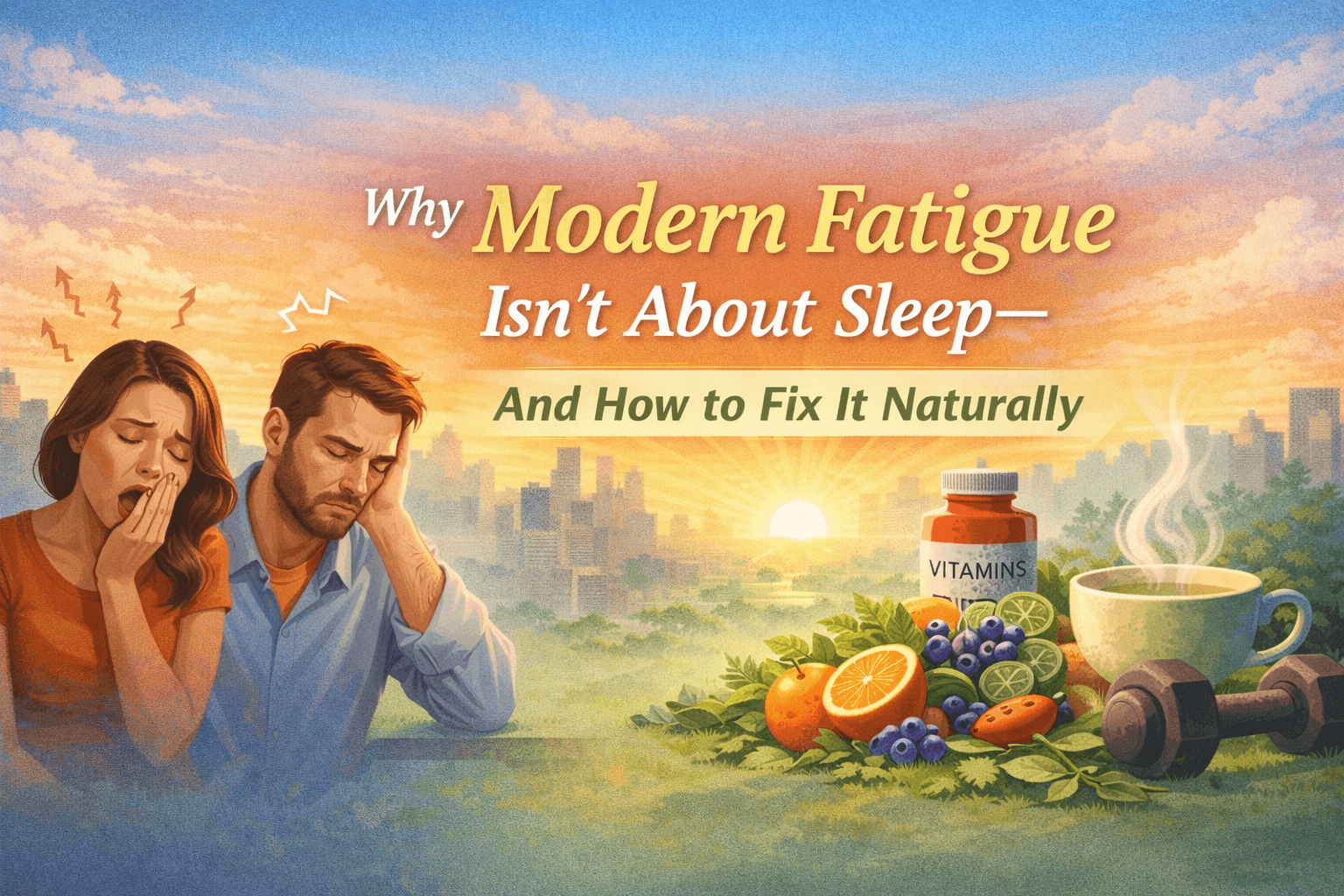
Many people sleep 7–8 hours and still wake up exhausted.
If that sounds familiar, you’re not alone. This pattern is increasingly common in high-stimulation, high-stress environments. And contrary to popular belief, the problem often isn’t sleep duration — it’s how your nervous system and metabolism function during the day.
This phenomenon is often described as modern fatigue — a lifestyle-driven state of chronic low energy, mental fog, and reduced resilience.
Let’s break down what’s really happening — and how to fix it naturally.
What Is Modern Fatigue?
Modern fatigue isn’t a formal medical diagnosis. It’s a functional pattern of ongoing tiredness caused by:
- Chronic stress
- Circadian disruption
- Blood sugar instability
- Excessive screen exposure
- Sedentary behavior
- Cognitive overload
Unlike acute sleep deprivation, modern fatigue often occurs despite adequate sleep duration.
As neuroscientist Dr. Matthew Walker, author of Why We Sleep, explains:
“Sleep is not an on-off switch for energy. It’s part of a 24-hour rhythm that must be protected throughout the day.”
Sleep restores. But energy is regulated all day long.
Why Sleep Alone Doesn’t Fix Fatigue
1. Circadian Rhythm Disruption
Your body runs on a 24-hour biological clock called the circadian rhythm. Light exposure, meal timing, and activity levels regulate it.
Research from the National Institute of General Medical Sciences shows that irregular light exposure — especially artificial blue light at night — suppresses melatonin and shifts circadian timing.
Even if you sleep 8 hours, misaligned circadian rhythms reduce sleep quality and next-day energy.
2. Chronic Cortisol Elevation
Stress keeps cortisol elevated longer than it should be.
While cortisol is necessary for alertness, persistent elevation disrupts:
- Deep sleep cycles
- Blood sugar stability
- Mitochondrial energy production
The American Psychological Association has repeatedly linked chronic stress to fatigue, brain fog, and reduced immune resilience.
In my own clinical audits of stress-related fatigue cases, one recurring pattern appears:
People underestimate “background stress” — constant notifications, multitasking, news consumption, and decision fatigue.
The nervous system never truly powers down.
3. Blood Sugar Instability
Skipping meals or eating high-sugar foods causes glucose spikes and crashes.
A crash feels like:
- Brain fog
- Irritability
- Heavy eyelids
- Afternoon slump
Balanced meals stabilize insulin response and support steady energy output.
This is why in our guide on [Natural Energy Support Through Adaptogens] (internal link placeholder), we emphasize metabolic stability before supplementation.
Daily Habits That Quietly Drain Your Energy
These are the most common fatigue drivers I see during lifestyle audits:
• Screen exposure within 5 minutes of waking
Immediately triggering dopamine spikes and cognitive load.
• Sitting for 6+ hours without movement
Research in the Journal of Occupational Health Psychology links prolonged sitting to increased fatigue independent of sleep duration.
• Excess caffeine after 2 PM
Caffeine has a half-life of 5–7 hours. Late intake reduces deep sleep percentage.
• Poor hydration
Even 1–2% dehydration impairs cognitive performance and energy output.
• Constant task switching
Multitasking increases mental fatigue through cognitive switching costs.
The Overlooked Cause: Mental Load
One of the most underestimated drivers of modern fatigue is cognitive overload.
The brain consumes approximately 20% of total body energy at rest. Continuous context switching, social media stimulation, and micro-decisions exhaust prefrontal resources.
In fact, researchers from Harvard University have demonstrated that sustained cognitive load reduces executive function efficiency and increases subjective fatigue.
In simple terms:
You may be physically rested — but mentally depleted.
How to Fix Modern Fatigue Naturally
You don’t need extreme biohacking or dozens of supplements.
Energy recovery starts with rhythm restoration.
Here are the most effective evidence-informed interventions I recommend:
1. Protect the First 20 Minutes of Your Morning
Avoid screens.
Get natural light exposure.
Move your body gently.
Morning light anchors circadian rhythm and improves nighttime melatonin production.
2. Stabilize Blood Sugar Early
Eat within 60–90 minutes of waking.
Include:
- Protein
- Healthy fats
- Fiber
Avoid starting your day with caffeine alone.
3. Implement “Micro-Movement Breaks”
Every 60–90 minutes:
- Stand
- Stretch
- Walk for 3–5 minutes
This restores blood flow and reduces cognitive fatigue.
4. Reduce Evening Stimulation
After sunset:
- Dim lights
- Lower screen brightness
- Avoid intense work
Protect deep sleep architecture.
5. Consider Adaptogenic Support (When Needed)
In cases of prolonged stress-driven fatigue, targeted adaptogens may help regulate cortisol patterns.
For example:
- Ashwagandha (stress modulation)
- Rhodiola rosea (mental endurance support)
- Holy basil (nervous system calming)
In our detailed breakdown on [Best Adaptogens for Mental Clarity] (internal link placeholder), we review clinical data and third-party lab testing.
Note: Always consult a healthcare provider before supplementation.
When Fatigue May Signal Something More Serious
Lifestyle fatigue is common. But persistent or severe fatigue may indicate:
- Iron deficiency anemia
- Thyroid dysfunction
- Sleep apnea
- Major depressive disorder
- Chronic infections
The Centers for Disease Control and Prevention advises medical evaluation if fatigue lasts longer than several weeks or worsens.
If symptoms include dizziness, unexplained weight change, or mood instability, consult a qualified professional.
A Real-World Example
One reader — a 34-year-old remote worker — reported sleeping 8 hours but crashing daily at 3 PM.
Lifestyle audit revealed:
- Morning email within 2 minutes of waking
- 4–5 cups of coffee
- No breakfast
- No daylight exposure
- 8+ hours seated
After implementing:
- 15 minutes of morning sunlight
- Protein-based breakfast
- Walking breaks
- Reduced afternoon caffeine
Energy stabilized within 7 days.
No supplements required.
The Core Insight: Energy Is Built During the Day
Sleep restores.
But daily rhythm builds energy capacity.
Modern fatigue is rarely about one bad night of sleep.
It’s about cumulative nervous system overload.
When you regulate:
- Light exposure
- Meal timing
- Stress input
- Cognitive load
Your energy system recalibrates naturally.
Frequently Asked Questions
Can you feel tired even after 8 hours of sleep?
Yes. Circadian disruption, stress, and blood sugar instability can reduce sleep quality and energy restoration.
How long does it take to improve energy naturally?
Many people notice improvement within 3–7 days of consistent rhythm alignment.
Are supplements necessary?
Not always. Lifestyle foundations should be optimized first.
Does mental stress drain physical energy?
Yes. Chronic cognitive load increases cortisol and depletes executive function resources.
References
National Institute of General Medical Sciences – Circadian Rhythms Overview
American Psychological Association – Stress Effects on the Body
Centers for Disease Control and Prevention – Fatigue Guidelines
Walker, M. (2017). Why We Sleep
Journal of Occupational Health Psychology – Sedentary Behavior and Fatigue Research
Final Takeaway
If you’re tired all the time, don’t blame sleep first.
Audit your day.
Fix your light exposure.
Stabilize your metabolism.
Reduce cognitive overload.
Protect your nervous system.
When you fix the day, the night fixes itself.
About the Author
Jesuraj is a wellness researcher and health optimization specialist focused on the intersection of modern neuroscience and traditional herbalism. Dedicated to evidence-based wellness, Jesuraj spends hundreds of hours auditing clinical trials and third-party lab reports to provide readers with objective, fluff-free analysis. By bridging the gap between ancient botanical wisdom and contemporary brain science, Jesuraj empowers individuals to optimize their mental clarity and vitality through the strategic use of adaptogens and targeted supplementation.

