

The First 20 Minutes of the Day: How a Simple Morning Routine Resets Your Focus and Energy
Picture a typical morning: your smartphone alarm rings. Before your eyes are fully open, your hand instinctively reaches across the nightstand. Within seconds, bright LED light hits your eyes as you scroll through urgent work emails, dramatic news headlines, missed chat notifications, and social media feeds.
Before you even step out of bed or take a glass of water, your nervous system is flooded with external demands. You have surrendered control of your attention to algorithms, employers, and internet outrage. You are spending your finite mental energy reacting to everyone else’s priorities instead of cultivating your own.
Now, imagine an entirely different start to your morning.
What if those first 20 minutes of the day were peaceful, intentional, and entirely dedicated to preparing your brain for deep work and emotional stability?
You do not need to wake up at 4:30 AM to achieve this. You do not need extreme cold plunges, dozens of expensive biohacking supplements, or a rigid two-hour wellness ritual designed for social media influencers. Extreme routines fail because they conflict with real-world schedules. A truly simple morning routine succeeds because it is low-friction, adaptable, and easy to maintain—even when your schedule is chaotic.
The Neuroscience Behind the First 20 Minutes of the Day
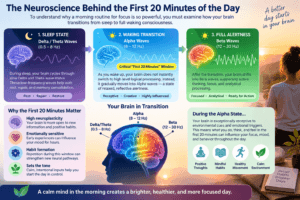
To understand why a morning routine for focus is so powerful, you must examine how your brain transitions from sleep to full waking consciousness.
so powerful, you must examine how your brain transitions from sleep to full waking consciousness.
When you sleep, your brain cycles through slow delta and Theta wave states. As you wake up, your brain does not instantaneously flip a switch into high-level logical processing. Instead, it moves through a precise neurochemical shift, moving gradually from low-frequency Theta waves into Alpha waves (relaxed, reflective alertness) before finally landing in Beta waves (active, analytical focus).
During this transitional Alpha state, your brain exhibits high neuroplasticity—it is exceptionally receptive to incoming environment cues and emotional triggers.
Cortisol and the Cortisol Awakening Response (CAR)
In the first 30 to 45 minutes after waking, your body experiences a natural surge in cortisol known as the Cortisol Awakening Response (CAR). This spike is healthy when balanced; it raises your heart rate, boosts blood pressure slightly, and prepares your mind to tackle the day.
However, if you immediately flood your Alpha wave state with high-stress inputs—such as urgent work demands or breaking news—your body overproduces cortisol and adrenaline. This triggers a fight-or-flight response before you even put your feet on the floor.
Why the Brain Enters “Reaction Mode”
When your morning starts with digital overload, your prefrontal cortex—the seat of executive function, long-term planning, and emotional regulation—gets bypassed. Instead, the amygdala takes over.
You spend the remainder of the day operating in a defensive, reactive posture. You will likely notice:
- Increased impulse to multi-task inefficiently.
- Rapidly declining willpower by early afternoon.
- Persistent low-grade anxiety without a distinct cause.
- Susceptibility to distraction while attempting deep, creative work.
By protecting the first 20 minutes of the day from digital noise, you allow your brain to smoothly complete its Alpha-to-Beta transition, preserving your executive function for tasks that matter.
How Your Morning Phone Habits Destroy Concentration
For most adults, the primary obstacle to building healthy morning habits is the habit loop associated with smartphones. Looking at a screen within minutes of waking triggers an immediate dopamine response.
Social media apps, email clients, and news portals are engineered using variable rewards—the same psychological mechanism that makes slot machines addictive. When you pull down to refresh your inbox or feed, your brain releases a hit of dopamine in anticipation of novel information.
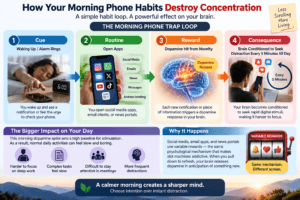
This morning dopamine spike sets a high baseline for stimulation. Standard daily activities—like writing a complex report, analyzing data, or listening attentively in a meeting—feel slow and boring by comparison. Your brain becomes conditioned to seek rapid digital stimuli every few minutes throughout the day.
| Immediate Morning Action | Impact Later in the Afternoon |
| Immediate Screen Light & Notifications | Accelerated decision fatigue and brain fog |
| Reading Work Emails from Bed | Elevated baseline stress and chronic worry |
| Scrolling Social Feeds | Comparison traps and emotional reactivity |
| Context Switching Between 5 Apps | Inability to enter deep focus states |
Research from the American Psychological Association (APA) shows that frequent context-switching and digital interruptions carry a heavy cognitive tax, taking up to 23 minutes for the brain to regain full focus on a task.
Action Step: Remove your phone from your bedside table tonight. Use a standalone digital or analogue alarm clock instead. Commit to a strict morning phone routine where you wait at least 20 minutes before turning on Wi-Fi or opening any social applications.
Why Realistic Routines Outperform Social Media “Biohacks”
If you browse video platforms or wellness sites, you will see high-profile entrepreneurs advocate for elaborate two-hour morning protocols. These routines often include:
- Cold plunges or 10-minute ice showers.
- Infrared sauna sessions.
- Complex 15-ingredient smoothie preparations.
- Comprehensive 45-minute journaling prompts.
- High-intensity interval training (HIIT) at 5:00 AM.
While these activities can offer individual physiological benefits, they are fundamentally unsustainable for the vast majority of working professionals, students, and parents.
The Failure of High-Friction Routines
When a routine requires an hour or more of setup, high energy, and complex gear, it carries heavy friction. On mornings when you sleep poorly, have an early meeting, or need to help your family, a complex routine breaks down immediately.
This often leads to an “all-or-nothing” psychological trap: if you cannot complete the entire 90-minute protocol, you abandon your habits altogether and default back to scrolling on your phone in bed.
The Power of Low-Friction Consistency
Behavioral science shows that habit retention is driven by frequency, not intensity. A simple 5-minute action performed 300 days a year creates deeper neural pathways than an intense 2-hour routine executed for two weeks and then abandoned.
A minimalist morning routine strips away non-essential tasks and focuses exclusively on high-leverage physiological inputs: basic hydration, light movement, deliberate stillness, and clear goal-setting.
The Minimalist 20-Minute Framework for Busy People
This practical framework requires exactly 20 minutes, zero specialized equipment, and can be easily adapted whether you are at home, traveling, or managing a busy household.
1. Minute 01–03: Rehydrate Your Physiology: Kickstart metabolic function and mental alertness.
During 6 to 8 hours of sleep, your body loses significant fluids through respiration and perspiration. Waking up slightly dehydrated impairs cognitive processing, mood, and kidney performance.
Before reaching for caffeinated drinks like coffee or tea, drink 16–20 ounces of room-temperature water. Keep a glass or reusable flask on your nightstand the evening before so it is immediately visible upon waking. Water signals your digestive tract to wake up and aids in clearing metabolic waste.
2.Minute 03–08: Gentle Movement & Mobility: Transition your motor system out of sleep mode.
Intense cardiovascular exercise is not required in your first 10 minutes awake. The primary objective here is to lubricate joints, increase blood circulation, and signal to your brain that physical movement has begun.
Spend 5 minutes executing low-intensity movements. You might try gentle spine rolls, thoracic rotations, slow cat-cow stretches, or a short walk around your home. For structured guidance on integrating daily movement into your lifestyle, read our guide on Healthy Habits That Last.
3. Minute 08–13: Deliberate Stillness & Breathwork: Calm the nervous system and build emotional resilience.
In an increasingly noisy world, starting your day with deliberate silence builds a reliable mental buffer. This time can be used for deep diaphragm breathing, silent reflection, or mindfulness practice.
Sit comfortably with a upright spine. Inhale slowly through your nose for 4 seconds, hold gently for 2 seconds, and exhale slowly through your mouth for 6 seconds. This extended exhale activates the parasympathetic nervous system, lowering your resting heart rate. To deepen this practice, explore our Beginner’s Guide to Morning Meditation or learn simple exercises via our resource on Breathing Exercises for Stress Relief.
4. Minute 13–18: Set Your Core Daily Priorities: Transition from reactive scrolling to planning.
Once your body is hydrated, your joints are mobile, and your mind is quiet, take 5 minutes to direct your attention toward what actually matters today. Avoid pulling out a massive master task list with dozens of items.
Open a physical notebook and answer these 3 targeted questions:
- What is the single most important task I must complete today to make progress?
- What minor distraction or low-value task can I safely postpone?
- What mindset do I want to bring to my work and relationships today?
5.Minute 18–20: Transition with Purpose: Move seamlessly into your broader day.
Use the final two minutes to conclude your quiet period. Put away your notebook, clear your space, and move intentionally into your normal daily activities—whether that means making a nutrient-dense breakfast, getting ready for work, or walking your dog outdoors.
Sample 20-Minute Morning Routine Breakdown
To make this framework as clear as possible, refer to the consolidated schedule below. Adjust the specific activities within each time block based on your individual lifestyle and preferences.
| Time Window | Primary Focus | Practical Examples | Key Physiological Benefit |
| 0–3 Min | Hydration | Drink 16–20 oz of fresh water | Restores fluid balance & digestive readiness |
| 3–8 Min | Gentle Movement | Neck rolls, cat-cow, light stretches | Circulates blood & lubricates spinal discs |
| 8–13 Min | Stillness | Box breathing, silent reflection | Lowers morning cortisol & calms nervous system |
| 13–18 Min | Priority Setting | Writing top 1–2 objectives on paper | Activates prefrontal cortex for strategic focus |
| 18–20 Min | Daily Transition | Meal prep, dressing, or outdoor light | Establishes a clean mental boundary into the day |
Aligning Your Morning with Circadian Rhythms

To maximize the benefits of a simple morning routine, align your actions with your body’s internal biological clock, known as the circadian rhythm.
The Role of Natural Light Exposure
One of the most powerful natural cues for your brain is direct sunlight exposure early in the day. Specialized cells in your eyes, known as intrinsically photosensitive retinal ganglion cells (ipRGCs), detect photon intensity and send signals directly to the master clock in your brain: the suprachiasmatic nucleus (SCN).
When natural light hits these cells, your brain immediately:
- Suppresses ongoing melatonin production (the sleep hormone).
- Sets a precise internal timer for melatonin release 14–16 hours later, making it easier to fall asleep at night.
- Boosts natural mood-enhancing neurotransmitters like dopamine and serotonin.
According to research published by the National Center for Complementary and Integrative Health (NCCIH), proper circadian alignment is foundational to long-term sleep hygiene, metabolic health, and emotional resilience.
Whenever possible, step outside on your balcony, patio, or porch for 5 to 10 minutes during your movement or breathwork block. Even on cloudy days, outdoor light intensity far exceeds typical indoor lighting.
Tailoring Your Routine to Fit Real Life
A common mistake when trying to adopt healthy morning habits is attempting to replicate someone else’s routine without accounting for your personal context. The most effective routine is not the one that looks ideal on paper—it is the one you can stick to six months from now.
For Parents and Caregivers
If you have young children or family care responsibilities, demanding uninterrupted solitude at 7:00 AM can lead to frustration.
- The Strategy: Wake up 15 to 20 minutes before the rest of your household. Protect those quiet 20 minutes as your non-negotiable personal space. Alternatively, involve your children in a simplified 5-minute stretching or hydration ritual.
For Remote and Shift Workers
If you work night shifts or operate across multiple time zones, your morning is defined by when you wake up—not what the clock says.
- The Strategy: Apply the exact same 20-minute sequence regardless of the hour. Drink water immediately upon waking, perform gentle joint mobility, execute breathwork, and state your intentions on paper before opening work messaging tools like Slack or Teams.
4 Frequent Morning Mistakes (And How to Fix Them)
Building a successful morning framework involves knowing what not to do. Here are four common traps that disrupt progress:
- Trying to Overhaul Every Habit Overnight
Deciding to radically alter your sleep schedule, diet, exercise habits, and productivity tools all on the same day leads to cognitive overload.
- The Fix: Implement one micro-habit at a time. Focus exclusively on drinking a full glass of water and delaying screen use for one week. Once that feels natural, add 5 minutes of gentle movement.
- Treating Your Schedule as Rigid
Life is unpredictable. Business trips, sickness, family demands, or poor sleep will occasionally interrupt your morning.
- The Fix: Use a “minimum viable routine” approach. If you only have 5 minutes instead of 20, compress the routine into 1 minute of water, 2 minutes of deep breathing, and 2 minutes of mental priority setting. Keep the core habit loop alive without stress.
- Relying on Coffee for Immediate Energy
Reaching for coffee within the first 10 minutes of waking can lead to an afternoon energy crash. Upon waking, your body still has residual adenosine (the neurochemical responsible for sleep pressure) circulating in your blood. Caffeine binds to adenosine receptors, masking fatigue rather than clearing it.
- The Fix: Delay your first cup of coffee by 60 to 90 minutes after waking. Allow your body time to clear adenosine naturally while rehydrating with plain water first.
- Overpacking Your Quiet Time
Attempting to squeeze journaling, heavy reading, language study, and budget tracking into your quiet morning creates time scarcity and hurry.
- The Fix: Keep the first 20 minutes simple and low-demand. Treat this time as an oasis of calm before external responsibilities begin.
Evening Preparation: The True Key to Great Mornings
A calm, productive morning begins the night before. If you go to sleep late with a cluttered environment and a high stress load, your morning will feel rushed regardless of your intentions.
To support your minimalist morning routine, build a brief 5-minute wind-down ritual before bed:
┌────────────────────────────────────────────────────────┐
│ EVENING PREPARATION CHECKLIST │
└────────────────────────────────────────────────────────┘
[1] Fill a clean glass or flask with fresh water and place
it on your nightstand.
[2] Set out comfortable, flexible clothes for light morning
movement.
[3] Write down your single most important task for tomorrow
to clear your working memory.
[4] Move your smartphone charger across the room or into
another space.
By removing micro-decisions from your waking environment, you eliminate friction and make healthy morning choices the default option. For actionable advice on setting up your living space for success, review our guide on the Five Pillars of Wellness.
Frequently Asked Questions
How long should a morning routine actually be?
A morning routine does not need to take an hour or more. Even 20 structured minutes can significantly improve focus, lower stress, and set a productive tone for the rest of your day.
Is it really that bad to check my phone first thing in the morning?
Yes. Checking your phone immediately floods your brain with external demands, spikes cortisol, and conditions your mind for short-term dopamine hits. This makes it much harder to sustain deep focus later in the day.
What if I am not a morning person?
Being a “morning person” is not a requirement. This 20-minute framework is designed to help your brain transition smoothly out of sleep inertia, regardless of what time you wake up.
How soon will I notice improvements in focus and energy?
Many people notice reduced morning stress and better emotional balance within the first 3 to 5 days of protecting their first 20 minutes from screen use. Long-term improvements in deep work capacity typically settle in after 2 to 3 weeks of consistent practice.
Final Thoughts: Start Small Tomorrow Morning
The first 20 minutes of the day offer a rare window of quiet potential. You do not need extraordinary willpower, complex gadgets, or hours of free time to regain control over your focus and long-term health.
Simple, intentional choices—rehydrating your body, moving gently, taking a few quiet breaths, and setting your primary objectives before picking up your smartphone—can fundamentally alter how your day unfolds.
Remember that long-term success is not about chasing perfection; it is about building daily consistency. Choose one single adjustment to make tomorrow morning—whether that means moving your phone charger away from your bed or drinking water as soon as you wake up. Practice it steadily, build momentum, and let that calm foundation support the rest of your day.

