
You’re breathing right now. You have been, all day. The question is whether the breath is working for you or simply happening.
Anxiety and breathing are locked in a two-way relationship most people don’t fully recognise. Anxiety disrupts breathing — it makes it shallow, fast, and chest-dominant. But shallow, fast, chest-dominant breathing also creates and amplifies anxiety. The loop runs in both directions.
Pranayama — the traditional yogic science of breath regulation — interrupts this loop at the physiological level. Not by “relaxing” in a general sense, but by directly modulating the autonomic nervous system through the mechanics of breathing.
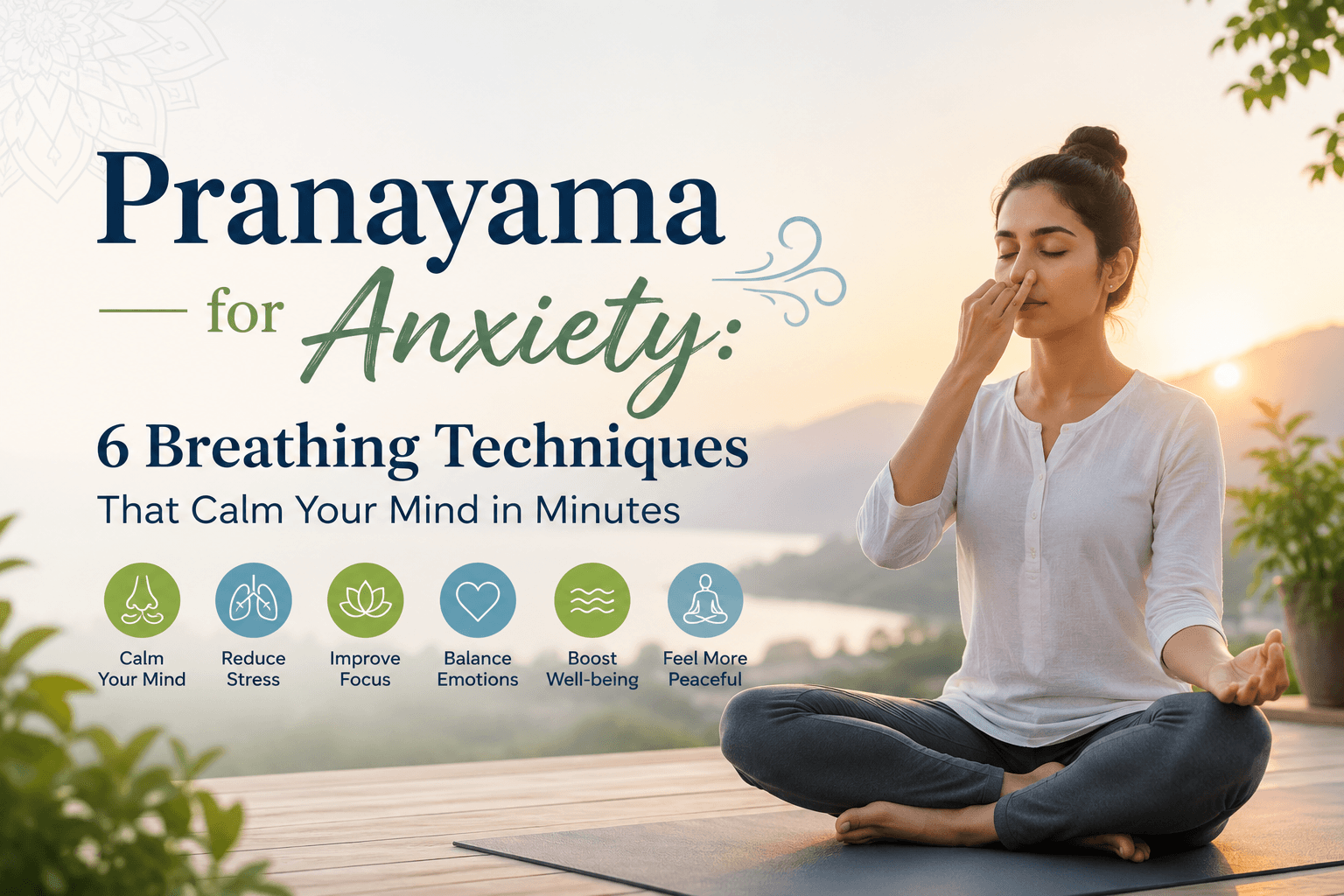
Here are six techniques, from the most immediately accessible to the more refined.
Why Breathing Controls Anxiety Physiologically
The connection isn’t metaphorical. The diaphragm — the primary breathing muscle — is innervated by the phrenic nerve, which is directly connected to the vagus nerve. The vagus nerve is the main conductor of the parasympathetic nervous system, responsible for the rest-and-digest state.
When you slow your exhale and breathe from the diaphragm rather than the chest, you’re mechanically stimulating parasympathetic activity. Heart rate variability increases, cortisol drops, and the amygdala — the brain’s alarm centre — becomes less reactive. This is measurable and it happens quickly.
The 6 Techniques
1. Extended Exhale Breathing
The simplest, most immediately effective technique. Breathe in for 4 counts, breathe out for 6–8 counts. That’s it.
The extended exhale is the key mechanism. The exhale activates the parasympathetic system; the inhale activates the sympathetic. Making the exhale longer than the inhale tips the balance toward calm. Do this for 5 minutes during an anxious moment and notice what happens.
This is the technique to use when you’re in the middle of anxiety and need something that works immediately.
2. Box Breathing (Sama Vritti)
Inhale for 4 counts. Hold for 4 counts. Exhale for 4 counts. Hold for 4 counts. Repeat.
The equal-ratio structure creates a predictable rhythm that the nervous system can anchor to. The holds train CO2 tolerance, which is significant — one of the physiological drivers of anxiety is hypersensitivity to rising CO2 levels during normal breathing.
Box breathing is used by military special forces and emergency personnel for acute stress regulation. It’s effective precisely because of its simplicity and consistency.
3. Nadi Shodhana (Alternate Nostril Breathing)
Close the right nostril with your right thumb. Inhale slowly through the left nostril. Close both nostrils briefly. Release the right nostril, exhale. Inhale right. Close both. Exhale left. That’s one cycle.
Research from the Indian Journal of Physiology and Pharmacology found that Nadi Shodhana significantly reduced sympathetic nervous system activity after five minutes of practice. It also enhances interhemispheric communication in the brain, which tends to be disrupted during anxiety.
This is a 5-minute daily practice, not just an emergency tool. Used consistently, it shifts the anxiety baseline rather than just addressing acute moments.
4. Bhramari (Humming Bee Breath)
Inhale normally. On the exhale, close your ears with your thumbs, rest your fingers over your eyes, and hum continuously until the breath is complete. Repeat 5–10 times.
The humming creates a vibration that directly stimulates the vagus nerve. The sound is produced in the throat, where the vagal nerve runs close to the surface. Bhramari is particularly effective for acute anxiety, racing thoughts, and situations where the mind is genuinely running fast.
It looks unusual. It works unusually well.
5. 4-7-8 Breathing
Inhale through the nose for 4 counts. Hold for 7 counts. Exhale completely through the mouth (making a soft whooshing sound) for 8 counts. Repeat 4 cycles.
The extended hold with a long exhale produces significant parasympathetic activation. Some people find this technique produces a noticeable physical warmth or heaviness in the body — that’s the relaxation response occurring.
This is particularly useful before sleep, after a stressful event, or as part of a pre-meditation settling practice.
6. Kumbhaka (Breath Retention Practice)
This is the more advanced technique, introduced last for good reason. Inhale fully. Retain the breath with a gentle lock (close the throat slightly). Hold comfortably without strain for 10–20 seconds. Release slowly.
Kumbhaka builds CO2 tolerance over time, which directly reduces the tendency toward hyperventilation under stress. It’s a training technique more than an emergency one — practiced regularly, it shifts the physiological threshold at which the stress response is triggered.
Start with comfortable hold durations. Never strain. The benefit comes from consistent, gentle practice, not from pushing.
A Simple Daily Protocol
- Morning: 5 minutes of Nadi Shodhana — establishes baseline calm
- During anxious moments: Extended exhale or Box Breathing — immediate regulation
- Before sleep: 4-7-8 or Bhramari — transitions nervous system toward rest
None of these techniques require prior yoga experience. They require only a willingness to use the breath deliberately rather than letting it run on autopilot.
The breath is always with you. So is the choice to use it.

