

10 Simple Mindfulness Exercises for Busy Professionals (2026 Guide)
Introduction: The High Cost of the “Always-On” Economy
Modern work culture rewards speed, multitasking, and constant availability. However, as we move through 2026, we are seeing the fallout of this “hyper-productivity.” Beneath the surface lies a growing crisis: chronic mental overload.
Professionals today aren’t just busy; they are cognitively fragmented. The shift toward AI-integrated workflows has increased the volume of decisions we make daily, leading to what neuroscientists call “Attention Residue”—the cost of shifting your focus from one task to another without fully leaving the first behind.
This is where mindfulness exercises provide a measurable competitive advantage. Mindfulness is not about escaping work or sitting on a mountain; it’s about optimizing the “biological hardware” you use to perform.
The Science of the Corporate Pause
Studies from Harvard Medical School and the American Psychological Association confirm that even microdoses of mindfulness can
Regulate Cortisol: Lower the primary stress hormone that clouds judgment.
Strengthen the Prefrontal Cortex: The area of the brain responsible for executive function and logic.
Shrink the Amygdala: Reducing the “fight or flight” response to a stressful email.
If you are looking to integrate these practices into a broader wellness routine, you may also benefit from:
Why Mindfulness Matters More Than Ever in 2026
In my years analyzing workplace wellness patterns, the biggest issue I see isn’t the workload—it’s uninterrupted cognitive strain. The human brain is not designed for 8–10 hours of continuous high-beta wave activity. When we don’t pause, we trigger:
Decision Fatigue: Your 4:00 PM decisions are significantly worse than your 9:00 AM decisions.
Emotional Reactivity: You stop responding and start reacting.
The “Doom-Loop” of Efficiency: Doing things faster, but with less meaning.
Mindfulness exercises act as cognitive “reset buttons.” By activating the parasympathetic nervous system for even 60 seconds, you flush out accumulated mental “noise,” allowing for a return to clarity.
10 Simple Mindfulness Exercises for Busy Professionals
1. The “Box-Breathing” Power Reset
Why it works: Used by Navy SEALs to maintain calm in high-stakes environments, box breathing regulates the autonomic nervous system. It forces your heart rate to sync with your breath, signaling safety to the brain.
The Practice:
Inhale for 4 seconds.
Hold for 4 seconds.
Exhale for 4 seconds.
Hold empty for 4 seconds.
Pro Tip: Perform one “box” before you hit “Join” on a Zoom call. It ensures you enter the meeting as a leader, not a follower of your own stress.
2. The Mindful Desk Awareness Scan
What it does: Interrupts “Autopilot Thinking.” Most professionals spend 80% of their day in a semi-dissociated state of execution.
The Practice: Without moving, notice three physical sensations. The pressure of your feet on the floor, the texture of your keyboard, and the temperature of the air on your skin.
Unique Insight: Awareness is the antidote to burnout. When you check in with your body, you catch tension in your jaw or shoulders before it turns into a tension headache.
3. The 90-Second Coffee Ritual
Neuroscience angle: This exercise leverages “Sensory Grounding.” By focusing intensely on one sense (taste/smell), you temporarily quiet the “Default Mode Network” (the part of the brain that worries about the future).
The Practice: For the first three sips of your coffee or tea, do nothing else. No phone, no laptop. Notice the weight of the mug, the steam, and the complexity of the flavor.
Personal Observation: This is often the most transformative exercise for my clients. It turns a mundane habit into a sanctuary.
4. The 5-4-3-2-1 Grounding Method
Best for: Pre-presentation anxiety or “Sunday Scaries.”
The Steps:
5 things you can see (the dust on a leaf, the color of a pen).
4 things you can touch (your watch, the chair fabric).
3 things you can hear (the hum of the AC, distant traffic).
2 things you can smell.
1 thing you can taste.
Expert Insight: This is a clinical tool used in CBT (Cognitive Behavioral Therapy) to pull the brain out of a “worry loop” and back into the present moment.
5. Mindful Transition Walking

The Practice: We often treat the walk from our desk to the breakroom (or the commute) as “dead time” to check phones. Instead, feel the rolling motion of your foot from heel to toe.
The Benefit: It prevents the accumulation of stress between tasks.
2026 Strategy: If you work from home, a 2-minute “fake commute” walk around your garden or hallway helps create a psychological “firewall” between home life and work life.
6. The Three-Breath “Send” Pause
Real-world benefit: Prevents “Reply-All” disasters and impulsive communication.
The Practice: Before hitting send on a high-stakes email:
Breath 1: Locate physical tension.
Breath 2: Ask, “What is my intention with this message?”
Breath 3: Soften the shoulders and click.
Why it works: It engages the “Observation” brain, moving you from the reactive Limbic system to the rational Prefrontal Cortex.
7. Mindful Listening (The 2-Second Gap)
Leadership Insight: Research shows that most people are “listening to respond” rather than “listening to understand.”
The Practice: When a colleague finishes speaking, wait exactly 2 seconds before you respond. Use that time to breathe and absorb their tone and subtext.
The Result: You will be perceived as more thoughtful, authoritative, and empathetic.
8. The Micro Body Scan (2 Minutes)
Practice: Close your eyes (if possible). Start at your brow—is it furrowed? Move to your jaw—is it clenched? Drop your shoulders. Soften your stomach.
Why it matters: Professionals often carry “micro-tensions” that drain energy like background apps on a smartphone. Closing these “apps” saves metabolic energy for actual work.
9. The “Gratitude Reframe” Exercise
Science-backed insight: Gratitude isn’t just “positive thinking”; it’s a neurochemical hack. It boosts dopamine and serotonin, which are essential for creative problem-solving.
The Practice: At 4:45 PM, identify
One small win from today.
One person who made your job easier.
One “lesson” from a mistake.
This simple practice is also highlighted in The Best Meditation Practices to Build Emotional Strength, where structured gratitude techniques are used to strengthen emotional resilience.
10. The Digital Detox Micro-Break
The Practice: For 5 minutes every 90 minutes, look at something that isn’t a screen. Ideally, look out a window at something green (nature).
Unique Insight: “Attention Fragmentation” is the biggest hidden productivity killer of 2026. This exercise allows your eyes to reset their focal length, reducing “computer vision syndrome” and mental fatigue.
How to Build a Sustainable Habit (The Behavioral Science)
Knowledge is not power; implementation is power. To make these stick, use these three strategies:
| Strategy | Action |
| Habit Stacking | Attach a breath exercise to an existing habit (e.g., “When I refill my water, I will do 1 minute of mindful walking”). |
| Visual Triggers | Put a small dot or sticker on your laptop. Every time you see it, take one deep, conscious breath. |
| The 1% Rule | Don’t try all 10. Pick one and do it for a week. Consistency beats intensity every time. |
FAQ: Mindfulness for the Modern Professional
1. Can micro-exercises replace 20-minute meditation?
They serve different purposes. Longer meditation is like “the gym” for your brain, while micro-exercises are like “staying active” throughout the day. You need both for optimal performance.
2. How do I practice mindfulness in an open-plan office?
The “5-4-3-2-1” method and “Box Breathing” are completely invisible. You can practice them in the middle of a meeting without anyone knowing.
3. Does mindfulness actually improve my bottom line?
Yes. High-level decision-making requires a “cool” brain. By reducing emotional reactivity, you make fewer expensive mistakes.
Conclusion: Your Most Important Productivity Tool
The biggest misconception about mindfulness is that it requires time. It doesn’t. It requires attention.
In 2026, the most successful professionals won’t be the ones who work the fastest; they will be the ones who can remain calm and focused amidst the noise. These exercises are your “Cognitive Insurance Policy.”
Start with just one. Not tomorrow. Right now. Take one deep breath before you scroll away.
Take the 7-Day Micro-Mindfulness Challenge
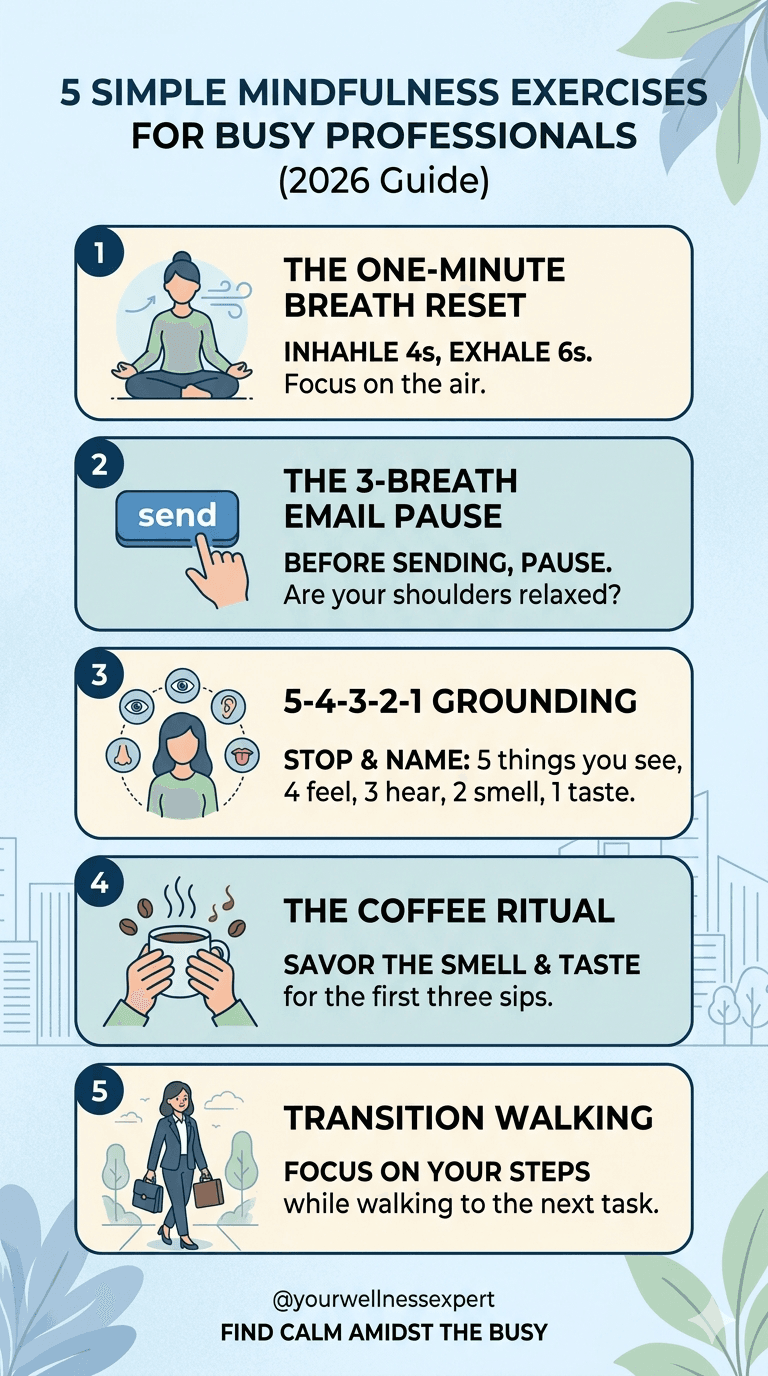
The hardest part of mindfulness is remembering to do it. Follow this simple plan to integrate your first habit in just one week.
| Day | Exercise Focus | Recommended Cue |
| Day 1 | Exhale Reset (Exhale twice as long as inhale) | Before you check email (Do it 3x) |
| Day 2 | One-Sip Coffee Ritual | Focus purely on the first sip of your morning drink. |
| Day 3 | Mindful Desk Transition | The 10-second walk from your desk to the breakroom. |
| Day 4 | 5-4-3-2-1 Grounding | Right before a challenging meeting or during a peak stress moment. |
| Day 5 | The Three-Breath Decision Pause | Wait 3 breaths before sending that one email you really want to send. |
| Day 6 | 2-Second Gap (Mindful Listening) | Use during a casual interaction with a coworker. |
| Day 7 | Digital Detox Break | Set a timer: 5 minutes, 0 screens, just looking at something in nature (or a plant). |
References
- Harvard Medical School – Mindfulness research
https://www.health.harvard.edu - American Psychological Association – Stress & mindfulness
https://www.apa.org - Greater Good Science Center (UC Berkeley)
https://greatergood.berkeley.edu - National Institutes of Health (NIH)
https://www.nih.gov
About the Author
Jesuraj is a wellness researcher and health optimization specialist focused on the intersection of modern neuroscience and traditional herbalism.
He specializes in analyzing clinical trials, adaptogens, and cognitive performance strategies to deliver evidence-based, actionable insights.
By combining ancient wisdom with modern neuroscience, Jesuraj helps readers improve mental clarity, resilience, and long-term brain health—without fluff or misinformation.

