
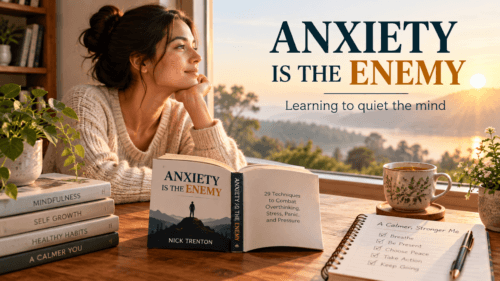
Anxiety Is the Enemy by Nick Trenton: A Practical Book Review for Overthinking, Stress, and Mental Peace
“A noisy mind can make even a quiet life feel difficult.”
Have you ever gone to bed physically tired but found your mind still working?
You replay an old conversation.
You worry about tomorrow.
You imagine what could go wrong.
You think about a decision you have already made.
Then another thought arrives.
And another.
This is the exhausting world of overthinking.
Nick Trenton’s book Anxiety Is the Enemy: 29 Techniques to Combat Overthinking, Stress, Panic, and Pressure takes a practical self-help approach to this problem. Published by PKCS Media in 2022, the book is 185 pages long and presents 29 techniques to help readers manage anxiety, stress, overthinking, and mental pressure. (Google Books)
But there is an important question behind the book:
Can we really learn to respond differently to anxious thoughts?
That is what makes this book worth exploring.
Rather than treating the book as a promise to eliminate anxiety, this review looks at its practical ideas, what they can teach us about our thinking, where they connect with established psychological approaches, and how the lessons can be applied in everyday life.
Book at a Glance
Book: Anxiety Is the Enemy: 29 Techniques to Combat Overthinking, Stress, Panic, and Pressure
Author: Nick Trenton
Publisher: PKCS Media
Published: May 17, 2022
Length: 185 pages
Genre: Self-help / stress management / psychology
Primary theme: Managing overthinking, stress, anxiety, and mental pressure. (Google Books)
What Is Anxiety? Is the Enemy About?
At its core, Anxiety Is the Enemy is about changing our relationship with anxious thoughts.
The book does not rely on one single technique.
Instead, Trenton presents 29 approaches. Among the techniques listed in the book are questioning yourself using the Socratic method, using the ABC model to understand stress, limiting caffeine, mental anchoring, belly breathing, body scanning, loving-kindness meditation, metaphorizing anxiety, role-playing, accepting anxiety and writing to your future self. (Google Books)
This variety is important.
There is no universal technique that will feel equally useful to every reader.
One person may benefit from breathing exercises.
Another may prefer journaling.
Someone else may find that questioning their automatic thoughts is more useful.
The book therefore works best when viewed as a toolbox rather than a prescription.
You are not required to use every tool.
You can experiment, observe, and discover which approaches fit your circumstances.
Why Overthinking Feels So Exhausting
Overthinking often looks like problem-solving.
But there is a difference between solving a problem and repeatedly thinking about a problem without reaching a useful action.
For example:
Problem-solving:
“I have an important meeting tomorrow. What do I need to prepare?”
You make a list.
You prepare.
You go to bed.
Overthinking:
“What if the meeting goes badly?”
“What if they don’t like my presentation?”
“What if I forget something?”
“What if they ask a question I cannot answer?”
“What if this affects my future?”
The second process can continue for hours without producing anything useful.
The mind is working hard, but it is not necessarily moving forward.
This is one reason practical strategies for managing anxious thinking can be valuable.
Anxiety Is Normal—But Anxiety Disorders Are Different
One of the most important points to establish before discussing any self-help book is that anxiety itself is not automatically a disorder.
The National Institute of Mental Health explains that feeling anxious is a normal part of life. Anxiety disorders are different: anxiety may persist, occur across situations, and interfere with daily life.
For example, feeling nervous before an interview can be completely normal.
Feeling worried about an important medical appointment can also be understandable.
But persistent and excessive anxiety that becomes difficult to control and interferes with everyday functioning deserves professional attention.
This distinction makes the book’s message more useful.
The goal should not be:
“I must never feel anxious.”
A healthier goal is:
“I want to develop better ways of responding when anxiety appears.”
29 Techniques: The Book’s Practical Strength
The strongest feature of Anxiety Is the Enemy is its emphasis on practical exercises.
Here are some of the techniques highlighted in the book.
1. Question Your Thoughts
The Socratic method encourages us to question our assumptions.
When an anxious thought appears, instead of immediately believing it, ask:
- What evidence supports this thought?
- What evidence contradicts it?
- Am I assuming the worst?
- Is there another possible explanation?
- What would I tell a friend experiencing the same situation?
This approach has a strong connection with cognitive behavioural therapy.
NIMH describes CBT as a research-supported psychotherapy that helps people identify automatic or unhelpful patterns of thinking and question them.
That does not mean every exercise in the book should be considered clinical CBT.
Rather, it shows that some of the book’s ideas overlap with principles used in established psychological approaches.
2. Use the ABC Model
The book also discusses the ABC model for understanding stress.
A simple way of looking at it is:
A — Activating event
Something happens.
B — Belief
You interpret what happened.
C — Consequence
You experience an emotional or behavioural response.
The important insight is that the event itself is not always the whole story.
Our interpretation can influence how we respond.
Imagine two people receive the same email from their manager:
“Can we talk tomorrow?”
One person thinks:
“I’m probably in trouble.”
Another thinks:
“Maybe my manager wants to discuss a new project.”
The event is identical.
The interpretation is different.
This is one of the most useful ways to understand why examining our automatic thoughts can matter.
3. Practice Belly Breathing
Anxiety can have a physical component.
When we are stressed, our breathing may become rapid or shallow, and our body can feel tense.
Trenton includes belly breathing among his techniques.
The NHS also recommends a simple calming breathing exercise for stress, anxiety and panic. Its guidance suggests allowing the breath to move comfortably into the belly, breathing gently through the nose and out through the mouth, and practising regularly.
A simple practice is:
- Sit comfortably.
- Relax your shoulders.
- Breathe gently through your nose.
- Allow your abdomen to expand naturally.
- Exhale slowly.
- Continue for several minutes without forcing the breath.
The key word is gently.
Breathing exercises should not become another performance test.
4. Scan the Body
Sometimes we know we are stressed before we consciously recognise the emotion.
Our body may tell us first.
The jaw becomes tight.
The shoulders rise.
The stomach feels uncomfortable.
The hands become tense.
A body scan brings attention to these sensations.
You can simply ask:
“What am I feeling in my body right now?”
There is no need to immediately change anything.
Notice.
Breathe.
Relax where possible.
Continue observing.
This is closely related to mindfulness-based awareness.
5. Accept the Presence of Anxiety
Perhaps one of the most important lessons is acceptance.
Many people respond to anxiety with another thought:
“I shouldn’t be anxious.”
That can create a second layer of distress.
Instead, you might say:
“I notice that I am anxious right now.”
There is a subtle but important difference.
The first statement fights the experience.
The second observes it.
Acceptance does not mean approving of anxiety.
It does not mean giving up.
It means recognising what is happening without adding unnecessary resistance.
The National Institute of Mental Health notes that acceptance and commitment therapy uses nonjudgmental acceptance of thoughts and behaviours together with mindfulness and goal-setting strategies.
The Most Important Lesson: A Thought Is Not a Fact
Perhaps the most useful takeaway from this book is learning to create some distance from our thoughts.
Imagine your mind is a sky.
Thoughts are clouds.
Some clouds are white.
Some are dark.
Some move quickly.
Some stay longer.
But they are still clouds.
You don’t have to become every thought that passes through your mind.
When your mind says:
“Something terrible will happen.”
You can respond:
“I am having the thought that something terrible will happen.”
That small change in language can create psychological space.
It gives you an opportunity to examine the thought instead of automatically obeying it.
Does the Book Really Help You “Control” Your Thoughts?
This is where I would slightly reinterpret the book’s message.
We should be careful about the idea that we can completely control our thoughts.
Thoughts arise automatically.
Trying desperately to eliminate every negative thought may itself become exhausting.
A more realistic goal is:
Learn to notice thoughts, question them when appropriate, and choose your response.
That is a more sustainable approach.
You may not control the arrival of a thought.
But you can practise deciding what you do next.
Anxiety and the Body: Why Lifestyle Matters
The book also touches on lifestyle-related factors such as caffeine and hobbies. (Google Books)
This is an important addition because mental wellbeing does not exist separately from physical wellbeing.
The National Institute of Mental Health notes that healthy habits such as adequate sleep and reducing caffeine can help reduce anxiety symptoms when used alongside standard care; it also identifies exercise, mindfulness and meditation as potentially helpful stress-management practices.
The NHS similarly recommends regular exercise, healthy eating, calming breathing exercises, and meditation as things people can try when experiencing anxiety, fear, or panic. (nhs.uk)
This fits naturally with the BenVitalFive philosophy.
Mind and body are connected.
That does not mean lifestyle habits are a replacement for treatment.
It means that everyday habits can be part of a broader wellbeing strategy.
A Simple BenVitalFive Anxiety-Reset Routine
Here is a practical routine inspired by the ideas discussed in the book and supported by general stress-management guidance.
Step 1: Pause
Stop what you are doing for a moment.
Don’t immediately react.
Step 2: Name the experience.
Say:
“I am feeling anxious.”
Or:
“I am overthinking this situation.”
Step 3: Breathe
Spend a few minutes breathing slowly and comfortably.
The NHS recommends practising its calming breathing technique regularly rather than only during moments of stress.
Step 4: Question the thought.
Ask:
“What evidence do I actually have?”
Step 5: Separate facts from predictions.
Fact:
“I have an important meeting tomorrow.”
Prediction:
“The meeting will definitely go badly.”
They are not the same thing.
Step 6: Choose one action.
Ask:
“What is one useful thing I can do right now?”
Then do it.
This converts mental energy into action.
What I Like About Anxiety Is the Enemy
It is practical.
The book gives readers techniques rather than only theory.
It is accessible.
At 185 pages, it is relatively manageable for someone beginning to explore anxiety and overthinking. (Google Books)
It provides variety
The 29 techniques mean readers can explore different approaches.
It encourages self-awareness.
Many exercises require you to stop and observe your thoughts, emotions or physical sensations.
It can become a practice book.
Rather than reading it once and forgetting it, you can return to individual exercises when needed.
Where the Book Could Be Stronger
A balanced review should also acknowledge limitations.
The large number of techniques can feel somewhat like a toolbox without a single central pathway.
Some readers may prefer a more structured programme:
Understand → practice → review → progress.
Others may enjoy having many options.
There is also an important distinction between a self-help book and professional treatment.
Readers should not assume that practising the book’s techniques is equivalent to receiving evidence-based psychotherapy.
For people with persistent anxiety disorders, the National Institute of Mental Health identifies psychotherapy, medication, or a combination of the two as established treatment options depending on the individual’s situation.
Therefore, the book is best considered a self-help resource and practical companion—not a replacement for professional care.
Who Should Read This Book?
Anxiety Is the Enemy may appeal to readers who:
- Frequently overthink
- Have difficulty switching off mentally
- Want practical stress-management ideas
- Are interested in mindfulness
- Want to understand their thought patterns
- Enjoy self-development books
- Prefer exercises to lengthy theory
- Want to build a personal mental-wellness toolkit
It may be particularly useful for readers who are beginning to explore the relationship between thoughts, emotions, habits and behaviour.
Who Should Not Rely on the Book Alone?
If anxiety is persistent, severe or interfering substantially with work, relationships, sleep or everyday functioning, self-help should not be the only approach.
Professional support can make an important difference.
The National Institute of Mental Health recommends speaking with a healthcare provider or qualified mental-health professional when anxiety is causing significant problems. Evidence-based treatments include psychotherapy, medication or both, depending on individual circumstances.
This is not a weakness of the book.
It is simply an important boundary between self-development and clinical treatment.
How to Get the Most From the Book
Don’t try to practise all 29 techniques at once.
Instead:
Week 1 — Observe
Notice when you overthink.
Write down recurring thoughts.
Week 2 — Question
Start examining automatic assumptions.
Week 3 — Breathe
Introduce a short daily breathing practice.
Week 4 — Reflect
Identify which techniques actually helped you.
Then create your own personal toolkit.
For example:
When my mind races → breathing
When I catastrophise → question the thought
When my body feels tense → body scan
When I cannot change the situation → acceptance
This turns a book into a practice.
Commercial Intent: Useful Products for a Mindfulness Practice
If you are building a simple mindfulness or stress-management routine, you do not need many products.
A few basic items can make practice more comfortable.
Meditation cushion
Useful for readers who prefer sitting meditation and want additional support.
Yoga mat
A comfortable mat can provide a dedicated surface for breathing exercises, stretching, yoga or meditation.
Journal
A simple notebook can be useful for recording recurring thoughts, identifying triggers and reflecting on what helps.
Comfortable clothing
Loose, comfortable clothing can make breathing exercises, meditation and gentle movement easier.
Timer
A basic timer can help you practise for five or ten minutes without repeatedly checking your phone.
The important point is not to turn wellness into a shopping list.
The product should support the habit—not become the habit.
BenVitalFive Connection: Five Ways to Respond to Anxiety
This book fits naturally into the five pillars of BenVitalFive.
1. Yoga
Gentle movement can help bring attention away from constant mental activity and back toward the body.
2. Meditation
Meditation can help develop awareness of thoughts without automatically following them.
3. Physical Exercise
Regular movement is one of the lifestyle approaches recommended for supporting mental wellbeing.
4. Reading
A thoughtful book can give us new language for understanding experiences we previously struggled to describe.
5. Healthy Nutrition
Regular, balanced eating is part of a broader healthy lifestyle. The NHS recommends maintaining a healthy diet with regular meals when dealing with anxiety. (nhs.uk)
Together, these are not a cure for anxiety.
They are habits that can contribute to a more balanced approach to wellbeing.
Frequently Asked Questions
Is Anxiety Is the Enemy a good book for overthinking?
It is a practical self-help book specifically focused on overthinking, stress, anxiety and mental pressure. It provides 29 techniques readers can explore. (Google Books)
What is the main message of Anxiety Is the Enemy?
The book encourages readers to work differently with anxious thoughts through practical techniques involving thought questioning, breathing, body awareness, acceptance and other approaches.
Can reading this book cure anxiety?
No book should be presented as a guaranteed cure for an anxiety disorder. Persistent or severe anxiety may require professional assessment and treatment. (National Institute of Mental Health)
What is the best technique for anxiety?
There is no single technique that is best for everyone. Different approaches work for different people and different situations. NIMH notes that treatment decisions should take individual needs and circumstances into account.
Can breathing exercises help with anxiety?
Breathing exercises can be useful as a calming practice. The NHS provides a breathing technique specifically for stress, anxiety and panic and recommends practising regularly. (nhs.uk)
Final Review: Is Anxiety Is the Enemy Worth Reading?
Anxiety Is the Enemy is not a magic formula for eliminating anxiety.
And that may actually be its most useful lesson.
Anxiety is part of being human.
We cannot prevent every uncertain event.
We cannot control every thought.
We cannot know exactly what tomorrow will bring.
But we can become more aware of our thinking.
We can learn to pause.
We can breathe.
We can question assumptions.
We can notice what our body is telling us.
We can choose our next action.
And when anxiety becomes persistent or seriously interferes with life, we can seek appropriate professional support.
That is where this book has value.
It gives readers a collection of ideas to explore and practise.
The real benefit, however, does not come from simply finishing the final page.
It comes when one of those ideas becomes a daily habit.
Read less. Practise more.
Take one technique.
Try it.
Observe yourself.
Learn from the experience.
Then continue.
Because the goal is not to build a life without difficult thoughts.
The goal is to build a mind that does not have to obey every difficult thought.
BenVitalFive Takeaway
You may not control every thought that enters your mind. But with awareness, practice and appropriate support, you can learn to respond to your thoughts differently.
That is a lesson worth carrying beyond the final page.
Author Bio
Jesu Raj Athisayam is the founder of BenVitalFive, a wellness platform exploring five interconnected areas of everyday wellbeing: Yoga, Meditation, Physical Exercise, Reading and Healthy Nutrition.
Through BenVitalFive, he shares practical ideas that encourage readers to build sustainable habits rather than chase quick fixes.
Suggested Excerpt:
Suggested Internal Links for BenVitalFive
Use these as anchor-text opportunities rather than forcing exact-match keywords:
- Meditation for People Who Can’t Sit Still
- How to Improve Focus and Reduce Mental Distraction
- The First 20 Minutes of the Day
- Why Discipline Matters More Than Motivation
- How to Build a Healthier Mindset
- Yoga Isn’t What You Think It Is
- Beginner Yoga Guide: Why You Don’t Need Flexibility
These links can create a strong content cluster around Mindfulness → Anxiety → Focus → Habits → Yoga → Healthy Living.
Featured Image SEO Plan
Recommended size: 1600 × 900 px
Aspect ratio: 16:9
Filename: anxiety-is-the-enemy-nick-trenton-book-review.jpg
Alt text:
Anxiety Is the Enemy by Nick Trenton book review about overthinking and stress
Featured-image concept:
A warm, realistic editorial scene showing a person sitting quietly beside a window in the early morning, with an open self-help book, journal and cup of herbal tea on a wooden table. The person appears thoughtful but calm rather than distressed. Soft natural light enters the room, creating a visual transition from mental tension to calm. Keep the composition clean and premium, suitable for a wellness website.
Suggested overlay:
ANXIETY IS THE ENEMY
Learning to quiet the mind
Authoritative external links to include
For E-E-A-T, I recommend linking naturally from the article to NIMH’s anxiety-disorders guidance, NIMH’s psychotherapy information, and the NHS breathing-exercise guide. These provide readers with trustworthy medical context alongside the book review. (National Institute of Mental Health)
For the book itself, Google Books provides the bibliographic information and the book’s listed techniques. (Google Books)
Important SEO point: I would keep the commercial section relatively small. For this particular topic, reader trust is more important than turning the article into a product-heavy post. That will also make the review feel more authentic and consistent with BenVitalFive.

