
Introduction
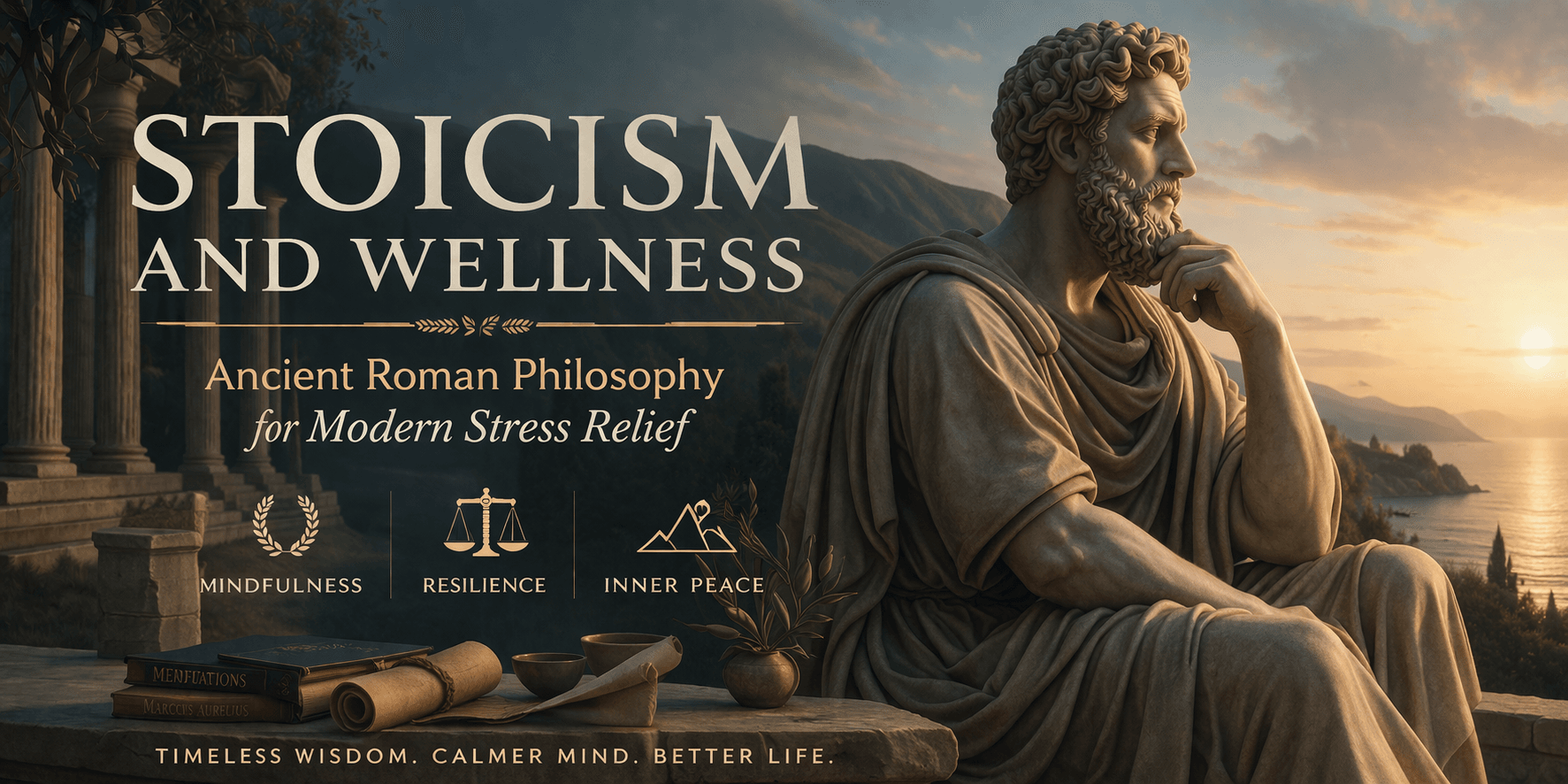
Of all the philosophical traditions I have encountered in my lifelong journey of reading and reflection, Stoicism is perhaps the most immediately practical for modern life. While it originated in ancient Athens and was refined in Rome over 2,000 years ago, its core teachings address the central anxiety of the modern world with startling precision: we suffer more from our thoughts about events than from the events themselves.
Stoicism aligns deeply with the fifth pillar of BenVitalFive’s wellness philosophy — growth through reading and intellectual development. But it goes beyond reading. Stoicism is a way of living. It is a daily practice of mental wellness that has helped emperors, enslaved people, soldiers, and ordinary citizens endure extraordinary challenges with equanimity and purpose.
In this guide, I will introduce you to the core principles of Stoicism, show how they apply to modern stress and wellness, and give you practical tools to begin applying them today.
What Is Stoicism?
Stoicism is a school of philosophy founded in Athens around 300 BCE by Zeno of Citium. It was later developed by figures including Epictetus (a formerly enslaved person), Seneca (a statesman and writer), and Marcus Aurelius (Roman Emperor and perhaps history’s most powerful Stoic practitioner).
The central insight of Stoicism can be summarized in one sentence, articulated by Epictetus in his Enchiridion:
‘Some things are in our control and others are not.’
This seemingly simple statement — the Stoic Dichotomy of Control — is the foundation of everything. Stoics argue that our emotions, judgments, and responses are within our control. External events, other people’s opinions, illness, loss, and death are not. Suffering arises when we treat things outside our control as though they are within it.
The 4 Core Virtues of Stoicism
Stoics believed that a good life was one lived in accordance with four cardinal virtues:
- Wisdom — knowing what is truly good, bad, and indifferent
- Justice — treating others fairly and acting for the common good
- Courage — doing what is right even when it is difficult
- Temperance — self-control and moderation in all areas of life
Notice that wealth, status, pleasure, fame, and even health are not on this list. The Stoics called these ‘preferred indifferents’ — things that may be pleasant to have but are not necessary for a good life. This perspective alone can dramatically reduce the anxiety that comes from chasing things beyond our control.
Stoic Principles for Modern Stress and Wellness
1. The Dichotomy of Control
This is the foundational Stoic tool for stress reduction. When you feel anxious or stressed, ask yourself: Is this within my control? If it is — act. If it is not — accept.
Modern anxiety is largely driven by our attempts to control things outside our control: other people’s opinions of us, economic conditions, health outcomes, traffic, the behavior of family members. The Stoic practice is not to become indifferent to these things, but to redirect your energy from the uncontrollable to the controllable — your response, your effort, your values.
2. Negative Visualization (Premeditatio Malorum)
This Stoic practice involves deliberately imagining difficult or challenging scenarios — losing your job, experiencing illness, losing a loved one — not to induce pessimism, but to appreciate what you have and to mentally prepare for life’s inevitable challenges.
Modern research in positive psychology supports this practice. A study published in Psychological Science found that thinking about the absence of positive events in your life (a version of negative visualization) significantly increases present-moment gratitude and life satisfaction.
The practice also reduces the shock and disruption when difficult events actually occur. You have already faced them in your mind. You know you can endure.
3. The View from Above (Cosmic Perspective)
Marcus Aurelius regularly practiced what philosophers call the View from Above — imagining your life, your problems, and your concerns from an ever-widening perspective: your city, your country, the Earth from space, the vast span of cosmic time.
This perspective practice does not make your problems trivial. It places them in proportion. The performance review you are dreading, the argument with a colleague, the financial worry — these are real, but they are also vanishingly small in the context of cosmic time and space. This is not nihilism. It is liberation.
4. Memento Mori (Remember That You Will Die)
Far from being morbid, the Stoic contemplation of mortality is one of the most life-affirming practices I know. Marcus Aurelius wrote in his Meditations that remembering the impermanence of life — including his own — made him more intentional, more grateful, and less willing to waste time on trivial concerns.
The practice is simple: each morning or evening, briefly acknowledge that your time is finite. Ask yourself: Am I living in alignment with my values? Am I wasting the day on things that do not matter? This is not a practice of fear — it is a practice of intentional living.
5. The Daily Review (Evening Journaling)
Stoic philosopher Seneca wrote extensively about the value of daily self-examination. Each evening, he would review his day: Where did I act in accordance with my values? Where did I fall short? What could I do better tomorrow?
This practice aligns with modern research on journaling. Studies from the University of Texas found that expressive writing and self-reflection reduce psychological distress and improve immune function. The Stoic evening review combines this therapeutic benefit with a framework for moral and practical growth.
Key Stoic Books to Read
If you wish to explore Stoicism through reading — perfectly aligned with BenVitalFive’s fifth pillar — here are the primary texts:
- Meditations by Marcus Aurelius — the private journal of a Roman Emperor, written with no intention of publication. Perhaps the most direct and human Stoic text.
- Letters from a Stoic by Seneca — practical philosophical letters on topics from friendship to grief to the value of time.
- Enchiridion by Epictetus — a short, powerful distillation of Stoic practice by a man who experienced slavery and physical disability with remarkable dignity.
- A Guide to the Good Life by William Irvine — an accessible modern introduction to Stoicism for contemporary readers.
Stoicism and BenVitalFive’s ‘Live Long, Live Quietly’ Philosophy
The Stoics and the rural Tamil Nadu elders I observed in my early years had something remarkable in common: both found contentment not in the accumulation of more, but in the disciplined appreciation of what was already present. Both valued simplicity, self-mastery, and equanimity in the face of change.
Stoicism is not a cold, emotionless philosophy. It is a practice of deep engagement with life — on its own terms, not our projected expectations of how it should be. In this sense, it is one of the most wellness-oriented philosophies ever conceived.
Key Takeaways
- Stoicism is an ancient philosophy with directly applicable tools for modern stress and anxiety management
- The Dichotomy of Control — focusing only on what is within your power — is the foundational practice
- Negative visualization, the View from Above, Memento Mori, and the daily evening review are four practical Stoic techniques
- Reading Marcus Aurelius’s Meditations is one of the most accessible and transformative starting points
- Stoicism teaches that a good life is available to anyone, regardless of wealth, status, or external circumstances — a truth deeply aligned with BenVitalFive’s philosophy

