
Medical Disclaimer
The content on BenVitalFive is for informational and educational purposes only. This is not intended as medical advice or to replace a relationship with a qualified healthcare professional. If you have pre-existing health conditions or injuries, consult your physician before beginning any new exercise program. Reliance on any information provided on this website is solely at your own risk.
Introduction
Common exercise mistakes can quietly slow your progress, drain your motivation, and increase your risk of injury. especially when you’re just getting started. As a regular fitness enthusiast, I frequently see beginners committing simple mistakes. And the majority of the mistakes can be corrected with a few clever tweaks.
In this blog, we’ll cover the most frequent exercise mistakes, explain why they happen, and provide practical tips to avoid them.
Mistake 1: Skipping Warm-Ups and Cool-Downs
Why it’s a mistake: Jumping straight into intense movement is like trying to drive a car at 100 mph while the engine is freezing. Cold muscles are less elastic and more prone to tears. Furthermore, your joints need “lubrication” before they can handle impact safely.
How to fix it (Expert-Recommended) A proper warm-up serves two biological purposes:
Joint Lubrication: Movement triggers the release of synovial fluid, a thick liquid that cushions your joints and reduces friction.
Vasodilation: It slowly increases your heart rate, widening blood vessels (vasodilation) to ensure your muscles are flooded with oxygen-rich blood before the real work begins.
The Routine:
5–10 Minutes of Dynamic Prep: Focus on active movements like arm circles and leg swings. This wakes up the nervous system without overstretching a “cold” muscle.
Post-Workout Cool Down: Spend 5 minutes on static stretching. This helps your heart rate return to baseline and prevents blood pooling in your limbs, which reduces next-day dizziness and stiffness.
Mistake 2: Exercising Too Much Too Soon
Why it’s a mistake
Beginners often train too hard, too often, and too quickly. That usually leads to extreme soreness, fatigue, poor recovery, and sometimes injury—then motivation drops.
How to fix it
Start with a realistic schedule and progress gradually:
15–30 minutes per session
3–5 days per week
Increase only one thing at a time (time, reps, or intensity)
Community Best Practice: If you can’t recover between workouts, you’re doing too much.
Mistake 3: Poor Form and Technique
Why it’s a mistake
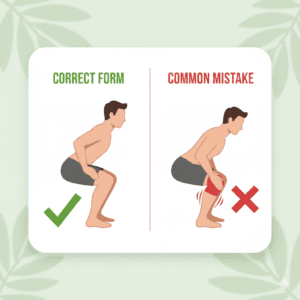
Poor form places stress on joints and connective tissue and reduces the effectiveness of the exercise. Over time, it can lead to knee pain, lower back strain, or shoulder issues.
How to fix it
Prioritize technique before speed or weight:
Start with bodyweight movements
Use a mirror or record your sets
Follow reliable tutorials or get coaching feedback
Common form errors to watch for
Squats: knees collapsing inward
Push-ups: hips dropping, neck craning forward
Lunges: leaning forward, unstable steps
Mistake 4: Ignoring Rest and Recovery
Why it’s a mistake: A common fitness myth is that you get stronger at the gym. In reality, exercise creates microscopic tears in your muscle fibers. You actually get stronger while you sleep. If you skip rest, you remain in a state of “chronic breakdown,” leading to stagnant results and elevated cortisol (stress hormone) levels.
How to fix it
The 7–9 Hour Rule: Aim for 7–9 hours of quality sleep. During deep sleep, your body releases Growth Hormone (GH), which is the primary driver for tissue repair and muscle protein synthesis.
Scheduled Deloading: Every 4–6 weeks, reduce your workout intensity by 50%. This “active recovery” allows your central nervous system to recover without you becoming sedentary.
Mistake 5: Not Setting Realistic Goals
Why it’s a mistake
Unrealistic goals often lead to frustration and quitting early. Sustainable fitness comes from small wins stacked over time.
How to fix it
Use simple, measurable goals like
“I’ll walk 20 minutes, 3x per week.”
“I’ll strength train twice a week for 4 weeks.”
“I’ll complete 10 workouts this month.”
Community Best Practice: Your goal should feel challenging—but achievable.
Mistake 6: Neglecting Strength and Flexibility
Why it’s a mistake
Doing only cardio can lead to weak muscles, poor posture, and imbalances. Strength training supports your joints, improves metabolism, and builds long-term fitness. Mobility work helps you move better and feel less stiff.
How to fix it
Build a balanced routine with:
Cardio: heart health and stamina
Strength training: muscle, posture, joint support
Flexibility/mobility: better movement and reduced tightness
Minimum effective dose:
Even 10 minutes of mobility 2–3 times per week helps.
Mistake 7: Skipping Hydration and Nutrition
Why it’s a mistake
If you’re under-fueled or dehydrated, you will feel workouts harder, recovery will be slower, and energy levels will crash.
How to fix it
Hydration basics:
Drink water before, during, and after training
Add extra fluids if you sweat heavily
Balanced meals should include:
Protein: eggs, chicken, tofu, beans
Complex carbs: oats, rice, potatoes, fruit
Healthy fats: olive oil, nuts, avocado
Community Best Practice: Consistent nutrition beats “perfect” nutrition.
Mistake 8: Comparing Yourself to Others
Why it’s a mistake
Comparing yourself to influencers or advanced gym-goers creates unrealistic expectations. Most people don’t see the years of work behind someone else’s results.
How to fix it
Focus on your personal progress:
Track your strength, energy, and consistency
Celebrate small milestones
Stay patient—progress is not linear
Reminder: Fitness is a journey. You only need to beat your past self.
Beginner Safety Rules (Follow These Every Week)
Start slow: progress gradually
Track your workouts: a journal or app helps
Sharp pain = stop: adjust or switch exercises
Form first: technique matters more than speed
Consistency wins: moderate workouts done regularly beat extreme workouts done rarely
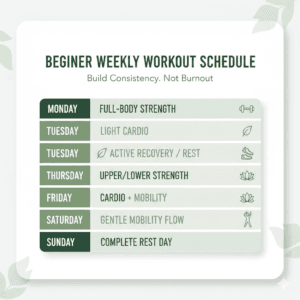
Beginner-Friendly Weekly Workout Plan (With Exercises + Reps)
How hard should it feel?
Aim for a 7/10 effort: challenging, but you can still maintain good form.
Monday—Full-Body Strength (30 minutes)
Warm-up (5 minutes): brisk walk + arm circles + leg swings
Workout (2–3 rounds):
Bodyweight Squats—10–12 reps
Incline Push-ups (hands on bench/wall)—8–12 reps
Glute Bridges—12–15 reps
Dumbbell or Backpack Rows—10–12 reps
Plank—20–30 seconds
Rest: 60–90 seconds between exercises
Tuesday—Light Cardio + Mobility (20–30 minutes)
Brisk walk, bike, or jog—20 minutes
Mobility (5 minutes):Hip flexor stretch—30 sec each side
Hamstring stretch—30 sec each side
Chest opener stretch—30 sec
Wednesday—Rest or Active Recovery (10–20 minutes)
Choose one:
Easy walk—10–20 minutes
Gentle stretching—10 minutes
Thursday—Strength + Core (30 minutes)
Warm-up (5 minutes): light cardio + dynamic stretching
Workout (2–3 rounds):
Reverse Lunges—8–10 reps each leg
Dumbbell Shoulder Press (or water bottles)—10–12 reps
Dead Bug—8–10 reps each side
Romanian Deadlift (light dumbbells/backpack)—10–12 reps
Side Plank—15–25 seconds each side
Friday—Cardio + Conditioning (20–30 minutes)
Pick one option:
Option A: Steady Cardio
Walk/jog/cycle—25–30 minutes
Option B: Beginner Intervals (20 minutes)
1 minute fast walk
1-minute easy walk
Repeat 10 rounds
Saturday—Mobility + Light Movement (20 minutes)
Easy walk—10 minutes
Mobility flow—10 minutes
Cat-cow x 8 reps
Child’s pose 30 seconds
Thoracic rotations x 8 each side
Deep squat hold 20–30 seconds
Sunday—Full Rest
No structured workout needed.
Focus on hydration, good meals, and recovery.
Progression Plan (How to Improve Safely)
Each week, choose ONE improvement:
Add 1–2 reps per exercise, OR
Add 1 extra round, OR
Add 5 minutes of cardio
That’s how you build results without burning out.
Conclusion (Coach’s Final Message)
Avoiding common exercise mistakes is one of the fastest ways to improve your results—without training harder. When you focus on proper warm-ups, good form, smart recovery, realistic goals, hydration, and balanced training, your workouts become safer, more effective, and much more enjoyable.
Start where you are. Stay consistent. Train with purpose.
If you follow this plan for just 2–4 weeks, you’ll feel stronger, move better, and build real momentum.
Ready to take action?
Pick your first workout day, follow the weekly plan, and track your progress for the next 14 days.
Small steps done consistently will always beat big efforts done occasionally.
FAQs
1. What is the most common mistake beginners make while exercising?
Skipping warm-ups and cool-downs, which increases the risk of injury and soreness.
2. How can I avoid exercising too much too soon?
Start with short sessions and gradually increase your time, reps, or intensity each week.
3. How important is proper form during workouts?
Proper form prevents injuries and ensures the exercise targets the right muscles effectively.
4. How many rest days should a beginner take?
At least 1–2 rest days per week, plus active recovery if needed.
5. Should I compare my progress to others when exercising?
No. Focus on your own progress—consistency and patience create long-term results.
About the Author:
Jesuraj is a wellness researcher and health optimization specialist focused on the intersection of modern neuroscience and traditional herbalism. Dedicated to evidence-based wellness, Jesuraj spends hundreds of hours auditing clinical trials and third-party lab reports to provide readers with objective, fluff-free analysis. By bridging the gap between ancient botanical wisdom and contemporary brain science, Jesuraj empowers individuals to optimize their mental clarity and vitality through the strategic use of adaptogens and targeted supplementation.

