
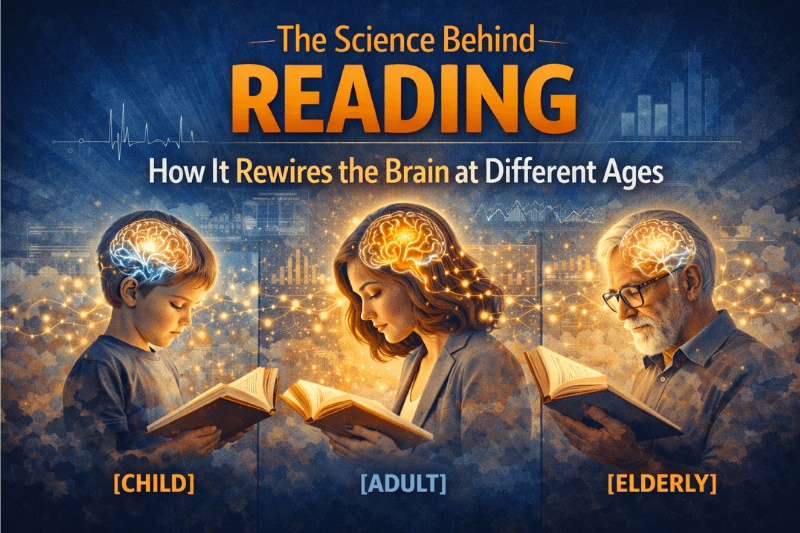
The Science Behind Reading: How It Rewires the Brain at Different Ages
Table of Contents
This guide explains how reading affects the brain at every age, from early childhood to older adulthood.
- How Reading Affects the Brain Through Neuroplasticity
- How Reading Shapes Brain Development in Children (Ages 3–12)
- How Reading Influences the Teenage Brain (Ages 13–19)
- Reading and Cognitive Performance in Adults (Ages 20–60)
- How Reading Protects Brain Health in Older Adults (60+)
- Fiction vs Non-Fiction: How Each Affects the Brain
- Reading vs Digital Scrolling: A Brain Comparison
- How Much Reading Is Enough for Brain Health?
- Key Takeaways: Why Reading Is a Lifelong Brain Exercise
- Frequently Asked Questions About Reading and the Brain
Introduction
Reading is not just a skill we learn in school—it is a lifelong mental exercise that reshapes how the brain thinks, feels, and adapts. From early childhood to old age, reading strengthens neural pathways responsible for language, memory, focus, and emotional understanding.
Neuroscience now confirms what cultures across history have long believed: the brain changes based on what we repeatedly engage with. Reading is one of the most powerful, low-cost habits for lifelong brain health.
Drawing from scientific research, community observations, and real-world experience, this guide explains how reading affects the brain at every stage of life—and how to use it intentionally.
What Happens to the Brain When You Read?
Reading activates multiple brain regions responsible for language, memory, visual processing, and emotion. With repeated reading, these regions form stronger neural connections through neuroplasticity, improving focus, comprehension, and emotional intelligence over time.
Why this works
- 1–2 sentences
- Definition-style
- Answers a “what happens” query directly
The Science Behind Reading and Brain Neuroplasticity
When we read, the brain performs a complex coordination task. Language centers decode meaning, visual regions recognize symbols, memory systems store information, and emotional areas respond to context and narrative.
This repeated activation strengthens neural connections through neuroplasticity, the brain’s ability to rewire itself in response to experience. Unlike passive screen consumption, reading requires active mental participation, making it one of the most effective ways to train the brain.
Unique insight:
In literacy programs across rural Tamil Nadu, adults who adopted daily reading habits showed noticeable improvements in recall, attention, and emotional expression—despite limited formal education. This highlights that brain growth is not age-limited but habit-dependent.
Actionable recommendation:
Read slowly and with intention. Comprehension matters more than speed for brain development.
Benefits of Reading for the Brain
Use this exact format:
- Strengthens memory and concentration
- Improves language and comprehension skills
- Enhances emotional intelligence and empathy
- Reduces stress and mental fatigue
- Slows age-related cognitive decline
How Reading Affects the Brain at Different Ages
Reading supports brain development in children, emotional regulation in teenagers, cognitive performance in adults, and memory preservation in older adults. The brain benefits from reading at every stage of life.
How Reading Shapes Brain Development in Children (Ages 3–12)
Childhood is the most critical phase for brain development. During these years, reading directly influences how language, imagination, and emotional understanding form.
Regular reading:
- Strengthens vocabulary and comprehension
- Improves attention span and listening skills
- Helps children recognize emotions and social cues
- Builds early empathy through storytelling
On-site observation:
Children exposed to daily storytelling showed stronger emotional articulation and better classroom focus than peers with limited reading exposure.
Unique insight:
Repetition is more powerful than variety. Reading the same story multiple times strengthens neural pathways far more effectively than switching books daily.
Actionable recommendation:
Read aloud consistently, even after a child learns to read independently.
How Reading Influences the Teenage Brain (Ages 13–19)
The teenage brain is still developing, particularly the prefrontal cortex, which controls decision-making, emotional regulation, and impulse control.
Reading during adolescence:
- Improves critical thinking and reasoning
- Enhances emotional intelligence and empathy
- Helps regulate stress and emotional volatility
- Strengthens sustained attention
Unique insight:
Fiction allows teenagers to “practice” complex social situations safely, improving emotional awareness without real-world risk.
Actionable recommendation:
Encourage reflective reading—asking teens to write or discuss one thought after reading reinforces deeper brain engagement.
Reading and Cognitive Performance in Adults (Ages 20–60)
In adulthood, reading helps preserve and expand mental capacity in an increasingly distracted world.
Benefits include:
- Improved memory and concentration
- Stronger problem-solving skills
- Reduced stress and mental fatigue
- Enhanced creativity and emotional balance
Studies indicate that reading for just 20 minutes can reduce stress levels more effectively than many relaxation techniques.
Unique insight:
Long-form reading retrains deep focus that is often weakened by constant digital scrolling.
Actionable recommendation:
Replace morning phone scrolling with 10–15 minutes of reading.
How Reading Protects Brain Health in Older Adults (60+)
Aging naturally slows certain cognitive functions, but reading helps build cognitive reserve, allowing the brain to function efficiently even as it ages.
Reading:
- Slows cognitive decline
- Maintains memory and reasoning skills
- Encourages lifelong learning
- Supports emotional well-being
On-site observation:
Older adults engaged in reading routines remained more socially confident and mentally alert than those without intellectual engagement.
Actionable recommendation:
Read aloud or discuss books with others—social interaction amplifies cognitive benefits.
Fiction vs Non-Fiction — How Each Shapes the Brain
- Fiction:empathy, imagination, emotional intelligence
- Non-fiction:logic, memory, analytical thinking
A balanced reading habit strengthens both emotional depth and intellectual clarity.
Reading vs Digital Scrolling — A Brain Comparison
| Reading | Digital Scrolling |
| Deep focus | Fragmented attention |
| Long-term memory | Short-term stimulation |
| Emotional processing | Dopamine loops |
Actionable recommendation:
Use “reading blocks” instead of screen breaks to restore attention.
How Much Reading Is Enough?
Even 15–20 minutes daily is enough to:
- Improve brain connectivity
- Strengthen memory
- Enhance learning ability
Consistency matters more than speed or volume.
Key Takeaways
- Reading is one of the most effective brain exercises
- ·Just 15–20 minutes daily makes a difference
- ·Consistency matters more than speed
- ·It’s never too early—or too late—to start
Want to strengthen your brain naturally?
Start with small, daily habits. Reading is just one of several science-backed practices that support mental clarity and emotional balance.
Button ideas
- Explore Brain-Healthy Habits
- Learn Simple Wellness Practices
Reader Questions
Why does reading feel calming even when the topic is serious?
Reading slows down the brain’s stress response by shifting attention away from constant external stimuli. It creates a focused mental state that helps regulate emotions, even when the content itself is complex or thought-provoking.
Can reading really improve focus in a distracted, digital world?
Yes. Regular reading retrains the brain to sustain attention for longer periods. Unlike scrolling, reading requires continuous engagement, which strengthens concentration and reduces mental restlessness over time.
Why do people who read regularly seem more emotionally aware?
Stories expose readers to different perspectives, emotions, and life situations. Over time, this repeated emotional engagement improves empathy, self-reflection, and emotional intelligence in everyday interactions.
Is reading still beneficial if I start later in life?
Absolutely. The brain remains adaptable throughout life. Even starting a reading habit in adulthood or older age can improve memory, clarity of thought, and emotional well-being.
What happens in the brain when I read fiction versus non-fiction?
Fiction activates imagination and emotional processing, while non-fiction engages analytical thinking and memory. Alternating between both strengthens different cognitive systems and supports balanced brain health.
Why does reading before bed help some people sleep better?
Reading helps quiet the mind by reducing overstimulation and lowering stress hormones. When done away from screens, it signals the brain that it’s time to slow down and rest.
Can short daily reading really make a difference?
Yes. Even 10–20 minutes of daily reading can strengthen neural connections over time. Small, consistent habits are more effective for brain health than occasional long sessions.
Why do children who are read to early develop stronger communication skills?
Early reading strengthens language centers in the brain and helps children connect words with emotions and meaning. This foundation supports clearer communication and emotional understanding later in life.
Does reading help with emotional stress and mental fatigue?
Yes. Reading creates mental distance from daily pressures and allows the brain to recover from overstimulation. Many people experience reduced stress and improved emotional balance after reading regularly.
What is the simplest way to build a lifelong reading habit?
Choose a fixed time and place, start small, and read topics that genuinely interest you. When reading feels rewarding rather than forced, the habit becomes sustainable.
AUTHOR BIO
Jesu Raj Athisayam is the founder of BenVitalFive. With a background in Sociology from Mysore University and over a decade of experience working with rural communities in Tamil Nadu, he specializes in integrating ancient natural wisdom with modern wellness habits. His work focuses on practical, habit-based approaches to mental clarity, emotional well-being, and lifelong learning.

